English:Lecture
Essas páginas foram desenvolvidas por Cesar Vilela da Silva.
Essas páginas são para quem está procurando aprender ou desenvolver seu inglês.
Se você estiver procurando algo mais desafiador, é só ter paciência e procurar com calma e atenção. Obrigado, Divirta-se.
"Lecture portal Home page"
Lecture study: “England history"
Here's a clear and detailed explanation of the "Anglo-Saxons", "Bretons",
the "Heptarchy", and their struggles against the Vikings.
🌍 Origins of the Anglo-Saxons and Bretons
1. The Britons (Bretons)
Who they were:
The Britons were the Celtic-speaking people who lived in Britain during and after Roman rule (43 AD – c. 410 AD).
Language & Culture:
Spoke Brittonic, a Celtic language. They had tribal societies and were influenced by Roman civilization during the Roman occupation.
After Rome left (early 400s):
Britain was left vulnerable to raids and invasions from Picts (from Scotland), Scots (from Ireland), and Saxons (from northern Europe).
2. The Anglo-Saxons
Who they were:
A mix of three main Germanic tribes:
Angles:
(from Angeln, in modern-day Denmark and northern Germany),
Saxons: (from northern Germany),
Jutes: (from Jutland, modern-day Denmark).
Arrival in Britain:
Around 410–450 AD, invited (according to tradition) by local Britons to help defend against invaders—but they stayed and took land for themselves.
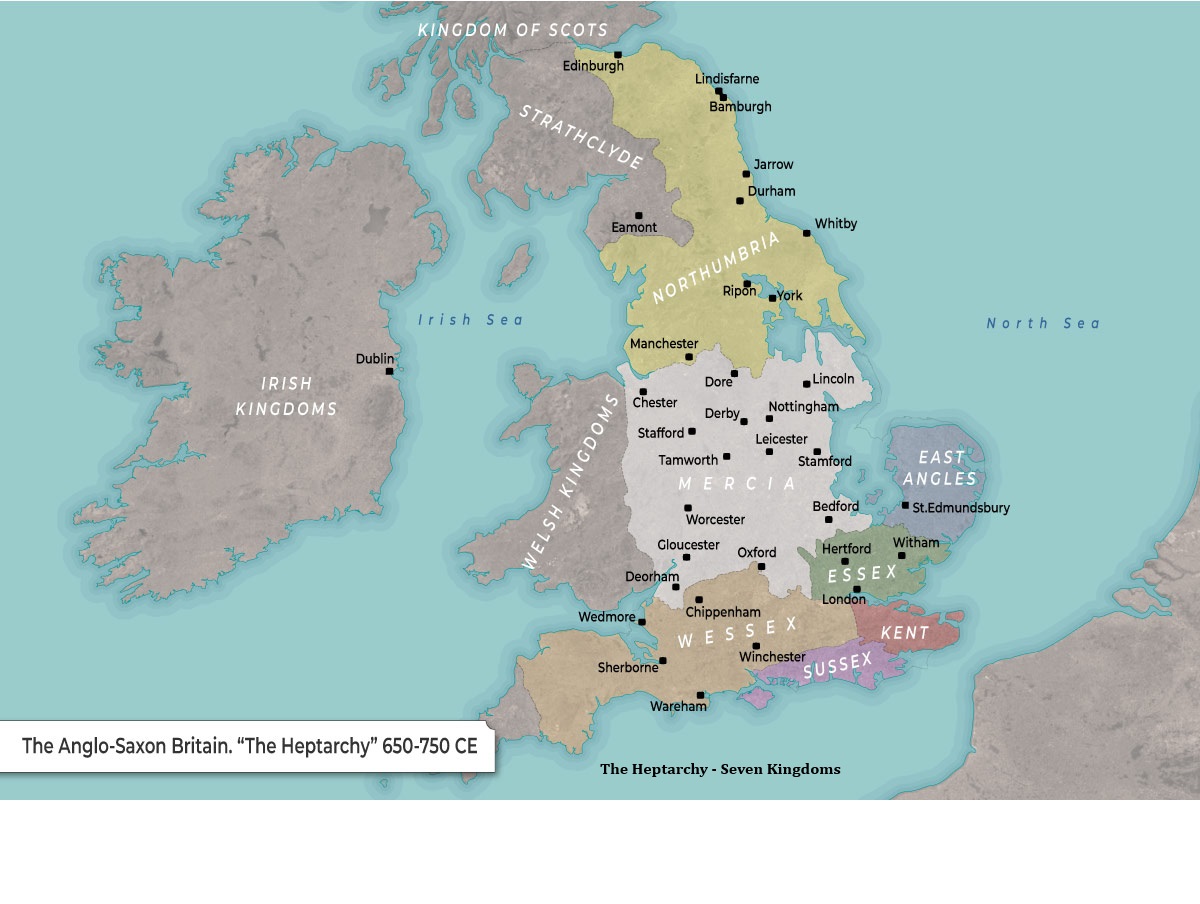
🏰 The HEPTARCHY:
The Seven Anglo-Saxon Kingdoms
The term Heptarchy (from Greek, meaning “seven rules”) refers to the seven main Anglo-Saxon kingdoms in England during the 5th to 9th centuries:
1.KENT:
Settled by the Jutes.
Early Christian center. Augustine of Canterbury began converting the English here in 597 AD.
2. SUSSEX (South Saxons):
Founded by the South Saxons.
A smaller, less influential kingdom.
3. ESSEX (East Saxons):
Founded by the East Saxons.
Included modern-day London early on.
4. WESSEX (West Saxons):
One of the most powerful.
Eventually unified all of England under "King Alfred the Great" and his successors.
5. MERCIA:
Located in the Midlands.
Often fought with Wessex and Northumbria for dominance.
6. EAST ANGLIA:
Settled by the Angles.
Known for King Edmund, a martyr killed by the Vikings.
7. NORTHUMBRIA:
In the north, combining Bernicia and Deira.
Powerful and culturally rich in the 7th and 8th centuries.
Home to monasteries like Lindisfarne and Jarrow.
⚔️ Viking Invasions and the Struggle:
Early Viking Raids (790s–850s):
First major Viking raid: Lindisfarne monastery (793 AD).
These Norse raiders came from Denmark, Norway, and Sweden, looking for plunder and land.
The Great Heathen Army (865 AD):
A massive Viking invasion force.
Instead of raiding, they came to conquer and settle.
Captured Northumbria, East Anglia, and large parts of Mercia.
Alfred the Great of Wessex:
Ruled from 871–899 AD.
Successfully defended Wessex from the Vikings.
Famous victory at the Battle of Edington (878) against Guthrum’s Viking army.
Established the Danelaw (a Viking-controlled area in eastern England).
Reformed military and law, encouraged education, and promoted English identity.
🧬 Legacy:
Wessex eventually absorbed other Anglo-Saxon kingdoms and became the core of a unified England.
The struggle with the Vikings led to a blending of Anglo-Saxonand Norse culture in areas like language, law, and farming.
The Bretons (Celtic Britons) who were not conquered by the Anglo-Saxons fled west into Wales, Cornwall, and across the sea to Brittany in France (hence the name Bretagne).