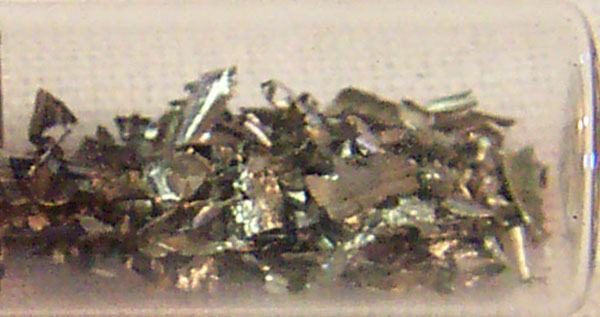
Zirconium Fortieth Element of the Periodic Table
ZirconiumPB or zirconiumPE (from the French zircon, zircon) is a chemical element of symbol Zr of atomic number 40 (40 protons and 40 electrons) and atomic mass equal to 91 u. At room temperature, zirconium is in the solid state. It is located in group 4 (IVB) of the periodic classification of elements. It was discovered in 1789 by the German Martin Heinrich Klaproth. It is a corrosion resistant carbide, mainly used in the coating of nuclear reactors.
History:
Zirconium (from Persian “zargun”, meaning “golden color”) was discovered 1789 by Martin Klaproth from the zircon. In 1824 Jöns Jacob Berzelius isolated him in the impure state; until 1914 it was not prepared as pure metal. Some biblical scriptures mention the zircon mineral, which contains zirconium, or some of its variations (jargon, hyacinth, etc.). The mineral was not known to contain a new element until Klaproth analyzed jargon from Ceylon in the Indian Ocean, calling the new element zirconium. Berzelius obtained it impure by heating a mixture of potassium and potassium fluoride and zirconium in a process of decomposition in an iron pipe. Pure zirconium was only obtained in 1914.
Main Features: It is a bright grayish white metal material and very corrosion resistant. It is lighter than steel with a hardness similar to copper. When finely divided, it can spontaneously burn in contact with the atmosphere and the air reacts more with nitrogen than with oxygen, especially at high temperatures. It is an acid resistant metal, but it can dissolve with hydrofluoric acid (HF), forming complexes with fluorides. Its most common oxidation states are +2, +3 and +4.
Applications:
It is mainly used (around 90% of consumption) as a nuclear reactor lining because of its very low neutron shock section. It is used as an additive in steels to obtain very resistant materials. It is also used in nickel alloys in the chemical industry due to its resistance to corrosive substances. Due to its corrosion resistance it is used as a substitute for hexavalent chromium in aluminum surface treatment lines.
Impure zirconium oxide is used to manufacture laboratory utensils that withstand sudden changes in temperature, furnace coatings and as a refractory material in the ceramic and glass industry. It is a metal well tolerated by human tissues, so it can be used to make artificial joints. It is also employed in heat exchangers, vacuum tubes and lamp filaments. Some of its salts are used to manufacture antiperspirants. Can be used as arsonist for military purposes. The alloy with niobium presents superconductivity at low temperatures and can be used to build superconducting magnets. On the other hand, zinc alloy is magnetic at temperatures below 35 K. Zirconium oxide is used in jewelry; It is an artificial gem called zirconia that mimics the diamond.
Abundance and obtaining:
Zirconium is not found in nature as a free metal but forms numerous minerals. The main source of zirconium comes from zircon (zirconium silicate, ZrSiO4), which is found in deposits in Australia, Brazil, India, Russia and the United States. Zircon is obtained as a mining by-product of processed heavy metals from titanium, ilmenite (FeTiO3) and rutilium (TiO2), and also from tin. Zirconium and hafnium are found in zircon at a 50 to 1 ratio and it is very difficult to separate them. It is also found in other minerals, such as badeleyite (ZrO2). The metal is obtained mainly from reductive chlorination through the process called Kroll: first the chloride is prepared and then reduced with magnesium. In a semi-industrial process electrolysis of molten salts can be performed, obtaining the zirconium powder that can be used later in pulvimetallurgy. To obtain the highest purity metal, the Van Arkel-de Boer Process is followed, based on the dissociation of zirconium iodide, obtaining a metallic zirconium sponge called crystal-bar. In this case, as in the previous case, the obtained sponge is fused to obtain the ingot. Zirconium is abundant in S-type stars, and has been detected in the sun and meteorites. In addition, high amounts of zirconium oxide have been found in lunar samples (compared to what exists in the earth's crust).
History:
Zirconium (from Persian “zargun”, meaning “golden color”) was discovered 1789 by Martin Klaproth from the zircon. In 1824 Jöns Jacob Berzelius isolated him in the impure state; until 1914 it was not prepared as pure metal. Some biblical scriptures mention the zircon mineral, which contains zirconium, or some of its variations (jargon, hyacinth, etc.). The mineral was not known to contain a new element until Klaproth analyzed jargon from Ceylon in the Indian Ocean, calling the new element zirconium. Berzelius obtained it impure by heating a mixture of potassium and potassium fluoride and zirconium in a process of decomposition in an iron pipe. Pure zirconium was only obtained in 1914.
Main Features: It is a bright grayish white metal material and very corrosion resistant. It is lighter than steel with a hardness similar to copper. When finely divided, it can spontaneously burn in contact with the atmosphere and the air reacts more with nitrogen than with oxygen, especially at high temperatures. It is an acid resistant metal, but it can dissolve with hydrofluoric acid (HF), forming complexes with fluorides. Its most common oxidation states are +2, +3 and +4.
Applications:
It is mainly used (around 90% of consumption) as a nuclear reactor lining because of its very low neutron shock section. It is used as an additive in steels to obtain very resistant materials. It is also used in nickel alloys in the chemical industry due to its resistance to corrosive substances. Due to its corrosion resistance it is used as a substitute for hexavalent chromium in aluminum surface treatment lines.
Impure zirconium oxide is used to manufacture laboratory utensils that withstand sudden changes in temperature, furnace coatings and as a refractory material in the ceramic and glass industry. It is a metal well tolerated by human tissues, so it can be used to make artificial joints. It is also employed in heat exchangers, vacuum tubes and lamp filaments. Some of its salts are used to manufacture antiperspirants. Can be used as arsonist for military purposes. The alloy with niobium presents superconductivity at low temperatures and can be used to build superconducting magnets. On the other hand, zinc alloy is magnetic at temperatures below 35 K. Zirconium oxide is used in jewelry; It is an artificial gem called zirconia that mimics the diamond.
Abundance and obtaining:
Zirconium is not found in nature as a free metal but forms numerous minerals. The main source of zirconium comes from zircon (zirconium silicate, ZrSiO4), which is found in deposits in Australia, Brazil, India, Russia and the United States. Zircon is obtained as a mining by-product of processed heavy metals from titanium, ilmenite (FeTiO3) and rutilium (TiO2), and also from tin. Zirconium and hafnium are found in zircon at a 50 to 1 ratio and it is very difficult to separate them. It is also found in other minerals, such as badeleyite (ZrO2). The metal is obtained mainly from reductive chlorination through the process called Kroll: first the chloride is prepared and then reduced with magnesium. In a semi-industrial process electrolysis of molten salts can be performed, obtaining the zirconium powder that can be used later in pulvimetallurgy. To obtain the highest purity metal, the Van Arkel-de Boer Process is followed, based on the dissociation of zirconium iodide, obtaining a metallic zirconium sponge called crystal-bar. In this case, as in the previous case, the obtained sponge is fused to obtain the ingot. Zirconium is abundant in S-type stars, and has been detected in the sun and meteorites. In addition, high amounts of zirconium oxide have been found in lunar samples (compared to what exists in the earth's crust).