Niobium Fourty First Element of the Periodic Table
Niobium is a chemical element of symbol Nb, atomic number 41 (41 protons and 41 electrons) and atomic mass 92,9 u. It is a transition element belonging to group 5 or VB of the periodic classification of the elements. The name derives from the Greek goddess Nobe, daughter of Dione and Tantalum - the latter in turn named another element of the 5B family, tantalum1. It is mainly used in alloy steel for the production of fluid conducting pipes. Under normal conditions it is solid. It was discovered in 1801 by the Englishman Charles Hatchett.
Brazil is the world's largest producer of niobium and ferroniobium, a niobium and iron alloy.2 3 There are only three niobium mines in the world. One of them is located in Minas Gerais, Brazil, accounting for 75% of the world's niobium production.
History:
The niobium (Greek mythology: Niobe, daughter of Tantalus) was discovered by Charles Hatchett in 1801. Hatchett found the element in the Columbite mineral sent to England around 1750 by John Winthrop, who was Connecticut's first governor. Due to the similarity, there was a great confusion between the niobium and tantalum elements that was not resolved until 1846 by Heinrich Rose and Jean Charles Galissard de Marignac who rediscovered the element. Unaware of Hatchett's work, he called the element niobium. In 1864 Christian Blomstrand was the first to prepare the element by reducing niobium chloride by heating in a hydrogen atmosphere.
Columbium was the name originally given to the niobium element by Hatchet, but IUPAC officially adopted the name niobium in 1950 after 100 years of controversy. Many chemical societies and government organizations refer to element 41 by the name IUPAC. However, most metalworkers and commercial producers of the metal, mainly Americans, adopt their original columbian name.
Recently, Professor Luiz Roberto Martins de Miranda, from COPPE, UFRJ (Federal University of Rio de Janeiro), in orientation to several master's and doctoral theses, found that niobium oxide is a powerful anti-corrosive agent capable of withstanding the action of Extremely aggressive acids, such as naphthenics, very common in the daily life of the oil industry. This discovery has generated process and product patents, now in use by oil and steel mills under the trade name Niobization.
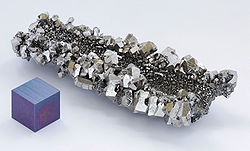
Main Features: Niobium is a ductile, bright gray metal that turns bluish when in contact with air at room temperature after a long period. Its chemical properties are very similar to those of tantalum (chemical element), which is situated in the same group.
The metal begins to oxidize with air at 201 ° C and its most common oxidation states are +3 and +5.
Applications:
Niobium has numerous applications. It is used in some stainless steels and other nonferrous metal alloys. Due to their strength, these alloys are generally used for the manufacture of long distance oil and water conveyor pipes.
Used in nuclear industries due to its low thermal neutron capture. Used in electric welding. Due to its coloration, it is generally used in the form of alloy for the production of jewelry and other ornaments. Appreciable quantities of niobium are used in superalloys for the manufacture of jet engine components, rocket subsets, ie equipment requiring high combustion resistances. Advanced research with this metal was used in the Gemini program. Niobium is being evaluated as an alternative to tantalum for use in capacitors.
Niobium becomes a superconductor when reduced to cryogenic temperatures. At atmospheric pressure (and when pure), it has the highest critical temperature among Type I, 9.3K superconducting elements. It is also an element present in Type II superconducting alloys (such as vanadium and technetium). , meaning it reaches the critical temperature at temperatures much higher than Type I superconductors
Occurrence:
Niobium plate.
The element was never found free in nature. It is found in minerals such as niobite (columbite) (Fe, Mn) (Nb, Ta) 2O6, niobite-tantalite [(Fe, Mn) (Ta, Nb) 2O6], pyrochlorine (NaCaNb2O6F), and euxenite [(Y, Ca, Ce, U, Th) (Nb, Ta, Ti) 2 O 6]. Niobium-containing minerals often also contain tantalum.
Large deposits of niobium were found associated with carbon - silicate rocks and as a constituent of pyrochlor.
Brazil has 98% of the world's exploitable niobium reserves in the world, and over 90% of the total ore present on planet Earth.6 7 The deposits are present in 3 Brazilian cities: 61% from Araxá (MG), 21% of reserves in Catalão (GO) and another 12% in São Gabriel da Cachoeira (AM).
Another important niobium mineral reserve is from Canada.
Brazil is the world's largest producer of niobium and ferroniobium, a niobium and iron alloy.2 3 There are only three niobium mines in the world. One of them is located in Minas Gerais, Brazil, accounting for 75% of the world's niobium production.
History:
The niobium (Greek mythology: Niobe, daughter of Tantalus) was discovered by Charles Hatchett in 1801. Hatchett found the element in the Columbite mineral sent to England around 1750 by John Winthrop, who was Connecticut's first governor. Due to the similarity, there was a great confusion between the niobium and tantalum elements that was not resolved until 1846 by Heinrich Rose and Jean Charles Galissard de Marignac who rediscovered the element. Unaware of Hatchett's work, he called the element niobium. In 1864 Christian Blomstrand was the first to prepare the element by reducing niobium chloride by heating in a hydrogen atmosphere.
Columbium was the name originally given to the niobium element by Hatchet, but IUPAC officially adopted the name niobium in 1950 after 100 years of controversy. Many chemical societies and government organizations refer to element 41 by the name IUPAC. However, most metalworkers and commercial producers of the metal, mainly Americans, adopt their original columbian name.
Recently, Professor Luiz Roberto Martins de Miranda, from COPPE, UFRJ (Federal University of Rio de Janeiro), in orientation to several master's and doctoral theses, found that niobium oxide is a powerful anti-corrosive agent capable of withstanding the action of Extremely aggressive acids, such as naphthenics, very common in the daily life of the oil industry. This discovery has generated process and product patents, now in use by oil and steel mills under the trade name Niobization.
Main Features: Niobium is a ductile, bright gray metal that turns bluish when in contact with air at room temperature after a long period. Its chemical properties are very similar to those of tantalum (chemical element), which is situated in the same group.
The metal begins to oxidize with air at 201 ° C and its most common oxidation states are +3 and +5.
Applications:
Niobium has numerous applications. It is used in some stainless steels and other nonferrous metal alloys. Due to their strength, these alloys are generally used for the manufacture of long distance oil and water conveyor pipes.
Used in nuclear industries due to its low thermal neutron capture. Used in electric welding. Due to its coloration, it is generally used in the form of alloy for the production of jewelry and other ornaments. Appreciable quantities of niobium are used in superalloys for the manufacture of jet engine components, rocket subsets, ie equipment requiring high combustion resistances. Advanced research with this metal was used in the Gemini program. Niobium is being evaluated as an alternative to tantalum for use in capacitors.
Niobium becomes a superconductor when reduced to cryogenic temperatures. At atmospheric pressure (and when pure), it has the highest critical temperature among Type I, 9.3K superconducting elements. It is also an element present in Type II superconducting alloys (such as vanadium and technetium). , meaning it reaches the critical temperature at temperatures much higher than Type I superconductors
Occurrence:
Niobium plate.
The element was never found free in nature. It is found in minerals such as niobite (columbite) (Fe, Mn) (Nb, Ta) 2O6, niobite-tantalite [(Fe, Mn) (Ta, Nb) 2O6], pyrochlorine (NaCaNb2O6F), and euxenite [(Y, Ca, Ce, U, Th) (Nb, Ta, Ti) 2 O 6]. Niobium-containing minerals often also contain tantalum.
Large deposits of niobium were found associated with carbon - silicate rocks and as a constituent of pyrochlor.
Brazil has 98% of the world's exploitable niobium reserves in the world, and over 90% of the total ore present on planet Earth.6 7 The deposits are present in 3 Brazilian cities: 61% from Araxá (MG), 21% of reserves in Catalão (GO) and another 12% in São Gabriel da Cachoeira (AM).
Another important niobium mineral reserve is from Canada.