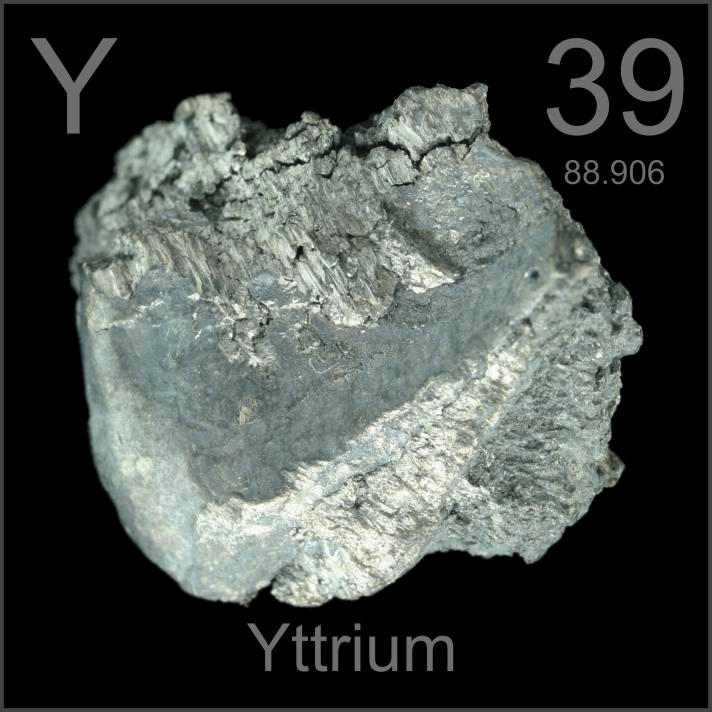
Yttrium Thirty-ninth Element of the Periodic Table
Yttrium is a chemical element of symbol Y, atomic number 39 (39 protons and 39 electrons), with atomic mass 89 u. At room temperature yttrium is in the solid state. It is a transition metal series metal belonging to group 3 (3B) of the Periodic Classification of Elements. It is common in lanthanide ores, and two of its components are used to obtain the red image on color television. It was discovered by Johan Gadolin in 1794 and isolated by Friedrich Wöhler in 1828.
Key Features
Yttrium is a metal belonging to the set of elements called rare earths, shiny silver metallic aspect, relatively stable in air, and chemically similar to lanthanides. Metal chips or fragments may ignite when the temperature exceeds 400 ° C. Finely divided is very unstable in the presence of air. The metal has a low cross section for nuclear uptake. Its most common oxidation state is +3.
Yttrium is being studied as a use for the production of nodular cast iron. Potentially yttrium can be used in the composition of ceramics and glass because its oxide has high melting point, high mechanical strength and low expansion characteristics.
Applications:
Yttrium oxide is the most important yttrium compound and is extensively used for the production of YVO4 and Y2O3 used in europium phosphors to give red color in television kinescopes. Other Uses: Yttrium oxide is also used for the production of very effective yttrium and iron grenades as microwave filters. Yttrium and aluminum, yttrium and iron, and yttrium and gadolinium grenades (examples: Y3Fe5O12 and Y3Al5O12) have interesting magnetic properties. Yttrium and iron grenade is very efficient as a transmitter and transducer of sound energy. Yttrium and aluminum grenade is 8.5 hard and is used for stoning or as a gem (diamond substitute) Small amounts of this element (0.1 to 0.2%) have been used to reduce the size of chromium, molybdenum, titanium and zirconium grains. It is also used to increase the strength of aluminum and magnesium alloys. Used as a catalyst for ethylene polymerization Yttrium Aluminum Grenade, Yttrium Lithium Fluoride and Yttrium Vanadate are used in combination with dopants such as Neodymium or Erbium in Infrared Lasers Yttrium can be used to deoxide vanadium and other nonferrous metals. Yttrium is also important in the development of high critical temperature superconducting ceramics.
History:
Yttrium (Ytterby, Swedish village near Vaxholm) was discovered by Johan Gadolin in 1794 and isolated by Friedrich Wohler in 1828 as an impure extract of yttria with reduction of anhydrous yttrium chloride (YCl3) with potassium. Yttria (Y2O3) is an yttrium oxide that was discovered by Johan Gadolin in 1794 in the gadolinite mineral from Ytterby. In 1843 Carl Mosander demonstrated that "yttria" was actually made of oxides formed by three different elements: yttrium, erbium and terbium. The mine near the village of Ytterby provided the extraction of various minerals that contained rare earths and other elements, some still unknown. The elements terbium, erbium, ytterbium and yttrium were named after this city.
Occurrence:
This element is not found free in nature. It is found in almost all rare earth minerals and uranium minerals. Yttrium is commercially recovered from monazitic sands (with 3% in addition to [(Ce, La, etc.) PO4)] and from bastnasite (with 0.2% in addition to [(Ce, La, etc.) (CO3) F]). It can be produced by reducing yttrium fluoride with calcium. This metal can also be obtained using other techniques. It is difficult to separate it from other rare earths, and when extracted it appears as a dark gray powder.
Moon rock samples collected during the Apollo program contained a high yttrium index.
Key Features
Yttrium is a metal belonging to the set of elements called rare earths, shiny silver metallic aspect, relatively stable in air, and chemically similar to lanthanides. Metal chips or fragments may ignite when the temperature exceeds 400 ° C. Finely divided is very unstable in the presence of air. The metal has a low cross section for nuclear uptake. Its most common oxidation state is +3.
Yttrium is being studied as a use for the production of nodular cast iron. Potentially yttrium can be used in the composition of ceramics and glass because its oxide has high melting point, high mechanical strength and low expansion characteristics.
Applications:
Yttrium oxide is the most important yttrium compound and is extensively used for the production of YVO4 and Y2O3 used in europium phosphors to give red color in television kinescopes. Other Uses: Yttrium oxide is also used for the production of very effective yttrium and iron grenades as microwave filters. Yttrium and aluminum, yttrium and iron, and yttrium and gadolinium grenades (examples: Y3Fe5O12 and Y3Al5O12) have interesting magnetic properties. Yttrium and iron grenade is very efficient as a transmitter and transducer of sound energy. Yttrium and aluminum grenade is 8.5 hard and is used for stoning or as a gem (diamond substitute) Small amounts of this element (0.1 to 0.2%) have been used to reduce the size of chromium, molybdenum, titanium and zirconium grains. It is also used to increase the strength of aluminum and magnesium alloys. Used as a catalyst for ethylene polymerization Yttrium Aluminum Grenade, Yttrium Lithium Fluoride and Yttrium Vanadate are used in combination with dopants such as Neodymium or Erbium in Infrared Lasers Yttrium can be used to deoxide vanadium and other nonferrous metals. Yttrium is also important in the development of high critical temperature superconducting ceramics.
History:
Yttrium (Ytterby, Swedish village near Vaxholm) was discovered by Johan Gadolin in 1794 and isolated by Friedrich Wohler in 1828 as an impure extract of yttria with reduction of anhydrous yttrium chloride (YCl3) with potassium. Yttria (Y2O3) is an yttrium oxide that was discovered by Johan Gadolin in 1794 in the gadolinite mineral from Ytterby. In 1843 Carl Mosander demonstrated that "yttria" was actually made of oxides formed by three different elements: yttrium, erbium and terbium. The mine near the village of Ytterby provided the extraction of various minerals that contained rare earths and other elements, some still unknown. The elements terbium, erbium, ytterbium and yttrium were named after this city.
Occurrence:
This element is not found free in nature. It is found in almost all rare earth minerals and uranium minerals. Yttrium is commercially recovered from monazitic sands (with 3% in addition to [(Ce, La, etc.) PO4)] and from bastnasite (with 0.2% in addition to [(Ce, La, etc.) (CO3) F]). It can be produced by reducing yttrium fluoride with calcium. This metal can also be obtained using other techniques. It is difficult to separate it from other rare earths, and when extracted it appears as a dark gray powder.
Moon rock samples collected during the Apollo program contained a high yttrium index.