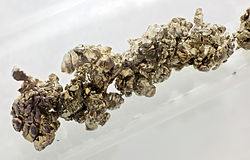
Strontium thirty-eighth element of the Periodic Table
Strontium is a chemical element of the Sr symbol of atomic number 38 (38 protons and 38 electrons) and of atomic mass equal to 87.6 u. At room temperature strontium is in the solid state.
History:
Strontium was identified in 1790 by Adair Crawford and William Cruickshank when analyzing a mineral originating from the town of Strontian in Scotland. Later this mineral was called Strontianite - where the name of the metal comes from. In 1798 Martin Klaproth and Thomas Hope independently discovered it. The first to isolate strontium was Humphry Davy by strontium electrolysis (or strontium oxide). It is an alkaline earth metal (group 2 or IIA) of the Periodic Classification of Elements. Abundant in nature in the form of sulfates and carbonates.
Its main application is in crystals for cathode ray tubes of color televisions.
Main Features Elemental strontium is a shiny, slightly malleable silver-colored metal that quickly oxidizes in the presence.
Strontium is an abundant element in nature, representing an average of 0.034% of all igneous rocks and is found mainly in the form of sulphate (celestite) and carbonate (strontianite). The similarity of ionic rays of calcium and strontium allows it to replace the former in the ionic networks of its mineral species, which causes the strontium to be widely distributed. Celestite is found in sedimentary deposits in sufficient quantities to make its mining profitable, which is why it is the main source of strontium. The economically viable strontianite deposits found so far are scarce. Major strontium ore explorations are carried out in England. The metal can be extracted by electrolysis of molten sulfate mixed with potassium chloride: oxygen from the air acquiring a yellowish hue due to the formation of oxide. Therefore it should be stored immersed in kerosene. Due to its high reactivity, the metal is in nature combined with other elements forming compounds. Reacts rapidly with water releasing hydrogen to form hydroxide.
The metal burns in the presence of air - spontaneously when it is in the form of finely divided powder - with pink red flame forming oxide and nitride; as nitrogen does not react below 380 ° C, Abundance and obtaining
It has three allotropic states with transition points at 235 ° C and 540 ° C.
Applications:
Currently the main application of strontium is in crystals for color television cathode ray tubes. There are regulations that require the use of this metal to filter x-rays, preventing them from focusing on the viewer.
History:
Strontium was identified in 1790 by Adair Crawford and William Cruickshank when analyzing a mineral originating from the town of Strontian in Scotland. Later this mineral was called Strontianite - where the name of the metal comes from. In 1798 Martin Klaproth and Thomas Hope independently discovered it. The first to isolate strontium was Humphry Davy by strontium electrolysis (or strontium oxide). It is an alkaline earth metal (group 2 or IIA) of the Periodic Classification of Elements. Abundant in nature in the form of sulfates and carbonates.
Its main application is in crystals for cathode ray tubes of color televisions.
Main Features Elemental strontium is a shiny, slightly malleable silver-colored metal that quickly oxidizes in the presence.
Strontium is an abundant element in nature, representing an average of 0.034% of all igneous rocks and is found mainly in the form of sulphate (celestite) and carbonate (strontianite). The similarity of ionic rays of calcium and strontium allows it to replace the former in the ionic networks of its mineral species, which causes the strontium to be widely distributed. Celestite is found in sedimentary deposits in sufficient quantities to make its mining profitable, which is why it is the main source of strontium. The economically viable strontianite deposits found so far are scarce. Major strontium ore explorations are carried out in England. The metal can be extracted by electrolysis of molten sulfate mixed with potassium chloride: oxygen from the air acquiring a yellowish hue due to the formation of oxide. Therefore it should be stored immersed in kerosene. Due to its high reactivity, the metal is in nature combined with other elements forming compounds. Reacts rapidly with water releasing hydrogen to form hydroxide.
The metal burns in the presence of air - spontaneously when it is in the form of finely divided powder - with pink red flame forming oxide and nitride; as nitrogen does not react below 380 ° C, Abundance and obtaining
It has three allotropic states with transition points at 235 ° C and 540 ° C.
Applications:
Currently the main application of strontium is in crystals for color television cathode ray tubes. There are regulations that require the use of this metal to filter x-rays, preventing them from focusing on the viewer.