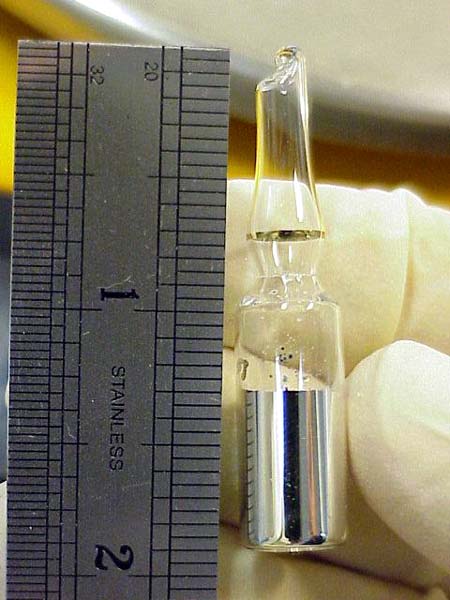
Rubidium thirty seventh element of the Periodic Table
Rúbidium is a chemical element of symbol Rb of atomic number 37 (37 protons and 37 electrons). Rúbidium is a light metallic element, white-silver and the group of alkali metals. The atomic mass is 85.4678 u. The element is highly reactive, with similar properties to other elements of group 1A, as well as a very rapid oxidation in the terrestrial atmosphere. Rufidium has a stable isotope, the 85Rb. The 87Rb isotope, which makes up almost 28% of the natural occurrence of rubidium, is slightly radioactive, with a half-life of 49 billion years - more than three times the estimated universe age.
Two German chemists, Robert Bunsen and Gustav Kirchhoff, discovered the existence of rubidium in 1861 by the then discovered method of flame atomic absorption spectroscopy. Its compounds have chemical and electronic applications. Rubidium metal is easily vaporized and has a practical spectral absorption range, making it a frequent target for laser manipulation of atoms.
No living being who needs rubidium in the body is known. However, like cesium, rubidium ions are handled by living organisms in a manner similar to potassium ions: they are actively harnessed by plants and live animal cells.
Rubidium is a soft alkaline metal with a brilliant silver-white color that loses its luster rapidly in contact with the air. Very reactive - it is the third most electropositive alkaline element - and liquid can be found at room temperature. Like the other elements of group 1, it can spontaneously burn with air producing a flame of yellowish violet coloration. reacts violently with water releasing hydrogen. Form amalgams with mercury. It can form alloys with gold, with the other alkali metals, with alkaline earth metals, antimony and bismuth.
Like other alkaline metals, it has a single oxidation state: +1. Reacts with carbon dioxide, hydrogen, nitrogen, sulfur and halogens. With oxygen it forms at least four oxides: Rb2O, Rb2O2, Rb2O3, and RbO2.
Where it is used:
Rubidium can ionize easily, so its use in ionic motors for spacecraft is being studied, although xenon and cesium have been shown to be more efficient for this purpose. It is mainly used in the manufacture of special crystals for fiber optic telecommunication systems and night vision equipment.
Other uses of rubidium are:
Photodetector coatings of tellurium-rubidium in photoelectric cells and electronic detectors. Vacuum tuner "getter" (substance that absorbs the last traces of a gas, especially oxygen) in vacuum tubes to ensure its correct functioning. Component of photoresistances (the LDR, "Light dependant resistors", resistances in which the electrical resistance varies with the illumination received.
In medicine Rúbidium-81, radioactive with emission of positron used in PET examination in nuclear medicine. Non-radioactive isotopes used for the treatment of epilepsy and the separation by ultracentrifugation of nucleic acids and viruses. Working fluid in steam turbines. RbAg4I5 has the highest known electrical conductivity at room temperature of all ionic crystals, and can be used in the manufacture of batteries in the form of thin blades, among other electrical applications. It is studied the possibility of using the metal in thermoelectric generators based on magnetohydrodynamics, so that the high temperature generated rubidium ions are conducted through a magnetic field, generating an electric current. Manufacture of special glass.
Two German chemists, Robert Bunsen and Gustav Kirchhoff, discovered the existence of rubidium in 1861 by the then discovered method of flame atomic absorption spectroscopy. Its compounds have chemical and electronic applications. Rubidium metal is easily vaporized and has a practical spectral absorption range, making it a frequent target for laser manipulation of atoms.
No living being who needs rubidium in the body is known. However, like cesium, rubidium ions are handled by living organisms in a manner similar to potassium ions: they are actively harnessed by plants and live animal cells.
Rubidium is a soft alkaline metal with a brilliant silver-white color that loses its luster rapidly in contact with the air. Very reactive - it is the third most electropositive alkaline element - and liquid can be found at room temperature. Like the other elements of group 1, it can spontaneously burn with air producing a flame of yellowish violet coloration. reacts violently with water releasing hydrogen. Form amalgams with mercury. It can form alloys with gold, with the other alkali metals, with alkaline earth metals, antimony and bismuth.
Like other alkaline metals, it has a single oxidation state: +1. Reacts with carbon dioxide, hydrogen, nitrogen, sulfur and halogens. With oxygen it forms at least four oxides: Rb2O, Rb2O2, Rb2O3, and RbO2.
Where it is used:
Rubidium can ionize easily, so its use in ionic motors for spacecraft is being studied, although xenon and cesium have been shown to be more efficient for this purpose. It is mainly used in the manufacture of special crystals for fiber optic telecommunication systems and night vision equipment.
Other uses of rubidium are:
Photodetector coatings of tellurium-rubidium in photoelectric cells and electronic detectors. Vacuum tuner "getter" (substance that absorbs the last traces of a gas, especially oxygen) in vacuum tubes to ensure its correct functioning. Component of photoresistances (the LDR, "Light dependant resistors", resistances in which the electrical resistance varies with the illumination received.
In medicine Rúbidium-81, radioactive with emission of positron used in PET examination in nuclear medicine. Non-radioactive isotopes used for the treatment of epilepsy and the separation by ultracentrifugation of nucleic acids and viruses. Working fluid in steam turbines. RbAg4I5 has the highest known electrical conductivity at room temperature of all ionic crystals, and can be used in the manufacture of batteries in the form of thin blades, among other electrical applications. It is studied the possibility of using the metal in thermoelectric generators based on magnetohydrodynamics, so that the high temperature generated rubidium ions are conducted through a magnetic field, generating an electric current. Manufacture of special glass.