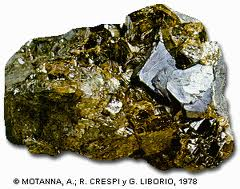
Zinc thirtieth element of the Periodic Table
Zinc (from German Zink) is a chemical element of symbol Zn, atomic number 30 (30 protons and 30 electrons) with atomic mass 65.4 um. At room temperature, zinc is in the solid state. It is located in group 12 (2 B) of the Periodic Classification of Elements.Zinc alloys have been used for centuries - brass pieces dating from 1000-1400 BC have been found in Palestine, and other objects with up to 87% zinc have been found in the former Transylvanian region. The main application of zinc - about 50% of annual consumption - is in galvanizing steel or iron to protect them from corrosion, ie zinc is used as a sacrificial metal (becoming the anode of a cell, or that is, only it will oxidize). It can also be used on sunscreens in the form of oxide as it has the ability to block solar radiation.
Zinc is an essential chemical element for life: it intervenes in the metabolism of proteins and nucleic acids, stimulates the activity of more than 100 enzymes, collaborates in the proper functioning of the immune system, is necessary for wound healing, intervenes in taste perceptions and smell and DNA synthesis. It was discovered by the German Andreas Sigismund Marggraf in 1746.
Main Features: Zinc is a metal, sometimes classified as a transition metal, although strictly not, similar to magnesium and beryllium in addition to the metals in its group. This element is not abundant in the earth's crust, but it can be easily obtained. It is a bluish white colored metal that burns in the air with bluish green flame. Dry air does not attack it, but in the presence of moisture it forms a base layer of basic oxide or carbonate that insulates the metal and protects it from corrosion.
Virtually the only oxidation state it has is 2+. Reacts with non-oxidizing acids to oxidation state 2+ and releasing hydrogen, and can dissolve in bases and acetic acid.
The metal has a great resistance to cold plastic deformation which decreases with heating, forcing it to roll above 100 ° C. Zinc is used in the manufacture of metal alloys such as brass and bronze, and is used in the production of residential tiles and gutters. Zinc is also used as a sacrificial metal to preserve iron from corrosion in some structures, in the production of dry piles and as a pigment in white colored paint.
History:
Zinc alloys have been used for centuries - brass pieces dating from 1000-1400 BC have been found in Palestine, and other objects with up to 87% zinc have been found in the former Transylvanian region - due to their low melting point and reactivity. In chemistry the metal tends to evaporate, which is why the true nature of zinc was not understood by the ancients.
It is known that the manufacture of brass was known to the Romans since 30 BC Plinio and Dioscorides describe obtaining aurichalcum (brass) by heating in a crucible a mixture of cadmia (calamine) with copper. The brass obtained is later cast or forged to make objects.
Andreas Marggraf:
The fusion and extraction of impure zinc was already performed in the year 1,000 in India - in Rasarnava (c. 1200) by an unknown author the procedure was described - and later in China. In 1597 Andreas Libavius describes a peculiar class of tin that had been prepared in India which he had received in small quantities through a friend; He guessed that it was zinc even though he could not recognize it as the metal from calamine.
In the west, in 1248, Alberto Magno describes the manufacture of brass in Europe. In the sixteenth century the existence of metal was already known. Agricola noted in 1546 that a condensed silver white metal formed on the walls of the furnaces into which zinc minerals fused, adding in his notes that a similar metal called zincum was produced in Silesia. Paracelsus was the first to suggest that zincum was a new metal and that its properties differed from known metals without giving any indication as to its origin, 5 6 in Basil Valentino's writings mention is also made of zincum. In later treaties, references to zinc, with different names, often refer to mineral rather than free metal, and often confused with bismuth.
Johann Kunkel in 1677 and shortly after Stahl in 1702 indicate that when preparing brass with copper and calamine, the latter was previously reduced to free zinc, which was later isolated by chemist Anton von Swab in 1742 and Andreas Marggraf in 1746. , whose exhaustive and methodical work On the method of extracting zinc from a true mineral, calamine sedimented zinc metallurgy and its reputation as a metal discoverer.
In 1743 was founded in Bristol the first establishment for the casting of metal on an industrial scale, but the procedure was a secret. Seventy years later Daniel Dony developed an industrial procedure for metal extraction, building the first factory on the European continent. After the development of the zinc sulfide flotation technique, calamine was disregarded as the main source of zinc production. The flotation method is currently employed to obtain various metals.
In 1800 Alessandro Volta invented the Volta battery.7 The basic unit of the Volta battery was a simplified galvanic cell, which was made of a copper plate and a zinc plate connected externally and separated by an electrolyte. These were stacked in series to make the voltaic cell, which in turn produced electricity by directing the electrons from zinc to copper and allowing zinc to corrode.