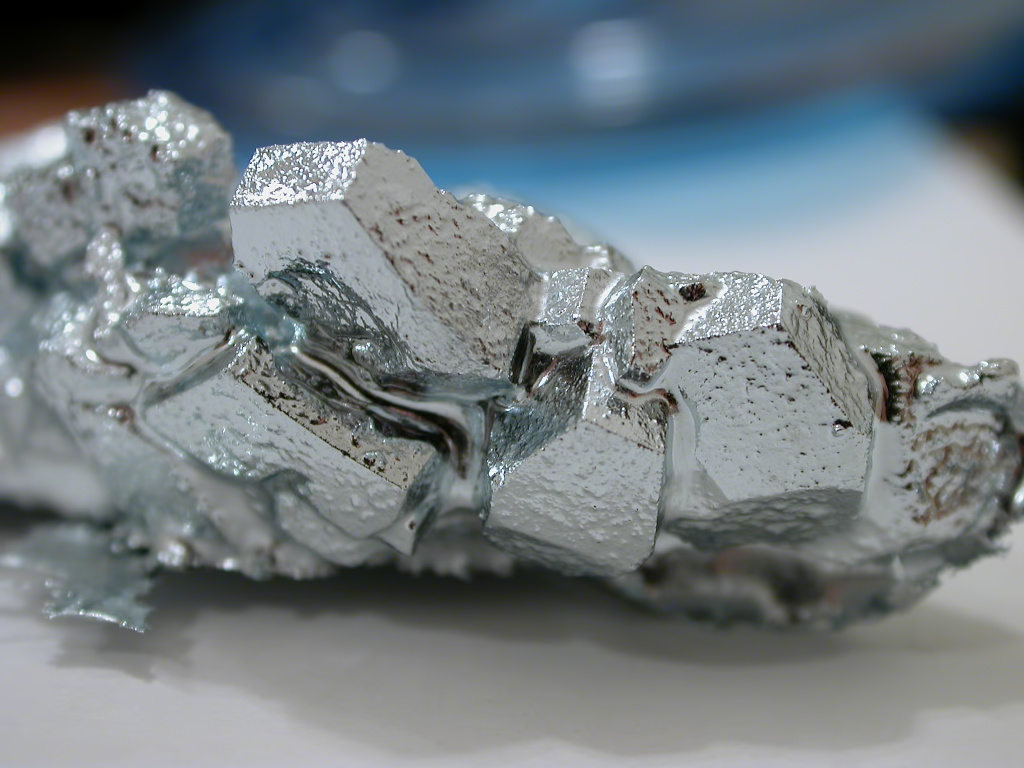
Gallium thirty-first element of the Periodic Table
Gallium (Ga) is a representative metal of the 4th period and 13th group of the periodic table (same group as boron and aluminum). Its atomic number is Z = 31, and its weighted atomic mass (based on the only two stable isotopes) is A = 69.7 u. It is the lowest melting metal of all known (it is capable of literally melting in the hands - as shown in the figure), but not necessarily the lowest boiling point.It has a bright silver color when solid, gray when molten and, like ice in water, the difference in density causes the sample to solidify to float in the liquid phase.
Physicochemical properties:
As already mentioned, gallium is easily turned into liquid (its melting point is around 30 ° C), but has relatively low vapor pressure. As a consequence, its boiling point is 2145 ° C after melting (approximately 2175 ° C). Being one of the largest melting-boiling ranges identified.
It has a tetragonal crystalline structure, and its most common oxidation states are +1 and +3 (characterized by the tendency to form amphoteric oxides). It is semiconductor of electricity and conducts heat 2 times less than iron.
It tends to melt below its melting point, but it can be kept solid by adding a grain (crystallizing germ) that is able to recrystallize it. Thus, as it diffuses into the crystal lattices of other metals, it can erode them. Occurrence and Applications:
Similar to aluminum, gallium is widely distributed in the earth's crust. However, it is virtually impossible to find pure: it is usually aggregated with aluminum ores in the form of hydroxide, zinc or germanium (in the latter two, often in the form of sulphate).
It has a bright silver color when solid, gray when molten and, like ice in water, the difference in density causes the sample to solidify to float in the liquid phase. Utilities on smaller scales consist of:
Manufacture of mirrors; Low Melting Alloys; Hydrogen extraction from water through Ga-Al alloy; In nuclear medicine, the Ga-67 acts as a tracing element for the diagnosis of diseases and tumors.
Biological action:
Harmful biological effects of gallium are not reported, however, due to its expansion when solidifying, it is not recommended to pack it in rigid containers (such as glass) or completely filled.
Bibliography:
Photo: http://www.terminaljunkie.com/wp/2011/02/06/which-metal-will-melt-in-you-hand/
It can also be found in chimney waste, as its oxide can be generated by reducing carbides present in wood or coal, or as a byproduct in processes for obtaining other metals.