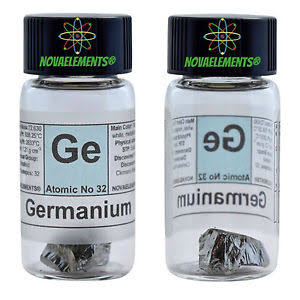
Germanium thirty-second element of the Periodic Table
Germanium (Ge) is a chemical element of semi-metallic, di or tetravalent, brittle-gray, stable in air and water, located in group 14 and period 4 of the Periodic Table. This has atomic number 32 and atomic mass 72.64. Germanium was discovered in 1886 in Freiberg, Germany, by chemist Clemens Winkler in a Himmelsfurst mine.The name Germanium derives from the Latin Germania meaning Germany. It is found in nature in argyrodite and germanite. The latter is a copper sulphide mineral, iron sulphide and germanium sulphide.
Until the late 1930s, Germanium was an element of scientific interest only. This situation changed radically when the importance of germanium as a semiconductor was discovered and rectifiers and amplifiers (transistors) were manufactured with it. With the germanium transistors began the great progress of microelectronics. In the 1960s, germanium lost importance when it began to be replaced by silicon, also a semiconductor, but with better characteristics in several aspects.
In the industrial application of semiconductors, germanium must be of extremely high purity. Tiny traces of foreign elements vary their semiconduction capacity.
With the usual metal purification methods it was not possible to extract all the impurities to a sufficient degree. Therefore a new method for germanium, zonal fusion, was developed. For this purpose, a narrow zone is fused into an elongated germanium crystal in which impurities dissolve. By slowly moving the heat source, this layer is moved from one end of the crystal to the other.