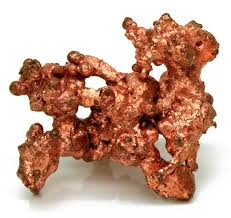
Copper twenty-ninth element of the periodic table
The copper transition element is a discreet yellowish-red metal, with a slightly opaque glow of pleasant appearance, is located in group IB of the periodic table, has atomic number 29, atomic mass 63.55 g mol-, dot Melting point 1038 ° C, boiling point 2927 ° C, is a soft, malleable and ductile metal. The chemical symbol of the metal is Cu, originated from the Latin cuprum, alluding to the island of Cyprus where it is believed to have been found for the first time. It is found in nature in the form of chalcopyrite CuFeS2, mainly there are others, but this one has a higher content of the metal, besides being one of the metals that can be found in elemental state.This is one of the oldest known metals because of the bronze age in the Neolithic period, when copper was widely used, researchers say that copper mining began some 5,000 years ago. Metal was once considered rare and expensive, after it was often found and its cost decreased, until it was discovered to be extremely conducive to heat and power, and to be used. become industrial, the value has increased considerably, but nothing compared to gold or silver, despite being considered a noble metal.
In contact with atmospheric air for a long time copper undergoes oxidation forming on its surface a toxic film originating from a mixture of oxides, hydroxides and carbonates, green color commonly called holmouse. The use of copper is quite wide and is widespread in various industrial segments.
Among them we have:
Kitchenware: Gypsy pots, pans, bowls, cutlery. Electrical conductors: high and low voltage cables, connectors, electrical contacts in general, motor manufacturing. Equipment: solar heaters, heat conductors, water pipes. Metallic alloys: copper and tin form bronze, copper and zinc form brass and finally copper and gold form 18 carat gold, for example, these are the most common and used alloys but there are numerous others.
Important Copper Information:
Chemically speaking of copper, it forms several compounds, the main one being copper sulfate CuSO4 · 5H2O, used as an algicide and blue color checker for swimming pool water. This anhydrous salt is white in color, but in contact with the product. Atmospheric air absorbs water and acquires coloration because it is hygroscopic. The purification of the metal can occur in two ways by heating the ores it is in or after heating, undergoing electrolysis to obtain a higher degree of purity. Copper has two oxidation states Cu + and Cu + 2.
In the qualitative analysis this element can be easily identified, with the addition of sodium hydroxide solution forming an intense blue gelatinous precipitate, it is also important to emphasize that for qualitative analysis only Cu + 2 is important. The metal belongs to the second group of cations, and has a positive standard electrode potential of 0.34 Volts, which makes it impossible for it to be attacked by dilute acids (HNO3, H2SO4 and HCl), but is attacked and dissolved in water. as well as dissolving easily in hot concentrated H2SO4.
Bibliography:
Russell, J. B. General Chemistry. Sao Paulo: Makron Books, 2004.
Vogel, Arthur Israel, 1905-Qualitative Analytical Chemistry / Arthur I. Vogel; [translation by Antonio Gimeno da] 5. ed. rev. by G. Svehla.- São Paulo: Mestre Jou, 1981.
Mahan, B. M. Chemistry: a university course. 4th ed. Sao Paulo: Edgard Blücher, 2003.
SHRIVER, DUWARD; ATKINS, PETER. Inorganic Chemistry - 4th edition. Porto Alegre, Bookman, 2008.
LEE, J.D .. Not so concise inorganic chemistry - translation from the 4th English edition. Sao Paulo, Edgard Blücher, 1996.
http://www.ulbra.br/mineralogia/colecao/cobre_nativo.htm