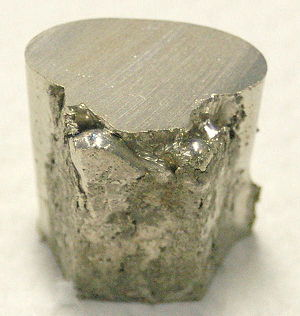
Nickel twenty-eighth element of the Periodic Table
Nickel (Ni) is a metallic chemical element belonging to the transition metals class, silver-white, tough and magnetic, which is located in group 10 and period 4 of the Periodic Table. It has atomic number 28 and atomic mass 58,6934. Nickel was discovered in 1751 in Stockholm, Sweden by Swedish chemist Axel Cronstedt. The name nickel derives from the German kupfernickel which means both Devil's copper and St. Nicholas' copper.This element has natural isotopes with atomic masses 58, 60, 61, 62 and 64, and artificial radioactive isotopes, with half-disintegration periods between 50 seconds and 80 000 years, and with atomic weights of 56, 57, 59, 63, 65 and 67 Nickel is found in nature in the form of sulphide, accompanying iron in Canada's nickel magnetic pyrites or pyrrhotites, from which most of the world's production comes, and as garnierite (magnesium silicate silicate) in New Caledonia. There are also deposits in the Russian Federation.
It is also found in nickel in oceanic manganese nodules (about 1.3% nickel) and associated with iron in meteorites (25-80% nickel). Metal is obtained from ores in a similar manner to copper. To do this, the ore is heated and the resulting oxide is reduced using coal, which also contains iron, copper and cobalt, subjecting the nickel to further purification. Nickel is very resistant to oxidation and alkaline hydroxides, which is why it is used as an element in stainless steel alloys, high nickel alloys and for electroplating.
The elements most commonly alloyed with nickel are copper, iron, silicon, molybdenum, manganese and aluminum. Metal and its inorganic compounds are non-toxic, but prolonged contact with nickel may cause allergic reactions. In contrast, some organic nickel compounds are highly toxic. Vapors and nickel dust are carcinogenic.