Xenon Fifty-fourth Element of the Periodic Table
The Portuguese xenon from Portugal or Portuguese xenon from Brazil (accepted xenon predilection), from the Greek xenos - foreign, is a chemical element of symbol Xe of atomic number 54 (54 protons and 54 electrons) and of atomic mass equal to 131 , 3 u. At room temperature, xenon is in the gaseous state.
It is one of the noble gases of the periodic classification of elements, group 18 (VIIIA or 0). It is odorless, very heavy, colorless, found as a trace in the earth's atmosphere, and is part of the first synthesized noble gas compound.
It was discovered by William Ramsay and Morris Travers in 1898. Its main application is in the manufacture of light emitting devices such as strobe lamps, bactericidal lamps and others.
History:
Xenon (from the Greek meaning "strange") was discovered by William Ramsay and Morris Travers in 1898 in the waste resulting from the evaporation of liquid air components.1 · 2. Ramsay proposed to call the new gas xenon from the Greek ξένον [xenon], singular neutral form of ξένος [xenos], meaning "foreign" or "guest" 3 · 4
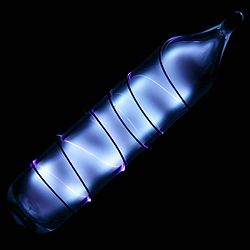
Main Features: Xenon is a member element of the noble or inert gas group. The word inert is no longer used to describe this chemical group, as some elements of this group form compounds. In a gas-filled tube, xenon gives off a beautiful blue glow when excited by an electric discharge. Metallic xenon has been obtained by applying pressures of several hundred kilobars. Xenon can also form solvates with water when its atoms become trapped in the network of water molecules.
Applications:
The main and most famous use of this gas is in the manufacture of light emitting devices such as bactericidal lamps, electronic tubes, strobe lamps and photographic flashes, as well as ruby laser excitation lamps that generate coherent light.
Other uses are:
As an anesthetic in general anesthesia. In nuclear installations, in bubble chambers, probes, and other areas where their high molecular weight is desirable. Perxenates are used as oxidizing agents in analytical chemistry. The isotope Xe-133 is used as a radioisotope in lung ventilation scintigraphy in nuclear medicine. In space rocket propulsion, ionic propulsion, which uses particle accelerators to accelerate xenon ions. In English, this system is called XIP (Xenon Ion Propulsion).
Abundance and obtaining:
Traces of xenon are found in the earth's atmosphere, appearing in part by twenty million. The element is obtained commercially by extracting waste from liquid air. This noble gas is found naturally in the gases emitted by some natural springs. The isotopes Xe-133 and Xe-135 are synthesized by neutron irradiation in air-cooled nuclear reactors.
It is one of the noble gases of the periodic classification of elements, group 18 (VIIIA or 0). It is odorless, very heavy, colorless, found as a trace in the earth's atmosphere, and is part of the first synthesized noble gas compound.
It was discovered by William Ramsay and Morris Travers in 1898. Its main application is in the manufacture of light emitting devices such as strobe lamps, bactericidal lamps and others.
History:
Xenon (from the Greek meaning "strange") was discovered by William Ramsay and Morris Travers in 1898 in the waste resulting from the evaporation of liquid air components.1 · 2. Ramsay proposed to call the new gas xenon from the Greek ξένον [xenon], singular neutral form of ξένος [xenos], meaning "foreign" or "guest" 3 · 4
Main Features: Xenon is a member element of the noble or inert gas group. The word inert is no longer used to describe this chemical group, as some elements of this group form compounds. In a gas-filled tube, xenon gives off a beautiful blue glow when excited by an electric discharge. Metallic xenon has been obtained by applying pressures of several hundred kilobars. Xenon can also form solvates with water when its atoms become trapped in the network of water molecules.
Applications:
The main and most famous use of this gas is in the manufacture of light emitting devices such as bactericidal lamps, electronic tubes, strobe lamps and photographic flashes, as well as ruby laser excitation lamps that generate coherent light.
Other uses are:
As an anesthetic in general anesthesia. In nuclear installations, in bubble chambers, probes, and other areas where their high molecular weight is desirable. Perxenates are used as oxidizing agents in analytical chemistry. The isotope Xe-133 is used as a radioisotope in lung ventilation scintigraphy in nuclear medicine. In space rocket propulsion, ionic propulsion, which uses particle accelerators to accelerate xenon ions. In English, this system is called XIP (Xenon Ion Propulsion).
Abundance and obtaining:
Traces of xenon are found in the earth's atmosphere, appearing in part by twenty million. The element is obtained commercially by extracting waste from liquid air. This noble gas is found naturally in the gases emitted by some natural springs. The isotopes Xe-133 and Xe-135 are synthesized by neutron irradiation in air-cooled nuclear reactors.