Iodine Fifty-third Element of the Periodic Table
Iodine (Greek violet iodine) is a chemical element of symbol I, of atomic number 53 (53 protons and 53 electrons) and of atomic mass 126,9 u. At room temperature, the iodine is in solid state.
It is a nonmetal of the halogen group (17 or VIIA) of the periodic classification of elements. It is the least reactive and least electronegative of all the elements in your group.
It is a trace element, used mainly in medicine, photography and as a dye. It was discovered in France by chemist Bernard Courtois in 1811 from seaweed.
History:
Iodine (from the Greek iodine, which means "violet") was discovered in France by chemist Bernard Courtois in 1811 from seaweed, not continuing his investigations for lack of money. Subsequently, English chemist Humphry Davy and French chemist Gay-Lussac studied the substance separately and eventually identified it as a new element. Both gave the discovery credit to Courtois.
Main features:
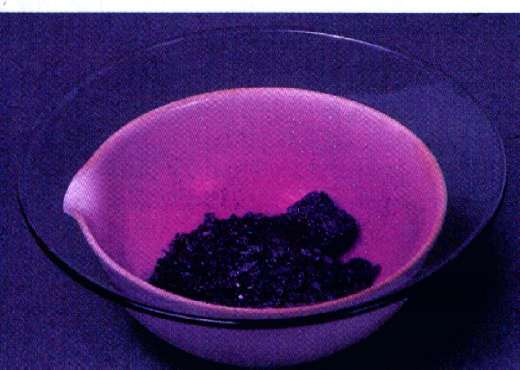
Iodine is a glossy black solid with a slight metallic sheen that sublimates under normal conditions to form a violet-colored gas with an irritating odor. Like other halogens, it forms a large number of compounds with other elements, but is the least reactive in the group, and has certain metallic characteristics. Lack of iodine causes retardation of prolactins.
It is poorly soluble in water, but easily dissolves in organic substances such as ethanol, chloroform, CHCl3, carbon tetrachloride, CCl4, or carbon disulfide, CS2, producing violet colored solutions. Dissolving in the presence of starch gives a blue tint. Its solubility in water increases if we add iodide due to the formation of the triodide, I3-.
It can have several oxidation states: -1, +1, +3, +5, +7.
Applications:
Potassium iodide, KI, is added to the common salt, NaCl (a mixture called iodized salt), to prevent the onset of endemic goiter, a disease caused by a dietary iodine deficit.
Iodine tincture is a solution of iodine and KI in alcohol, water or a mixture of both (e.g. 2 grams of iodine and 2.4 grams of KI in 100 mL of ethanol) which has antiseptic properties. It is used as a skin disinfectant or for cleaning wounds. It can also be used to disinfect water. Iodine compounds are important in the field of organic chemistry and are very useful in medicine; Iodides, as well as thyroxine, which contains iodine, are used in internal medicine.
Potassium iodide, KI, is used in photography. Iodine is used in tungsten (wolfram) filament lamps to increase their useful life.
Nitrogen tri triiodide, NI3, is an impact explosive that is too unstable for commercialization, but it can easily be prepared at home. Radioactive isotopes Iodine-123 and Iodine-131 are used in nuclear medicine to study the thyroid gland. Iodine-131 is also used in the therapy of some types of thyroid cancer, thanks to its decay with beta particle production. Silver iodide, AgI, is used to create artificial rainfall.
Biological Functions: Iodine is an essential chemical element. One of the known functions of iodine is as an integral part of thyroid hormones. The thyroid gland manufactures the hormones thyroxine and triiodothyronine, which contains iodine. Iodine deficiency leads to hypothyroidism resulting in goiter and myxedema.
The occurrence of iodine deficiency in childhood may lead to cretinism, causing mental and physical retardation.
Overproduction of hormones in the thyroid leads to hyperthyroidism. Iodine may also be known as a disinfectant due to its easy reactivity with organic elements due to its high electronegativity.
Abundance and Obtainment:
Iodine is the least abundant halogen, presenting in the earth's crust with a concentration of 0.14 ppm, being in sea water in an abundance of 0.052 ppm.
Iodine can be obtained from iodides, I-, present in seawater and algae. It can also be obtained from iodates, 10 3 - present in the nitrates of Chile, separating them previously from them.
If iodates are broken off, some of them are reduced to iodides, and the iodides obtained react with the rest of the iodates, producing iodine: 103- + 5I- + 6H + → 3I2 + 3H2O
When the iodides are broken off, they oxidize with chlorine, and the iodine obtained is filtered off. Iodine can be purified by reducing it and reoxidizing it with chlorine. 2I- + Cl2 → I2 + 2Cl-
Iodine can be prepared in ultrapure form by reacting potassium iodide, KI, with copper sulfate, CuSO4.
It is a nonmetal of the halogen group (17 or VIIA) of the periodic classification of elements. It is the least reactive and least electronegative of all the elements in your group.
It is a trace element, used mainly in medicine, photography and as a dye. It was discovered in France by chemist Bernard Courtois in 1811 from seaweed.
History:
Iodine (from the Greek iodine, which means "violet") was discovered in France by chemist Bernard Courtois in 1811 from seaweed, not continuing his investigations for lack of money. Subsequently, English chemist Humphry Davy and French chemist Gay-Lussac studied the substance separately and eventually identified it as a new element. Both gave the discovery credit to Courtois.
Main features:
Iodine is a glossy black solid with a slight metallic sheen that sublimates under normal conditions to form a violet-colored gas with an irritating odor. Like other halogens, it forms a large number of compounds with other elements, but is the least reactive in the group, and has certain metallic characteristics. Lack of iodine causes retardation of prolactins.
It is poorly soluble in water, but easily dissolves in organic substances such as ethanol, chloroform, CHCl3, carbon tetrachloride, CCl4, or carbon disulfide, CS2, producing violet colored solutions. Dissolving in the presence of starch gives a blue tint. Its solubility in water increases if we add iodide due to the formation of the triodide, I3-.
It can have several oxidation states: -1, +1, +3, +5, +7.
Applications:
Potassium iodide, KI, is added to the common salt, NaCl (a mixture called iodized salt), to prevent the onset of endemic goiter, a disease caused by a dietary iodine deficit.
Iodine tincture is a solution of iodine and KI in alcohol, water or a mixture of both (e.g. 2 grams of iodine and 2.4 grams of KI in 100 mL of ethanol) which has antiseptic properties. It is used as a skin disinfectant or for cleaning wounds. It can also be used to disinfect water. Iodine compounds are important in the field of organic chemistry and are very useful in medicine; Iodides, as well as thyroxine, which contains iodine, are used in internal medicine.
Potassium iodide, KI, is used in photography. Iodine is used in tungsten (wolfram) filament lamps to increase their useful life.
Nitrogen tri triiodide, NI3, is an impact explosive that is too unstable for commercialization, but it can easily be prepared at home. Radioactive isotopes Iodine-123 and Iodine-131 are used in nuclear medicine to study the thyroid gland. Iodine-131 is also used in the therapy of some types of thyroid cancer, thanks to its decay with beta particle production. Silver iodide, AgI, is used to create artificial rainfall.
Biological Functions: Iodine is an essential chemical element. One of the known functions of iodine is as an integral part of thyroid hormones. The thyroid gland manufactures the hormones thyroxine and triiodothyronine, which contains iodine. Iodine deficiency leads to hypothyroidism resulting in goiter and myxedema.
The occurrence of iodine deficiency in childhood may lead to cretinism, causing mental and physical retardation.
Overproduction of hormones in the thyroid leads to hyperthyroidism. Iodine may also be known as a disinfectant due to its easy reactivity with organic elements due to its high electronegativity.
Abundance and Obtainment:
Iodine is the least abundant halogen, presenting in the earth's crust with a concentration of 0.14 ppm, being in sea water in an abundance of 0.052 ppm.
Iodine can be obtained from iodides, I-, present in seawater and algae. It can also be obtained from iodates, 10 3 - present in the nitrates of Chile, separating them previously from them.
If iodates are broken off, some of them are reduced to iodides, and the iodides obtained react with the rest of the iodates, producing iodine: 103- + 5I- + 6H + → 3I2 + 3H2O
When the iodides are broken off, they oxidize with chlorine, and the iodine obtained is filtered off. Iodine can be purified by reducing it and reoxidizing it with chlorine. 2I- + Cl2 → I2 + 2Cl-
Iodine can be prepared in ultrapure form by reacting potassium iodide, KI, with copper sulfate, CuSO4.