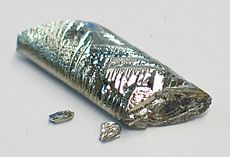
Tellurium Fifty-second Element of the Periodic Table
Tellurium is a chemical element of the symbol Te, atomic number 52 (52 protons and 52 electrons) and with atomic mass 127.6 u. It is a semi-metal belonging to group 16 (VIA) of the periodic classification of the elements. At room temperature tellurium is in a solid state. It was discovered in 1782 or 1783 in a calaverite ore by Franz Joseph Müller von Reichenstein, and was isolated in 1798 by Martin Heinrich Klaproth.
History:
Tellurium (from Latin tellus meaning “earth”) was discovered in 1782 or 1783 by Franz Joseph Müller von Reichenstein, Romania, from a gold ore called calaverite (AuTe2) from a Transylvanian mine. In 1798 it was isolated and named by Martin Heinrich Klaproth.
From 1960 onwards there was an increase in the use of tellurium in the manufacture of thermoelectric devices used in refrigeration and to improve the qualities of steel.
Main Features: Tellurium is a relatively rare element, belonging to the same chemical family as oxygen, sulfur, selenium, and polonium, all called chalcogens.
When crystalline, tellurium is silver-white, and when in pure form has a metallic sheen. It is a fragile and easily sprayable semi-metal (metalloid). Amorphous tellurium can be obtained by precipitation of a telluric acid or telluric acid solution. However, there is some controversy as to whether this tellurium is really amorphous or made up of tiny crystals. Tellurium is a semiconductor of the type that shows higher conductivity in certain directions, depending on atomic alignment.
Chemically related to selenium or sulfur, the conductivity of tellurium increases slightly when exposed to light. Can be doped with copper, gold, silver, tin or other metals. Tellurium, when burned in the air, produces a blue-green flame and forms tellurium dioxide (TeO2) as a product. When fused, tellurium has the ability to corrode copper, iron and stainless steel.
Applications:
Most tellurium is used in alloys with other metals. It is added to lead to increase its mechanical strength, durability and decrease the corrosive action of sulfuric acid. When added to stainless steel and copper makes these materials more machinable.
Other uses:
In cast iron (cast iron) for cold control. Used in ceramics. Added rubber increases its heat and aging resistance, and is used as a blue pigment to color the glass. Colloidal tellurium has fungicidal, insecticidal and germicidal action. Bismuth telluride is used in thermoelectric devices. Tellurium is used in the reflective layer of RW CDs in the form of an alloy with silver, tin and indium (AgSnInTe).
Tellurium is also used in explosive fuses and has potential applications in solar panels such as cadmium telluride. Although some efficiencies for the generation of electricity from solar energy have been increased through the use of this material, its application has not produced a significant increase in demand.
Occurrence:
Tellurium is sometimes found in native form, but is often found in the form of gold telluride (calaverite) or, in small quantities, combined with other metals constituting the minerals altaite, coloradoite, ricardite, pedzite, silvanite and tetradimite. The main commercial source of tellurium is from anodic sludge obtained from electrolytic refining of copper. The largest world producers of this element are the United States (Montana, Utah and Arizona), Canada, Japan and Peru.
History:
Tellurium (from Latin tellus meaning “earth”) was discovered in 1782 or 1783 by Franz Joseph Müller von Reichenstein, Romania, from a gold ore called calaverite (AuTe2) from a Transylvanian mine. In 1798 it was isolated and named by Martin Heinrich Klaproth.
From 1960 onwards there was an increase in the use of tellurium in the manufacture of thermoelectric devices used in refrigeration and to improve the qualities of steel.
Main Features: Tellurium is a relatively rare element, belonging to the same chemical family as oxygen, sulfur, selenium, and polonium, all called chalcogens.
When crystalline, tellurium is silver-white, and when in pure form has a metallic sheen. It is a fragile and easily sprayable semi-metal (metalloid). Amorphous tellurium can be obtained by precipitation of a telluric acid or telluric acid solution. However, there is some controversy as to whether this tellurium is really amorphous or made up of tiny crystals. Tellurium is a semiconductor of the type that shows higher conductivity in certain directions, depending on atomic alignment.
Chemically related to selenium or sulfur, the conductivity of tellurium increases slightly when exposed to light. Can be doped with copper, gold, silver, tin or other metals. Tellurium, when burned in the air, produces a blue-green flame and forms tellurium dioxide (TeO2) as a product. When fused, tellurium has the ability to corrode copper, iron and stainless steel.
Applications:
Most tellurium is used in alloys with other metals. It is added to lead to increase its mechanical strength, durability and decrease the corrosive action of sulfuric acid. When added to stainless steel and copper makes these materials more machinable.
Other uses:
In cast iron (cast iron) for cold control. Used in ceramics. Added rubber increases its heat and aging resistance, and is used as a blue pigment to color the glass. Colloidal tellurium has fungicidal, insecticidal and germicidal action. Bismuth telluride is used in thermoelectric devices. Tellurium is used in the reflective layer of RW CDs in the form of an alloy with silver, tin and indium (AgSnInTe).
Tellurium is also used in explosive fuses and has potential applications in solar panels such as cadmium telluride. Although some efficiencies for the generation of electricity from solar energy have been increased through the use of this material, its application has not produced a significant increase in demand.
Occurrence:
Tellurium is sometimes found in native form, but is often found in the form of gold telluride (calaverite) or, in small quantities, combined with other metals constituting the minerals altaite, coloradoite, ricardite, pedzite, silvanite and tetradimite. The main commercial source of tellurium is from anodic sludge obtained from electrolytic refining of copper. The largest world producers of this element are the United States (Montana, Utah and Arizona), Canada, Japan and Peru.