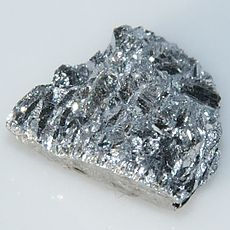
Antimony Fifty-first element of the Periodic Table
Antimonio (Brazilian Portuguese) or antimony (European Portuguese) (Greek antimons, as opposed to solitude), also called stibium, is a chemical element of the Sb symbol of atomic number 51 (51 protons and 51 electrons) and of atomic mass equal to 121.8 u. At room temperature the antimony is in the solid state. The symbol Sb is an abbreviation of its name in the Latin language, Stibium, conventionally abbreviated Sb.
It is a semi-metal (metalloid) of group 15 (VA) of the Periodic Classification of Elements. It presents four allotropic forms. Its stable shape is a bluish white metal. Black and yellow antimony are unstable non-metallic forms. Antimony is mainly used in metal alloys and some of their compounds to provide fire resistance, in paints, ceramics, enamels, rubber vulcanization and fireworks.
History:
Antimony has been known to the Chinese and Babylonians since 3,000 BC. Antimony sulfide has been used as a cosmetic and for medicinal purposes. The history of the antimony symbol, and its relationship to its name "stybium", is long: the Coptic name of the antimony sulfide cosmetic powder was taken from the Greek and then passed to Latin, resulting in the name stibium. The chemist Jöns Jacob Berzelius used an abbreviation of this name in his writings and thus became the symbol Sb.
One theory for its name "stibium" is that many wine-holding containers once contained metallic elements with antimony in their composition. It was oxidized and formed compounds that gave the wine a bitter taste; hence the meaning of its name: sour life. Antimony was widely used in alchemy. There are writings on this element by Georg Bauer (Georgios Agricola), and Basilio Valentín is the author of The Triumphant Car of Antimony, a treatise on the element.
Key Features:
Antimony in its elemental form is a crystalline, fusible, brittle, silver-white solid that has low electrical and thermal conductivity and evaporates at low temperatures. This semi-metallic (metalloid) element resembles metals in appearance and physical properties, but chemically does not behave like them. May be attacked by oxidizing acids and halogens.
Estimates of antimony abundance in the earth's crust range from 0.2 to 0.5 ppm. Antimony occurs with sulfur and other metals such as lead, copper and silver.
Applications:
Antimony is of increasing importance in the semiconductor industry for the construction of diodes, infrared detectors and Hall effect devices.
Used as an alloy, this semi-metal greatly increases the hardness and mechanical strength of lead. It is also used in different alloys such as pewter, antifriction metal (tin alloy), English metal (formed by zinc and antimony).
Some more specific applications:
batteries and accumulators; types of press; cable shells;
pads and bearings.
Antimony compounds in the form of antimony oxides, sulfides, antimoniates and halides are used in the manufacture of fire resistant materials, enamels, glass, paints and ceramics. Antimony trioxide is the most important and is mainly used as a flame retardant (fire fighting). These flame retardant applications include the production of various products such as clothing, toys, seat covers, etc.
Abundance and obtaining:
Antimony is found in nature in numerous minerals, although it is a poorly abundant element. Although it can be found free, it is usually in the form of sulfides. The main antimony ore is antimonite (also called stibin), Sb2S3.
By burning antimony sulfide antimony III oxide Sb2O3 is obtained, which is reduced with coke to obtain antimony: 2Sb2O3 + 3C → 4Sb + 3CO2
It can also be obtained by direct sulfide reduction with iron:
Sb2S3 + 3Fe → 2Sb + 3FeS
It is a semi-metal (metalloid) of group 15 (VA) of the Periodic Classification of Elements. It presents four allotropic forms. Its stable shape is a bluish white metal. Black and yellow antimony are unstable non-metallic forms. Antimony is mainly used in metal alloys and some of their compounds to provide fire resistance, in paints, ceramics, enamels, rubber vulcanization and fireworks.
History:
Antimony has been known to the Chinese and Babylonians since 3,000 BC. Antimony sulfide has been used as a cosmetic and for medicinal purposes. The history of the antimony symbol, and its relationship to its name "stybium", is long: the Coptic name of the antimony sulfide cosmetic powder was taken from the Greek and then passed to Latin, resulting in the name stibium. The chemist Jöns Jacob Berzelius used an abbreviation of this name in his writings and thus became the symbol Sb.
One theory for its name "stibium" is that many wine-holding containers once contained metallic elements with antimony in their composition. It was oxidized and formed compounds that gave the wine a bitter taste; hence the meaning of its name: sour life. Antimony was widely used in alchemy. There are writings on this element by Georg Bauer (Georgios Agricola), and Basilio Valentín is the author of The Triumphant Car of Antimony, a treatise on the element.
Key Features:
Antimony in its elemental form is a crystalline, fusible, brittle, silver-white solid that has low electrical and thermal conductivity and evaporates at low temperatures. This semi-metallic (metalloid) element resembles metals in appearance and physical properties, but chemically does not behave like them. May be attacked by oxidizing acids and halogens.
Estimates of antimony abundance in the earth's crust range from 0.2 to 0.5 ppm. Antimony occurs with sulfur and other metals such as lead, copper and silver.
Applications:
Antimony is of increasing importance in the semiconductor industry for the construction of diodes, infrared detectors and Hall effect devices.
Used as an alloy, this semi-metal greatly increases the hardness and mechanical strength of lead. It is also used in different alloys such as pewter, antifriction metal (tin alloy), English metal (formed by zinc and antimony).
Some more specific applications:
batteries and accumulators; types of press; cable shells;
pads and bearings.
Antimony compounds in the form of antimony oxides, sulfides, antimoniates and halides are used in the manufacture of fire resistant materials, enamels, glass, paints and ceramics. Antimony trioxide is the most important and is mainly used as a flame retardant (fire fighting). These flame retardant applications include the production of various products such as clothing, toys, seat covers, etc.
Abundance and obtaining:
Antimony is found in nature in numerous minerals, although it is a poorly abundant element. Although it can be found free, it is usually in the form of sulfides. The main antimony ore is antimonite (also called stibin), Sb2S3.
By burning antimony sulfide antimony III oxide Sb2O3 is obtained, which is reduced with coke to obtain antimony: 2Sb2O3 + 3C → 4Sb + 3CO2
It can also be obtained by direct sulfide reduction with iron:
Sb2S3 + 3Fe → 2Sb + 3FeS