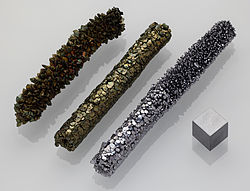
Vanadium twenty-third element of the Periodic Table
(Tribute to Goddess Vanadis) is a chemical element, symbol V, atomic number 23 (23 protons and 23 electrons) of atomic mass 51 and which, under ambient conditions, is found in the solid state.It was discovered by Spanish mineralogist Andrés Manuel del Río in Mexico in 1801 in a lead mineral. In 1830, the Swedish Nils Gabriel Sefström discovered the element in an oxide he found while working in an iron mine and gave it the name by which it is now known.
It is located in group 5 (VB) of the periodic table of elements. It is a ductile metal, soft and although much more abundant than copper, with a crustal abundance of 160 ppm, forms few minerals. The reason vanadium forms so few minerals is that the V3 + ion is geochemically similar to the Fe3 + ion, an abundant and constituent ion of many minerals. Thus, the V3 + ion generally replaces Fe3 + in minerals (notably magnetite) rather than forming its own minerals. It is nonetheless found in a number of minerals, and is mainly used in some metal alloys.
Main Features: Vanadium is a soft, ductile transition metal of bright gray color. It has high resistance to base attack, sulfuric acid (H2SO4) and hydrochloric acid (HCl). It is obtained from various minerals, even oil. It can also be obtained by recovering vanadium oxide powder from combustion processes. It has some nuclear applications due to its low neutron capture. It is an essential chemical element in some living beings, although its exact function is not known. In its compounds presents oxidation states +2, +3, +4 and +5.
Applications:
Approximately 80% of the vanadium produced is used as ferrovanadium or as a steel additive. It is used for the production of stainless steels for surgical instruments and tools, corrosion resistant steels and, mixed with aluminum in titanium alloys, is employed in reaction engines. Also, in steels, employed in wheel axles, gears and other critical components. It is an important carbide stabilizer in steel making. It is used in some components of nuclear reactors. It is part of some superconducting magnets. Some vanadium compounds are used as catalysts in the production of maleic anhydride and sulfuric acid. Vanadium pentoxide, V2O5, used in ceramics is widely used.
History:
Vanadium (from the goddess of beauty in Scandinavian mythology "Vanadis" due to the coloration of its compounds), was first discovered by a Spanish mineralogist Andrés Manuel del Río in Mexico in 1801 in a lead mineral. He first called it "panchrome" because of the similarity of its colors to those of chromium, then "erythronium" because of the coloration of its salts (turned red when heated). However, French chemist Hippolyte Victor Collet-Descotils questioned the finding on the grounds that it was indeed impure chromium, causing Andrés Manuel del Río to retract. In 1830, the Swedish Nils Gabriel Sefström discovered the element in an oxide he found while working in an iron mine and gave it the name by which it is now known. Later, in 1831, Friedrich Woehler concluded that this element was the same element discovered in 1801 by Andrés Manuel del Rio. Metallic vanadium was obtained in 1867 by Henry Enfield Roscoe by reducing the vanadium trichloride, VCl3, with hydrogen. Compounds
It has several oxidation states, with different colors. Through a simple experiment you can appreciate the relationship:
Starting from ammonium vanadate (NH4VO4), and using metallic zinc in an acid medium, the following reactions are produced: VO43- (colorless) → [VO (OH2) 5] 2+ (blue) → [V (OH2) 6] 3+ (green) → [V (OH2) 6] 2+ (violet)
Vanadium pentoxide, V2O5, which is obtained as an orange-colored pulverized solid, is an oxidizing agent and is used as a catalyst in the dye industry as a mordant and in the production of black aniline. The unit, VO2 +, in which vanadium has +4 oxidation state, with double V-O bond, can be found in several vanadium complexes, usually with four ligands forming a square base pyramid.
Biological paper:
Vanadium is an essential element in some organisms. In humans its essentiality has not been demonstrated, although there are vanadium compounds that mimic and potentiate insulin activity. It is found in some enzymes of different living things. For example, in the haloperoxidases (usually bromoperoxidases) of some algae, which reduce peroxides and halogenate an organic substrate. The ascidians (some urocordinated marine organisms from the subphylum urochordata) store high concentrations of vanadium, about one million times higher than in the surrounding water, and are found in a molecule called "hemovanadine". In these organisms vanadium is stored in cells called "vanadocytes". Also accumulate high concentrations of vanadium the fungus amanita muscaria. A complex with an ionophore ligand called "amavadine" is formed. Abundance and obtaining Vanadium is widely used in tool making as the key to this photograph.
Vanadium is never found in its native state, but it is present in about 65 different minerals, including patronite, VS4, vanadinite, Pb5 (VO4) 3Cl, and carnotite, K2 (UO2) 2 (VO4). 2 · 3H2O. It is also found in bauxite as well as carbon-containing deposits such as coal, crude petroleum oils. It is extracted from oil using porphyrins. It is also found in iron ores, volcanic rocks and clay minerals.
Most of the world's reserves, about 10 million tons, are in Russia, China and South Africa. In Brazil, a 23 million ore deposit was found in Maracás (BA) .1
Vanadate-containing ores are dissolved by an alkaline fusion. In acid medium, after other processes, V2O5 is obtained, which is partially reduced with carbon and then with calcium in an argon atmosphere, which allows to obtain metallic vanadium. When part of a mineral that does not contain vanadates but contains sulfide of this element, it is oxidized to vanadate and subsequently the same procedures as described for obtaining vanadium are performed.
The most common method of obtaining vanadium is by reducing vanadium pentoxide, V2O5, and calcium chloride to a pressure of 950 ° C in a steel pump. V2O5 + 5 Ca + 5 CaCl2 ---> 2 V + 5 (CaO + CaCl2) To obtain vanadium, aluminothermia can also be used, which consists in heating the oxide mixed with aluminum powder: 3 V2O5 + 10 AL ---> 6 V + 5 Al2O3 To obtain a purer vanadium one can also use the Van Arkel-de Boer method, which is the formation of a more volatile compound for further decomposition. Isotopes
In nature there is a single stable isotope, vanadium-51. Fifteen radioisotopes are known, the most stable being vanadium-50 with a half-life of 1.4 x 10¹⁷ years, vanadium-49 of 330 days and vanadium-48 of 15.9735 days. The others have average lives of less than one hour, most with less than ten seconds. This element has a meta state.
The atomic masses of vanadium isotopes range from 43,891 u for vanadium-43 to 59,959 u for vanadium-59. The main mode of decay of isotopes of masses below the most stable isotope, vanadium-51, is electron capture, the main decay products being element 22 (titanium) isotopes. In those with a mass greater than vanadium-51, the decay is beta disintegration, resulting as decay of the element 24 isotopes, the chromium.