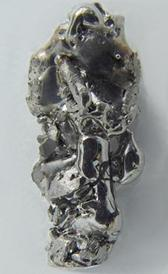
Titanium Twenty-second Element of the Periodic Table
Titanium is the chemical element of atomic number 22 and atomic mass 47.867 u. It was discovered by the English cleric William Justin Gregor through an ilmenite isolation (FeTiO3). Later a rediscovery occurred by the German chemist Martin Heinrich, now through the rutile mineral (TiO2). Martin is the author of the titanium denomination.It has as one of its main functions, the indication for its use in environments that provide corrosion, because it is a very resistant metal. Although somewhat reactive, it has such resistance due to an oxide film capable of protecting its surface. When subjected to a pressure of 298 K it is in solid state and has a silver color. It has a melting point of 1941K, a boiling point of 3560K and a low density.
It is the ninth most abundant element on earth, it can be found in the sun, meteorites and in various minerals such as ilmenite (FeTiO3) and rutile (TiO2). Its reserves on the planet are estimated to exceed 600 million tons.
Applications:
It is widely used in the aerospace industry (titanium only began to be explored on a large scale after the growth of this sector), where they form alloys with other metals to form various types of structures. It is recommended for being together strong, sturdy and light, and the ability to withstand high temperatures. Due to these characteristics it is also exploited by the automotive (connection manufacturing) and marine (turbines and propellers) sectors. The area of security also takes advantage of its properties, where metal is an important matter in the manufacture of armored cars, safes and security gates. Titanium is used to make prostheses for the purpose of replacing joints. Another essential application is made in dental implants, where titanium pins replace tooth roots. The use is indicated due to its high biocompatibility, besides having high corrosion resistance, which can occur due to human fluids.
Titanium Dioxide:
Its most famous compound is titanium dioxide (TiO2), so much so that approximately 95% of all titanium produced aims to obtain this compound and is used as a very important white pigment in the production of inks and papers. It is also used in the cosmetic industry as it is a constituent of almost every brand of sunscreen. There are also lesser known and to some extent curious uses, such as the demarcation of tennis court lines, and a good contribution to the film industry in the application of artificial snow scenes.
BIBLIOGRAPHICAL REFERENCES:
ATKINS, Peter, JONES, Loretta. Chemistry Principles:
questioning modern life and the environment. 3 ed. Porto Alegre: Bookman, 2006, p. 700.
http://www.webelements.com/titanium/
http://www.realum.com.br/titanio1.htm/
http://en.wikipedia.org/wiki/Titanium/
http://qnesc.sbq.org.br/online/qnesc23/a14.pdf