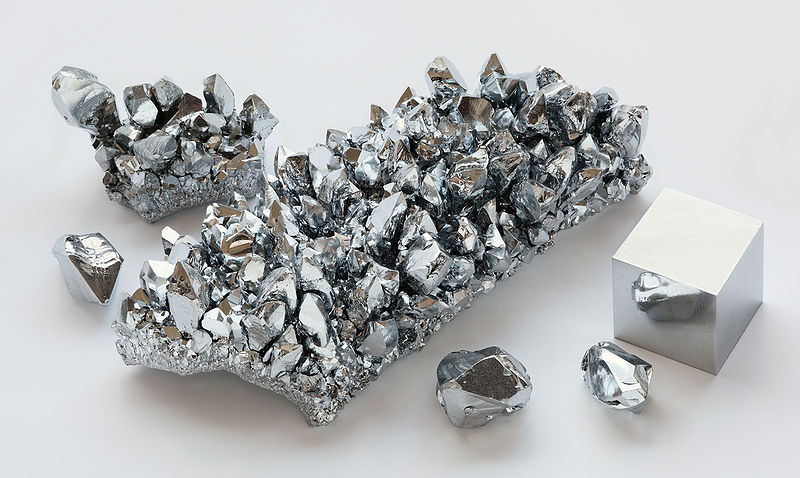
Chrome twenty-fourth element of the Periodic Table
Chrome
The chemical element chromium is a white, crystalline transition metal with low malleability and ductility, has atomic number 24 and relative atomic mass 51, 996 u is located in group VI-B of the table, its name derives from the word “Chroma” and translated Greek is color.
Metallic chrome
It is found in nature in the form of chromite (FeCr2O4), a double ocher yellow iron oxide and chromium, from which chromium is industrially extracted by thermal or electrolytic processes. It was first discovered by chemist Louis Nicolas in 1797 who isolated it in 1798 from a mineral called crocoite found in Siberia. It is resistant to attack by acids such as HCl and H2SO4 at room temperature, hence the importance of metal for electroplating, which covers everything from door handles to metal structures through the electroplating process, as well as being used in the manufacture of iron-containing alloys. and nickel which are highly corrosion resistant.
The salts of this element form extremely colored solutions, Cr + 2, Cr + 3 ions are green and violet, according to the reaction medium. While the dichromate is orange and chromate is yellow for Nox +6. Chromium is a metal that has a strong tendency to undergo oxy-reduction and can form numerous compounds at times behaving as acid, sometimes as a base.
Chromium is a heavy metal that has an accumulative effect, and causes many health and human health problems when its presence in the environment exceeds predetermined limits.
It has wide use in chemical processes mainly in electrochemistry and organic syntheses.
Physical Properties:
Melting point: 1765 ° C
Oxidation states: Cr + 2, Cr + 3 and Cr + 6
Electronic Configuration: 1s², 2s², 2p6, 3s², 3p6, 3d5, 4s¹
Symbol in the periodic table: Cr.