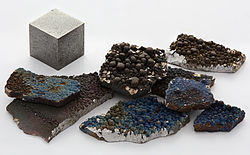
Manganese twenty-fifth element of the periodic table
Manganese, manganese, 1 (from French manganese) or manganese (a designation neglected by its resemblance to magnesium) is a chemical element, symbol Mn, atomic number 25 (25 protons and 25 electrons) and atomic mass 55 u, solid at temperature. environment. It is in group 7 (7B) of the periodic classification of the elements. Used in alloys mainly in steel and also for the production of piles. It was discovered in 1774 by the Swedish Johan Gottlieb Gahn, reducing its carbon oxide.Its main application is in the manufacture of alloys in which it is a sulfur and oxygen scavenger and other uses of its main compounds include manganese dioxide in the manufacture of dry cells and potassium permanganate in the laboratory as an oxidizing agent in various chemical reactions. .
It is the 12th most abundant element of the earth's crust and its main ores are pyrolusite and rhodochrosite. The largest deposits are located in South Africa, Brazil, Ukraine, Australia, India, China and Gabon. In the Brazilian territory the states of Pará, Minas Gerais and Mato Grosso do Sul are the main mining regions.
The manganese phosphating process is used in the treatment against rust and corrosion of steel. Depending on their oxidation state, manganese ions have varied colors and are used industrially as pigments. Alkaline and alkaline earth permanganates are powerful oxidizers. Manganese dioxide is used as a cathode (or electron receptor) in commercially available standard and alkaline dry cells and batteries.
In biology, manganese ions act as adjuvants to a wide variety of enzymes that perform many functions. Manganese enzymes are particularly essential in the process of detoxifying superoxide free radicals in organisms that need to make use of elemental oxygen. Manganese also works in the oxygen-releasing complex of photosynthetic plants. The element is a mineral needed in tiny amounts for all known living organisms. In larger amounts, and apparently with greater activity when inhaled, manganese can cause mammalian poisoning syndrome, with neurological damage sometimes irreversible.