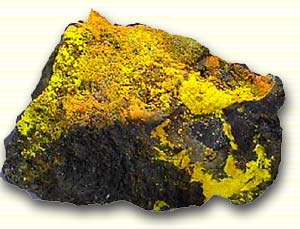
Uranium Ninety-second Element of the Periodic Table
Uranium (named after the planet Uranus), is a chemical element of U symbol and atomic mass equal to 238 u, has atomic number 92 (92 protons and 92 electrons), is a natural and common element, much more abundant than silver. , abundance comparable to molybdenum and arsenic, but four times less abundant than thorium.
At room temperature uranium is in a solid state. It is a radioactive metallic element belonging to the actinide family1.
It was discovered in 1789 by the German Martin Klaproth in Germany. It was the first element where radioactivity was discovered, its most common isotopes having a long half-life (~ 4.5 billion years for uranium-238 and ~ 700 million years for uranium-235). Uranium is used in the military industry (atomic and secondary bombs for hydrogen bombs), and as fuel in nuclear power plants.2
The International Atomic Energy Agency estimated world reserves of uranium at 5.4 million tonnes worldwide in 2009, 31% of which is in Australia, 12% in Kazakhstan, 9% in Canada and 9% in Russia. World production increased by 50 000 tonnes in 2009 compared to 2008, with the largest producers in 2009 being Kazakhstan (28%), Canada (20%), Australia (16%), Namibia (9%), Russia (7%), Niger (6%) and Uzbekistan (5%).
The new Tumalapalli mining mine unveiled in the press in August 2011, is located in the southern Indian state of Andhra Pradesh and could become the world's largest uranium reserve. According to the Indian Atomic Energy Department, it is confirmed that the mine contains 49,000 tons of ore, however there are indications that this total amount is three times that, which would reach a total production capacity of 150,000 tons and it would then become the largest in the world, even if it is low grade uranium.
History:
In 1972 French physicist Francis Perrin discovered a natural uranium reactor that is no longer active. The reactor operated for 100,000 years producing a power of 100 Kw, having a naturally controlled chain reaction that allowed it to operate for so long without creating masses that could spontaneously fission and explode.
Use during your pre-discovery:
Prior to its discovery, natural uranium in the form of uranium dioxide was used as a dye in paints and enamels giving a yellowish color, if added to the glass, made it green and luminescent. This use goes back to the year 79 BC.
Discovery:
The discovery of uranium is credited to the German scientist Martin Heinrich Klaproth in 1789. While in his experimental laboratory in Berlin, Klaproth was able to precipitate a yellow compound (probably sodium diuranate) by dissolving the uraninite in nitric acid and neutralizing the solution. with sodium hydroxide. Klaproth thought the yellow substance was the oxide of an undiscovered element, and heated with charcoal to obtain a black powder, which he thought was the newly discovered metal itself (in fact, the powder was uranium oxide. ). He named the new element discovered in honor of the planet Uranus, which had been discovered eight years ago by William Herschel (who had called the planet after the primordial Greek sky god Uranus) 4.
In 1841 Eugène-Melchior Peligot, Professor of Analytical Chemistry at the Conservatoire National des Arts et Métiers (Central School of Arts and Manufactures) in Paris, isolated the first sample of metallic uranium by heating potassium uranium tetrachloride. Uranium was not seen as particularly dangerous during most of the 19th century, leading to the development of various uses for the element5. One such use for oxide was cited, but the coloring of ceramics and glass was no longer secret6.
Henri Becquerel discovered radioactivity using uranium in 1896. Becquerel made the discovery in Paris by leaving a sample of uranium salt, K2 UO2 (SO4) 2, on an unexposed photographic plate in a drawer and noting that the plate had became "misty". He determined that a form of invisible light or rays emitted by uranium had exposed the plate accidentally creating the image.
Main Features: Uranium Ore:
When refined uranium is metallic white, slightly radioactive, with a slightly higher radioactivity than steel, strongly electropositive and poor electrical conductor. It is malleable, ductil and slightly paramagnetic, very dense, 70% denser than lead and slightly less dense than gold. Metallic uranium reacts with all non-metallic elements and their respective compounds, reactivity increases with temperature. Hydrochloric acid and nitric acid corrode uranium, but non-oxidizing acids dissolve very slowly, when dissolved can react with cold water, if exposed to air it forms a dark layer of uranium dioxide.
Uranium is the last natural chemical element of the periodic table. It is the heaviest-naturally occurring atom on Earth: it contains 92 protons and 135 to 148 neutrons. When pure, it is a solid, metallic and radioactive, very hard and dense, gray to silver white, very similar to the coloration of nickel.
Uraninite was thought to be a zinc, iron or tungsten ore. However, in 1789 Klaphroth proved the existence of a "semi-metallic substance" in this ore. He called the metal "uranium" in honor of Herschel's discovery in 1781 of the planet Uranus. Péligot later proved that Klaphroth had only been able to isolate oxide and not metal and in 1842 was able to isolate metallic uranium. Uranium was the first element in which the property of radioactivity was discovered. This discovery was made by Antoine Henri Becquerel in 1896.
Occurrence:
Mining:
Uranium producing countries Uranium exploration began in the United States in the early twentieth century, although the first extraction of uranium for economic purposes took place in the Czech Republic at the end of the nineteenth century, uranium was mined, and then uranium could be extracted. highly radioactive, radio, radio was then impregnated with fluorescent inks for watch hands and other instruments, as well as for use in medicine.
The increase in demand for uranium occurred after World War II, where the United States bought uranium from Congo (formerly a colony of Belgium) and Canada to increase the number of its nuclear weapons, the Congo mines had far more uranium than the mines within the US itself The Soviet Union was rapidly exploiting its uranium mines, which were mainly where today Kazakhstan is, for its emerging nuclear program, like the US mines, they did not have as much uranium, but they managed to create self-sufficiency by meeting the country's demand. At many nuclear plants in Europe and Russia, uranium re-enrichment is taking place, in which depleted uranium will be enriched again by removing more U-235.
At room temperature uranium is in a solid state. It is a radioactive metallic element belonging to the actinide family1.
It was discovered in 1789 by the German Martin Klaproth in Germany. It was the first element where radioactivity was discovered, its most common isotopes having a long half-life (~ 4.5 billion years for uranium-238 and ~ 700 million years for uranium-235). Uranium is used in the military industry (atomic and secondary bombs for hydrogen bombs), and as fuel in nuclear power plants.2
The International Atomic Energy Agency estimated world reserves of uranium at 5.4 million tonnes worldwide in 2009, 31% of which is in Australia, 12% in Kazakhstan, 9% in Canada and 9% in Russia. World production increased by 50 000 tonnes in 2009 compared to 2008, with the largest producers in 2009 being Kazakhstan (28%), Canada (20%), Australia (16%), Namibia (9%), Russia (7%), Niger (6%) and Uzbekistan (5%).
The new Tumalapalli mining mine unveiled in the press in August 2011, is located in the southern Indian state of Andhra Pradesh and could become the world's largest uranium reserve. According to the Indian Atomic Energy Department, it is confirmed that the mine contains 49,000 tons of ore, however there are indications that this total amount is three times that, which would reach a total production capacity of 150,000 tons and it would then become the largest in the world, even if it is low grade uranium.
History:
In 1972 French physicist Francis Perrin discovered a natural uranium reactor that is no longer active. The reactor operated for 100,000 years producing a power of 100 Kw, having a naturally controlled chain reaction that allowed it to operate for so long without creating masses that could spontaneously fission and explode.
Use during your pre-discovery:
Prior to its discovery, natural uranium in the form of uranium dioxide was used as a dye in paints and enamels giving a yellowish color, if added to the glass, made it green and luminescent. This use goes back to the year 79 BC.
Discovery:
The discovery of uranium is credited to the German scientist Martin Heinrich Klaproth in 1789. While in his experimental laboratory in Berlin, Klaproth was able to precipitate a yellow compound (probably sodium diuranate) by dissolving the uraninite in nitric acid and neutralizing the solution. with sodium hydroxide. Klaproth thought the yellow substance was the oxide of an undiscovered element, and heated with charcoal to obtain a black powder, which he thought was the newly discovered metal itself (in fact, the powder was uranium oxide. ). He named the new element discovered in honor of the planet Uranus, which had been discovered eight years ago by William Herschel (who had called the planet after the primordial Greek sky god Uranus) 4.
In 1841 Eugène-Melchior Peligot, Professor of Analytical Chemistry at the Conservatoire National des Arts et Métiers (Central School of Arts and Manufactures) in Paris, isolated the first sample of metallic uranium by heating potassium uranium tetrachloride. Uranium was not seen as particularly dangerous during most of the 19th century, leading to the development of various uses for the element5. One such use for oxide was cited, but the coloring of ceramics and glass was no longer secret6.
Henri Becquerel discovered radioactivity using uranium in 1896. Becquerel made the discovery in Paris by leaving a sample of uranium salt, K2 UO2 (SO4) 2, on an unexposed photographic plate in a drawer and noting that the plate had became "misty". He determined that a form of invisible light or rays emitted by uranium had exposed the plate accidentally creating the image.
Main Features: Uranium Ore:
When refined uranium is metallic white, slightly radioactive, with a slightly higher radioactivity than steel, strongly electropositive and poor electrical conductor. It is malleable, ductil and slightly paramagnetic, very dense, 70% denser than lead and slightly less dense than gold. Metallic uranium reacts with all non-metallic elements and their respective compounds, reactivity increases with temperature. Hydrochloric acid and nitric acid corrode uranium, but non-oxidizing acids dissolve very slowly, when dissolved can react with cold water, if exposed to air it forms a dark layer of uranium dioxide.
Uranium is the last natural chemical element of the periodic table. It is the heaviest-naturally occurring atom on Earth: it contains 92 protons and 135 to 148 neutrons. When pure, it is a solid, metallic and radioactive, very hard and dense, gray to silver white, very similar to the coloration of nickel.
Uraninite was thought to be a zinc, iron or tungsten ore. However, in 1789 Klaphroth proved the existence of a "semi-metallic substance" in this ore. He called the metal "uranium" in honor of Herschel's discovery in 1781 of the planet Uranus. Péligot later proved that Klaphroth had only been able to isolate oxide and not metal and in 1842 was able to isolate metallic uranium. Uranium was the first element in which the property of radioactivity was discovered. This discovery was made by Antoine Henri Becquerel in 1896.
Occurrence:
Mining:
Uranium producing countries Uranium exploration began in the United States in the early twentieth century, although the first extraction of uranium for economic purposes took place in the Czech Republic at the end of the nineteenth century, uranium was mined, and then uranium could be extracted. highly radioactive, radio, radio was then impregnated with fluorescent inks for watch hands and other instruments, as well as for use in medicine.
The increase in demand for uranium occurred after World War II, where the United States bought uranium from Congo (formerly a colony of Belgium) and Canada to increase the number of its nuclear weapons, the Congo mines had far more uranium than the mines within the US itself The Soviet Union was rapidly exploiting its uranium mines, which were mainly where today Kazakhstan is, for its emerging nuclear program, like the US mines, they did not have as much uranium, but they managed to create self-sufficiency by meeting the country's demand. At many nuclear plants in Europe and Russia, uranium re-enrichment is taking place, in which depleted uranium will be enriched again by removing more U-235.