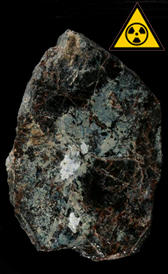
Neptune Ninety-third Element of the Periodic Table
Neptunium (European Portuguese) or Neptune1 (Brazilian Portuguese) (named after the planet Neptune) is a synthetic chemical element of the symbol Np, with atomic number 93 (93 protons and 93 electrons). Its atomic mass is 237.0482 u. At room temperature the neptunium is in a solid state. It is the fourth element of the actinide family.
It is a metallic, radioactive, silver element, belonging to the series of internal transition elements, being the first synthetic transuranic element. Its most stable isotope, Np-237, is a byproduct of nuclear reactors and plutonium production. It can be used in the composition of neutron detection equipment and as a nuclear fuel.
The first neptunium isotope was synthesized at the University of California, Berkeley by Edwin McMillan and Philip Abelson in 1940. Neptunium is found in uranium ores.
History:
Neptune (relative to the planet Neptune) was first discovered by Edwin McMillan and Philip Abelson in 1940. The discovery was made at the University of California, Berkeley, Crocker Radiation Radiation Laboratory, where the team produced the Np neptunium isotope. -239 (2.4 day half-life) bombarding uranium with accelerated neutrons in a cyclotron. It was the first synthetically produced transuranic element and the first element of the transuranic actinide group discovered.
Main Features: Neptunium is a reasonably reactive silver-looking metal. It is found in at least three structural forms:
Alpha neptunium: orthorhombic, density 20250 kg / m³, Beta neptunium (above 280oC): tetragonal, density (313 oC) 19360 kg / m³, Gamma neptunium (above 577oC), cubic, density (600oC) 18000 kg / m³.
This element has 4 ionic oxidation states when in solution:
Np + 3 (pale purple), similar to rare earth ion Pm + 3, Np + 4 (greenish yellow); NpO2 + (bluish green): NpO 2 + 2 (pale pink).
Neptunium has the tri and tetrahalide formulas such as NpF3, NpF4, NpCl4, NpBr3, NpI3, and oxides of various compositions as found in the uranium-oxygen system, including Np3O8 and NpO2.
Applications:
Neutron Detector:. It can be used in the composition of neutron detection equipment. Pu-238 producer: If we radiate neptune-237 with a neutron, it will capture it creating Np-238, which in turn has a half-life of 2.1 days and by negative beta decay decays to Pu-238, being used in thermoelectric generators.
Nuclear Weapon: Neptune is fissile and can theoretically be used in nuclear weapons. In September 2002, researchers at the University of California conducted research programs for the development of weapons of mass destruction using neptunium. They created the first nuclear critical mass using a sphere of neptune-237, which proved superior to plutonium (Pu-239) or uranium (U-235).
Occurrence:
Trace quantities of neptunium are naturally found as a decay product of transmutation reactions in uranium ores. Np-237 is produced by reducing NpF3 with barium or lithium vapor around 1200 ° C and often extracted as a byproduct of plutonium production in a nuclear reactor.
It is a metallic, radioactive, silver element, belonging to the series of internal transition elements, being the first synthetic transuranic element. Its most stable isotope, Np-237, is a byproduct of nuclear reactors and plutonium production. It can be used in the composition of neutron detection equipment and as a nuclear fuel.
The first neptunium isotope was synthesized at the University of California, Berkeley by Edwin McMillan and Philip Abelson in 1940. Neptunium is found in uranium ores.
History:
Neptune (relative to the planet Neptune) was first discovered by Edwin McMillan and Philip Abelson in 1940. The discovery was made at the University of California, Berkeley, Crocker Radiation Radiation Laboratory, where the team produced the Np neptunium isotope. -239 (2.4 day half-life) bombarding uranium with accelerated neutrons in a cyclotron. It was the first synthetically produced transuranic element and the first element of the transuranic actinide group discovered.
Main Features: Neptunium is a reasonably reactive silver-looking metal. It is found in at least three structural forms:
Alpha neptunium: orthorhombic, density 20250 kg / m³, Beta neptunium (above 280oC): tetragonal, density (313 oC) 19360 kg / m³, Gamma neptunium (above 577oC), cubic, density (600oC) 18000 kg / m³.
This element has 4 ionic oxidation states when in solution:
Np + 3 (pale purple), similar to rare earth ion Pm + 3, Np + 4 (greenish yellow); NpO2 + (bluish green): NpO 2 + 2 (pale pink).
Neptunium has the tri and tetrahalide formulas such as NpF3, NpF4, NpCl4, NpBr3, NpI3, and oxides of various compositions as found in the uranium-oxygen system, including Np3O8 and NpO2.
Applications:
Neutron Detector:. It can be used in the composition of neutron detection equipment. Pu-238 producer: If we radiate neptune-237 with a neutron, it will capture it creating Np-238, which in turn has a half-life of 2.1 days and by negative beta decay decays to Pu-238, being used in thermoelectric generators.
Nuclear Weapon: Neptune is fissile and can theoretically be used in nuclear weapons. In September 2002, researchers at the University of California conducted research programs for the development of weapons of mass destruction using neptunium. They created the first nuclear critical mass using a sphere of neptune-237, which proved superior to plutonium (Pu-239) or uranium (U-235).
Occurrence:
Trace quantities of neptunium are naturally found as a decay product of transmutation reactions in uranium ores. Np-237 is produced by reducing NpF3 with barium or lithium vapor around 1200 ° C and often extracted as a byproduct of plutonium production in a nuclear reactor.