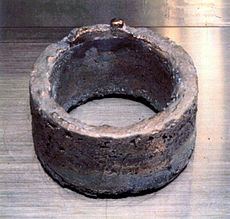
Plutonium Ninety Fourth Element of the Periodic Table
Plutonium (European Portuguese) or Plutonium (Brazilian Portuguese) (named after the celestial body Pluto) is a chemical element represented by the symbol Pu and of atomic number equal to 94 (94 protons and 94 electrons). At room temperature, plutonium is in the solid state. Belonging to the actinide family, it is a white, radioactive, brittle and very dense metal. It has the largest atomic number among the primordial elements, is found in small quantities near uranium ores and is naturally formed by neutron captures of uranium atoms.
Widely used in nuclear weapons, the world's first detonated nuclear weapon in the world in 1945, the Trinity Experiment, used a charge of plutonium at its core, as did the Fat Man, nuclear weapon launched on Nagasaki. It is also used in civil nuclear reactors and radioisotope thermoelectric generator in space probes.
It differs greatly in its physicochemical characteristics with the elements of the rest of the group. It has seven different allotropic forms based on the applied temperature and pressure: α, β, γ, δ, δ ', ε and ζ. Leading to oxidation levels from +2 to +7. Density ranges from allotropic forms from 19.8g / cm³ (α-Pu) to 15.9g / cm³ (δ-Pu).
History:
Discovery:
Enrico Fermi and a team of scientists at the University of Rome reported that they had discovered element 94 in 1934. Fermi called the element hesperium and mentioned the name in his lecture in 1938. The sample was actually a mixture of barium, krypton and other elements, but this was not known at the time, because nuclear fission had not yet been discovered.
Glenn T. Seaborg and his Berkeley team were the first to produce plutonium. Plutonium (specifically, plutonium-238) was first produced and isolated on December 14, 1940, and chemically identified on February 23, 1941 by Glenn T. Seaborg, Edwin McMillan, Joseph William Kennedy, and Arthur Wahl. it was produced by bombardment of uranium by deuterium on a 150 cm cyclotron at the University of California, Berkeley. In the 1940 experiment, Neptunium-238 was created directly by bombardment but deteriorated by beta emission two days later, which indicated the formation of element 94.
A paper documenting the discovery was prepared by the team and submitted to the magazine "Physical Review March 1941. The article was withdrawn prior to publication, following the discovery that an isotope of the new element (plutonium-239) can undergo nuclear fission in a manner that could be useful in an atomic bomb. ”The publication was delayed until a year after the end of World War II due to security concerns.
Edwin McMillan had recently named the first transuranic element after planet Neptune, and suggested that element 94, being the next element in the series, should be named for what was hitherto considered the next planet, Pluto. Seaborg originally considered the name "plutium", but later thought it didn't sound as good as "plutonium." He chose the letters "Pu" as a joke, which went unannounced to the periodic table. Other alternative names considered by Seaborg and others were "ultimium" or "extremium" due to the mistaken belief that they had found the last possible element in the periodic table.
First searches:
Plutonium-based chemistry has been found and resembles uranium after a few months of initial study. Initial research was kept secret at the University of Chicago Metallurgical Laboratory. On August 18, 1942, an amount of this element was isolated and measured for the first time. About 50 micrograms of plutonium-239 combined with uranium fission products was produced and only about 1 microgram was isolated. This sample allowed chemists to determine the weight of the new chemical element.
By 1942 the US had accumulated 500 grams of plutonium salts, and formed three groups of scientists to further analyze the element:
A group of scientists should provide pure plutonium by chemical methods (Los Alamos: JW Kennedy, CS Soares, AC Wahl, CS Garner, IB Johns), Another group that studied plutonium behavior in solutions, including a study of their oxidation states, ionization potentials and reaction kinetics (Berkeley: WM Latimer, ED Eastman, RE Connik, JW Gofman, etc.) And the group, which studied the chemistry of plutonium ion complexes (Iowa: FH Spedding, WH Sullivan, FA Voigt, as Newton), and several other groups of minor influence and importance.
In November 1943, plutonium trifluoride was reduced to create the first sample of metallic plutonium: a few micrograms of metallic plutonium. It was the first artificially synthesized transuranic element with a pure sample visible to the naked eye. The nuclear properties of plutonium-239 were also studied; the researchers found that when it is struck by a neutron it breaks down (fissions) releasing more neutrons and energy. These neutrons can reach other plutonium-239 atoms and so on, and form an exponential chain reaction. This can result in an explosion large enough to destroy a city if the isotope is concentrated enough to form a critical mass.
In the USSR the first experiments to create Pu-239 took place from 1934-1944, under the leadership of intellectuals Igor Kurchatov and B. Khlopin. Before long, the Soviet Union undertook extensive studies on the properties of plutonium. In early 1945, the first cyclotron in Europe was built in 1937 at the Radium Institute, the first plutonium sample was obtained by radiating uranium into the cyclotron. In the city of Ozersk in 1945 began the construction of the first commercial nuclear reactor to produce plutonium, Mayak's first object, which was executed June 19, 1948.
Production during the Manhattan Project:
Manhattan Project Research Locations.
The Manhattan Project began with a letter from Albert Einstein to Franklin Roosevelt, then US President. The letter said of Einstein's concern that Nazi Germany might develop nuclear weapons, so the US made this project to create nuclear weapons. during World War II. The nuclear program project, of which graduated from the Manhattan Project, was approved and established by presidential decree.1. His Manhattan Project activity began on August 12, 1942. His three main goals are:
Plutonium production in the Henfordskogo complex.
Uranium enrichment in Oak Ridge, Tennessee.
Research in the field of nuclear weapons and building an atomic bomb in Los Alamos National Laboratory.
The first Pu reactor that made it possible to obtain it was the Chicago-1, it was commissioned on December 2, 1942. It consisted of 6 tons of metallic uranium, 34 tons of uranium oxide and 400 tons of "black blocks". graphite3. The only thing that could stop the nuclear chain reaction was cadmium bars, which captured good thermal neutrons and, consequently, could prevent the possible occurrence of chain reaction that could cause the facility to detonate. Due to the lack of radiation and cooling protection, its normal capacity was only 200 Watts (very little compared to current reactor power), it allowed to produce much more plutonium than cyclotons, and months later the X-10 reactor ( Chicago-1 continued work on Pu production for the project, but it was found that the percentage of Pu-240 in the plutonium produced by these reactors was large, and it should be separated from Pu-239 by enrichment. to prevent accidental detonation of nuclear weapons. (Note: the reactors were uranium, but neutron captures by U-238 atoms ended up at Pu-239 fissile atoms.)
Trinity and Fat Man:
The form of detonation of plutonium nuclear weapons (by implosion) was not very reliable in detonation, so a test had to be done first to see if it would really work. So an artifact was created just before the use of these weapons in war. Trinity detonated on July 16, 1945, generating 20 kilotons.
Being sure of the success of these weapons, a bomb was soon made to be used in war, the Fat Man, this bomb had three targets, the primary was Kokura, the secondary Nagasaki, Kokura was clouded, and so it was almost certain that the bomb would miss the target. Then the B-29 Superfortress set out for Nagasaki, which although it was also under clouds and winds, soon dissipated, so it was ordered that the city should be attacked. The bomb was dropped but displaced during the fall, falling into a nearby valley and part of the blast was contained, yet the bomb decimated the city.
Availability and production:
Traces of plutonium must naturally exist in uranium minerals, formed similarly to neptune by the action on the uranium of neutrons present.
Artificially, plutonium-239 is produced in nuclear reactors by successive beta decays by U-239 and Np-239 expressed by this equation: \ mathrm {^ {238} _ {\ 92} U \ + \ ^ {1} _ {0} n \ longrightarrow \ ^ {239} _ {\ 92} U \ \ xrightarrow [23.5 \ min] {\ beta ^ -} \ ^ {239} _ {\ 93} Np \ \ xrightarrow [2.3565 \ d] {\ beta ^ -} \ ^ {239} _ {\ 94} Pu}
Pu-238 used in radioisotope thermoelectric generators, was the first to be synthesized, it is created when U-238 is bombarded by a deuterium producing neptune (intermediate) and then Pu-238. \ mathrm {^ {238} _ {\ 92} U \ + \ ^ {2} _ {1} D \ \ longrightarrow \ ^ {238} _ {\ 93} Np \ + \ 2 \ ^ {1} _ { 0} n \ quad; \ quad ^ {238} _ {\ 93} Np \ \ xrightarrow [2,117 \ d] {\ beta ^ -} \ ^ {238} _ {\ 94} Pu}
Other isotopes are produced when Pu-239 captures a neutron but does not undergo nuclear fission.
Properties:
Physical:
Plutonium, like most metals, has a bright silver appearance at first, as does nickel 45, but very quickly oxidizes to a grayish color, although olive and yellow are also reported in this case. At room temperature plutonium is in its alpha (α) allotropic form, this is the most common allotropic form among the elements, in this form it is as hard and brittle as cast iron unless it binds to other elements to stay softer and ductile. Like uranium, it is a poor conductor of electricity and heat.6 It has a low melting point (640 ° C) and an unusually high boiling point (3327 ° C).
Alpha decay is the main form of plutonium decay, alpha emission boils down to the release of a fully ionized (electron-less) Helium-4 nucleus so that the parent atom can stabilize by having its mass reduced to 4 atomic masses. . Every 5 kg of Pu-239 mass, there are about 12.5 × 1024 atoms. With a half-life of 24,100 years, about 11.5 × 10¹² atoms undergo alpha decay every second, emitting 5.157 MeV of energy for each alpha particle. This equates to 9.68 watts of power. The heat produced by the deceleration of these alpha particles will make it hot to the touch7.
Widely used in nuclear weapons, the world's first detonated nuclear weapon in the world in 1945, the Trinity Experiment, used a charge of plutonium at its core, as did the Fat Man, nuclear weapon launched on Nagasaki. It is also used in civil nuclear reactors and radioisotope thermoelectric generator in space probes.
It differs greatly in its physicochemical characteristics with the elements of the rest of the group. It has seven different allotropic forms based on the applied temperature and pressure: α, β, γ, δ, δ ', ε and ζ. Leading to oxidation levels from +2 to +7. Density ranges from allotropic forms from 19.8g / cm³ (α-Pu) to 15.9g / cm³ (δ-Pu).
History:
Discovery:
Enrico Fermi and a team of scientists at the University of Rome reported that they had discovered element 94 in 1934. Fermi called the element hesperium and mentioned the name in his lecture in 1938. The sample was actually a mixture of barium, krypton and other elements, but this was not known at the time, because nuclear fission had not yet been discovered.
Glenn T. Seaborg and his Berkeley team were the first to produce plutonium. Plutonium (specifically, plutonium-238) was first produced and isolated on December 14, 1940, and chemically identified on February 23, 1941 by Glenn T. Seaborg, Edwin McMillan, Joseph William Kennedy, and Arthur Wahl. it was produced by bombardment of uranium by deuterium on a 150 cm cyclotron at the University of California, Berkeley. In the 1940 experiment, Neptunium-238 was created directly by bombardment but deteriorated by beta emission two days later, which indicated the formation of element 94.
A paper documenting the discovery was prepared by the team and submitted to the magazine "Physical Review March 1941. The article was withdrawn prior to publication, following the discovery that an isotope of the new element (plutonium-239) can undergo nuclear fission in a manner that could be useful in an atomic bomb. ”The publication was delayed until a year after the end of World War II due to security concerns.
Edwin McMillan had recently named the first transuranic element after planet Neptune, and suggested that element 94, being the next element in the series, should be named for what was hitherto considered the next planet, Pluto. Seaborg originally considered the name "plutium", but later thought it didn't sound as good as "plutonium." He chose the letters "Pu" as a joke, which went unannounced to the periodic table. Other alternative names considered by Seaborg and others were "ultimium" or "extremium" due to the mistaken belief that they had found the last possible element in the periodic table.
First searches:
Plutonium-based chemistry has been found and resembles uranium after a few months of initial study. Initial research was kept secret at the University of Chicago Metallurgical Laboratory. On August 18, 1942, an amount of this element was isolated and measured for the first time. About 50 micrograms of plutonium-239 combined with uranium fission products was produced and only about 1 microgram was isolated. This sample allowed chemists to determine the weight of the new chemical element.
By 1942 the US had accumulated 500 grams of plutonium salts, and formed three groups of scientists to further analyze the element:
A group of scientists should provide pure plutonium by chemical methods (Los Alamos: JW Kennedy, CS Soares, AC Wahl, CS Garner, IB Johns), Another group that studied plutonium behavior in solutions, including a study of their oxidation states, ionization potentials and reaction kinetics (Berkeley: WM Latimer, ED Eastman, RE Connik, JW Gofman, etc.) And the group, which studied the chemistry of plutonium ion complexes (Iowa: FH Spedding, WH Sullivan, FA Voigt, as Newton), and several other groups of minor influence and importance.
In November 1943, plutonium trifluoride was reduced to create the first sample of metallic plutonium: a few micrograms of metallic plutonium. It was the first artificially synthesized transuranic element with a pure sample visible to the naked eye. The nuclear properties of plutonium-239 were also studied; the researchers found that when it is struck by a neutron it breaks down (fissions) releasing more neutrons and energy. These neutrons can reach other plutonium-239 atoms and so on, and form an exponential chain reaction. This can result in an explosion large enough to destroy a city if the isotope is concentrated enough to form a critical mass.
In the USSR the first experiments to create Pu-239 took place from 1934-1944, under the leadership of intellectuals Igor Kurchatov and B. Khlopin. Before long, the Soviet Union undertook extensive studies on the properties of plutonium. In early 1945, the first cyclotron in Europe was built in 1937 at the Radium Institute, the first plutonium sample was obtained by radiating uranium into the cyclotron. In the city of Ozersk in 1945 began the construction of the first commercial nuclear reactor to produce plutonium, Mayak's first object, which was executed June 19, 1948.
Production during the Manhattan Project:
Manhattan Project Research Locations.
The Manhattan Project began with a letter from Albert Einstein to Franklin Roosevelt, then US President. The letter said of Einstein's concern that Nazi Germany might develop nuclear weapons, so the US made this project to create nuclear weapons. during World War II. The nuclear program project, of which graduated from the Manhattan Project, was approved and established by presidential decree.1. His Manhattan Project activity began on August 12, 1942. His three main goals are:
Plutonium production in the Henfordskogo complex.
Uranium enrichment in Oak Ridge, Tennessee.
Research in the field of nuclear weapons and building an atomic bomb in Los Alamos National Laboratory.
The first Pu reactor that made it possible to obtain it was the Chicago-1, it was commissioned on December 2, 1942. It consisted of 6 tons of metallic uranium, 34 tons of uranium oxide and 400 tons of "black blocks". graphite3. The only thing that could stop the nuclear chain reaction was cadmium bars, which captured good thermal neutrons and, consequently, could prevent the possible occurrence of chain reaction that could cause the facility to detonate. Due to the lack of radiation and cooling protection, its normal capacity was only 200 Watts (very little compared to current reactor power), it allowed to produce much more plutonium than cyclotons, and months later the X-10 reactor ( Chicago-1 continued work on Pu production for the project, but it was found that the percentage of Pu-240 in the plutonium produced by these reactors was large, and it should be separated from Pu-239 by enrichment. to prevent accidental detonation of nuclear weapons. (Note: the reactors were uranium, but neutron captures by U-238 atoms ended up at Pu-239 fissile atoms.)
Trinity and Fat Man:
The form of detonation of plutonium nuclear weapons (by implosion) was not very reliable in detonation, so a test had to be done first to see if it would really work. So an artifact was created just before the use of these weapons in war. Trinity detonated on July 16, 1945, generating 20 kilotons.
Being sure of the success of these weapons, a bomb was soon made to be used in war, the Fat Man, this bomb had three targets, the primary was Kokura, the secondary Nagasaki, Kokura was clouded, and so it was almost certain that the bomb would miss the target. Then the B-29 Superfortress set out for Nagasaki, which although it was also under clouds and winds, soon dissipated, so it was ordered that the city should be attacked. The bomb was dropped but displaced during the fall, falling into a nearby valley and part of the blast was contained, yet the bomb decimated the city.
Availability and production:
Traces of plutonium must naturally exist in uranium minerals, formed similarly to neptune by the action on the uranium of neutrons present.
Artificially, plutonium-239 is produced in nuclear reactors by successive beta decays by U-239 and Np-239 expressed by this equation: \ mathrm {^ {238} _ {\ 92} U \ + \ ^ {1} _ {0} n \ longrightarrow \ ^ {239} _ {\ 92} U \ \ xrightarrow [23.5 \ min] {\ beta ^ -} \ ^ {239} _ {\ 93} Np \ \ xrightarrow [2.3565 \ d] {\ beta ^ -} \ ^ {239} _ {\ 94} Pu}
Pu-238 used in radioisotope thermoelectric generators, was the first to be synthesized, it is created when U-238 is bombarded by a deuterium producing neptune (intermediate) and then Pu-238. \ mathrm {^ {238} _ {\ 92} U \ + \ ^ {2} _ {1} D \ \ longrightarrow \ ^ {238} _ {\ 93} Np \ + \ 2 \ ^ {1} _ { 0} n \ quad; \ quad ^ {238} _ {\ 93} Np \ \ xrightarrow [2,117 \ d] {\ beta ^ -} \ ^ {238} _ {\ 94} Pu}
Other isotopes are produced when Pu-239 captures a neutron but does not undergo nuclear fission.
Properties:
Physical:
Plutonium, like most metals, has a bright silver appearance at first, as does nickel 45, but very quickly oxidizes to a grayish color, although olive and yellow are also reported in this case. At room temperature plutonium is in its alpha (α) allotropic form, this is the most common allotropic form among the elements, in this form it is as hard and brittle as cast iron unless it binds to other elements to stay softer and ductile. Like uranium, it is a poor conductor of electricity and heat.6 It has a low melting point (640 ° C) and an unusually high boiling point (3327 ° C).
Alpha decay is the main form of plutonium decay, alpha emission boils down to the release of a fully ionized (electron-less) Helium-4 nucleus so that the parent atom can stabilize by having its mass reduced to 4 atomic masses. . Every 5 kg of Pu-239 mass, there are about 12.5 × 1024 atoms. With a half-life of 24,100 years, about 11.5 × 10¹² atoms undergo alpha decay every second, emitting 5.157 MeV of energy for each alpha particle. This equates to 9.68 watts of power. The heat produced by the deceleration of these alpha particles will make it hot to the touch7.