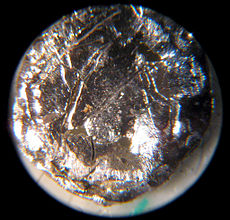
Americium Ninety-fifth Element of the Periodic Table
Americium (named after the American Continent) is a chemical element, symbol Am, atomic number 95 (95 protons and 95 electrons) with atomic mass [243] u, located in the actinide group in the periodic table of elements. All its isotopes are radioactive. At room temperature, americium is in the solid state.
It was discovered in 1944 by Glenn T. Seaborg, Leon O. Morgan, Ralph A. James and Albert Ghiorso, synthesized from plutonium.
Am-241 is used in some types of smoke detector, and as a source of gamma rays and neutrons that can be used in radiography.
History:
Americium was first synthesized by Glenn T. Seaborg, Leon O. Morgan, Ralph A. James, and Albert Ghiorso in 1944 at the University of Chicago Metallurgy Laboratory (now known as the Argonne National Laboratory). The team created the isotope Am-241 by subjecting plutonium -239 to successive electron capture reactions in a nuclear reactor. This process created Pu -240 and then Pu-241, which in turn decayed to Am-241 by beta decay.1 2
Americium was the fourth transuranic element to be discovered after neptunium, plutonium and the heaviest curium. With the discovery of the new element Seaborg restructured the periodic table as it now stands with the actinide line below that of the lanthanides, Seaborg noted that the new element was just below the europium, with which the americium shares many physicochemical characteristics,
Occurrence:
Americium does not exist in nature. It is a synthetic transuranic element obtained from plutonium in a nuclear reactor.
Main Features: The newly obtained Americium metal has a shiny silver-white appearance (more silver than plutonium or neptunium), slowly fading in the presence of dry air at room temperature. The alpha emission of Am-241 is approximately three times higher than that of radio. The Am-241 also features intense gamma ray emission.
Applications:
Smoke Detector:
This element can be produced in kilogram quantities, mostly the isotope Am-241, as it is easier to obtain relatively pure samples. Americium is used in some smoke detectors containing tiny amounts of Am-241 as a source of ionizing radiation in the form of americium dioxide. Am-241 has also been used as a portable gamma ray source for use in radiography. The element was also used to calibrate the glass thickness, allowing to obtain very flat glasses. Am-242 is a neutron emitter used in neutron radiography. However, this isotope is extremely expensive to produce in usable quantities.
It was discovered in 1944 by Glenn T. Seaborg, Leon O. Morgan, Ralph A. James and Albert Ghiorso, synthesized from plutonium.
Am-241 is used in some types of smoke detector, and as a source of gamma rays and neutrons that can be used in radiography.
History:
Americium was first synthesized by Glenn T. Seaborg, Leon O. Morgan, Ralph A. James, and Albert Ghiorso in 1944 at the University of Chicago Metallurgy Laboratory (now known as the Argonne National Laboratory). The team created the isotope Am-241 by subjecting plutonium -239 to successive electron capture reactions in a nuclear reactor. This process created Pu -240 and then Pu-241, which in turn decayed to Am-241 by beta decay.1 2
Americium was the fourth transuranic element to be discovered after neptunium, plutonium and the heaviest curium. With the discovery of the new element Seaborg restructured the periodic table as it now stands with the actinide line below that of the lanthanides, Seaborg noted that the new element was just below the europium, with which the americium shares many physicochemical characteristics,
Occurrence:
Americium does not exist in nature. It is a synthetic transuranic element obtained from plutonium in a nuclear reactor.
Main Features: The newly obtained Americium metal has a shiny silver-white appearance (more silver than plutonium or neptunium), slowly fading in the presence of dry air at room temperature. The alpha emission of Am-241 is approximately three times higher than that of radio. The Am-241 also features intense gamma ray emission.
Applications:
Smoke Detector:
This element can be produced in kilogram quantities, mostly the isotope Am-241, as it is easier to obtain relatively pure samples. Americium is used in some smoke detectors containing tiny amounts of Am-241 as a source of ionizing radiation in the form of americium dioxide. Am-241 has also been used as a portable gamma ray source for use in radiography. The element was also used to calibrate the glass thickness, allowing to obtain very flat glasses. Am-242 is a neutron emitter used in neutron radiography. However, this isotope is extremely expensive to produce in usable quantities.