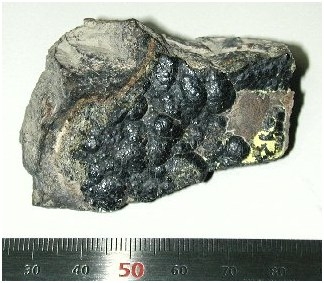
Protactinium Ninety First Periodic Table Element
Protactinium is a chemical element of symbol Pa and of atomic number 91 (91 protons and 91 electrons), with an approximate atomic mass of 231.0 u. At room temperature, the protactinium is in the solid state. There is currently no use for protactin outside the scope of basic scientific research. It was first identified in 1913 by Kasimir Fajans and O. H. Göhring.
History:
Protactinium (from the Greek "protos", "first") was first identified in 1913 when Kasimir Fajans and OH Göhring found the short-lived isotope 234m-Pa with a half-life of approximately 1.17 minutes during their studies on the U-238 decay series. They named the new element "Brevium" (from Latin "brevis", "brev"). The name was changed to "Protoactinium" ("protoactinium") in 1918 when two groups of scientists (Otto Hahn and Lise Meitner in Germany, and Frederick Soddy and John Cranston in the United Kingdom) independently discovered 231-Pa. In 1949, the name was abbreviated to "protactinium".
In 1927, Aristid V. Grosse prepared 2 mg Pa2O5, from which protactinium was isolated. In 1934, it was isolated for the first time from 0.1 mg Pa2O5, first converting the oxide to iodide and then electrically decomposing the iodide using a high vacuum heated filament, according to the reaction:
2PaI5 → 2Pa + 5I2.
It can be recovered from uranium minerals by solvent extraction. The obtained PaF4 is reduced with barium.
In 1961, in the United Kingdom, 125 grams of 99.9% pure protactinium was produced, processing 60 tonnes of uranium ore. This was the only source of protactinium in the world for many years to come.
Key Features:
Protactinium is a silver metallic element that belongs to the actinide group, with a shiny metallic luster that remains in the air for a few hours. Becomes a superconductor at temperatures below 1.4K.
Applications:
Due to its scarcity, high radioactivity and toxicity, there is currently no use for protactinium outside the scope of basic scientific research.
Occurrence:
Protactin is a product of fission of thorium, plutonium and uranium. It is the rarest of the naturally occurring elements.
Protactin occurs in pechblenda in the ratio of 1 part Pa-231 to 10 million parts of ore. Zaire ores are about 3 ppm. Protactin is one of the rarest and most expensive elements.
History:
Protactinium (from the Greek "protos", "first") was first identified in 1913 when Kasimir Fajans and OH Göhring found the short-lived isotope 234m-Pa with a half-life of approximately 1.17 minutes during their studies on the U-238 decay series. They named the new element "Brevium" (from Latin "brevis", "brev"). The name was changed to "Protoactinium" ("protoactinium") in 1918 when two groups of scientists (Otto Hahn and Lise Meitner in Germany, and Frederick Soddy and John Cranston in the United Kingdom) independently discovered 231-Pa. In 1949, the name was abbreviated to "protactinium".
In 1927, Aristid V. Grosse prepared 2 mg Pa2O5, from which protactinium was isolated. In 1934, it was isolated for the first time from 0.1 mg Pa2O5, first converting the oxide to iodide and then electrically decomposing the iodide using a high vacuum heated filament, according to the reaction:
2PaI5 → 2Pa + 5I2.
It can be recovered from uranium minerals by solvent extraction. The obtained PaF4 is reduced with barium.
In 1961, in the United Kingdom, 125 grams of 99.9% pure protactinium was produced, processing 60 tonnes of uranium ore. This was the only source of protactinium in the world for many years to come.
Key Features:
Protactinium is a silver metallic element that belongs to the actinide group, with a shiny metallic luster that remains in the air for a few hours. Becomes a superconductor at temperatures below 1.4K.
Applications:
Due to its scarcity, high radioactivity and toxicity, there is currently no use for protactinium outside the scope of basic scientific research.
Occurrence:
Protactin is a product of fission of thorium, plutonium and uranium. It is the rarest of the naturally occurring elements.
Protactin occurs in pechblenda in the ratio of 1 part Pa-231 to 10 million parts of ore. Zaire ores are about 3 ppm. Protactin is one of the rarest and most expensive elements.