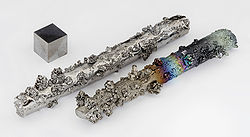
Tungsten Seventy-fourth Element of the Periodic Table
Tungsten (Brazilian Portuguese) or Tungsten (European Portuguese) (also known as wolfram or wolfram) is a chemical element of symbol W and atomic number 74.
A gray white metal under standard conditions, when not combined, tungsten is found in nature only combined with other elements. It was identified as a new element in 1781, and was first isolated as metal in 1783. Its most important ores are wolframite and scheelite. The free element is notable for its robustness, especially because it has the highest melting point of all metals and the second highest of all elements after carbon. Also notable is its high density, 19.3 times higher than water, comparable to uranium and gold, and much higher (about 1.7 times) than lead.1 Tungsten with small amounts of Impurities are often brittle and hard, making it difficult to work with. However, very pure tungsten is more ductile, and can be cut with a metal saw.3
The uncombined elemental form is mainly used in electronic applications. The many tungsten alloys have numerous applications, including incandescent lamp filaments, X-ray tubes (as filament and as target), and superalloys. Tungsten's hardness and high density make it useful in military applications such as penetrating projectiles. Tungsten compounds are generally used industrially as catalysts.
Tungsten is the only third transition metal known to occur in biomolecules used by some species of bacteria. It is the heaviest element known to be used by living things. However, tungsten interferes with molybdenum and copper metabolism and is somewhat toxic to animal life.
History:
The first reports known today to refer to occurrences of this element date back to the 16th century. At that time, miners extracting tin ore in the Metalliferous Hills reported the existence of a mineral that accompanied tin ore and reduced the extraction efficiency of this metal from ore. Johann Gottlob Lehmann, in 1761, was the first to fuse pure crystals of wolframite into sodium nitrate.6
The existence of tungsten would be first proposed in 1779 by Peter Woulfe, who after examining the wolframite, concluded that this mineral contained a new substance.7 In 1781 Carl Wilhelm Scheele discovered that a new acid, tungstic acid, could be obtained from scheelite (then called tungstenite).
Scheele and Torbern Bergman suggested that it could be A new metal can be obtained by reducing this acid.8 In 1783, Juan José and Fausto Delhuyar discovered an acid obtained from wolframite that was identical to tungstic acid. Later that same year, in Spain, the brothers were able to isolate tungsten by reducing its acid with charcoal, and they were credited with discovering this element, published in September 1783 in the work Analisis chemico del volfram, y examen de a new metal, which comes into your composition.6 9
Early applications of tungsten began to be developed in the mid-nineteenth century, chemistry (1847) and steel (1855), and in the early twentieth century, filaments (1903) and carbides (1913).
During World War II, tungsten played a significant role in backstage political business. Portugal, as the main European producer of the element, was pressured by both sides due to its deposits of wolframite ore. Tungsten's high temperature resistance and its ability to increase the strength of alloys made it an important raw material for the armaments industry.
Etymology:
The term "tungsten" originates from the Norse tung sten meaning "heavy stone", used by Axel Fredrik Cronstedt in 1757 to designate the mineral today called scheelite, discovered in Sweden in 1750.6 It is used in many languages as the name of this element. .
The term "wolfram" (or "wolfram"), used in many European languages (mainly Slavic and Germanic languages), derives from the mineral wolframite. This, in turn, derives from the German "wolf rahm" ("wolf soot", "wolf cream"), the name given to tungsten by Johan Gottschalk Wallerius in 1747, and from which also derived the chemical symbol of the element, W.3 "Wolf rahm" in turn derives from "Lupi spuma", the name used by Georg Agricola for this element in 1546, translated into "foam" or "wolf cream" (the etymology is not certain), and is a reference to the large amounts of tin lost in the extraction of this metal due to the presence of wolframite in the tin-containing ore.11
Features: Physical properties:
Tungsten in its impure form is a white to gray metal, often fragile and difficult to work with, but when pure it can be easily worked.3 It can be cut with a metal saw, forged, drawn, extruded or sintered. Among all metals in pure form, tungsten has the highest melting point (3,422 ° C), the lowest vapor pressure and (at temperatures above 1,650 ° C) the highest tensile strength.12 Has the lowest coefficient of thermal expansion among all pure metals. The small thermal expansion and high melting point and resistance of tungsten are due to the strong covalent bonds formed between tungsten atoms by electrons 5d.13 The binding of small amounts of tungsten to steel greatly increases the resistance of tungsten.1
Tungsten, when exposed to air, forms on its surface a protective oxide (always tungsten trioxide, WO3) when formed between 327 and 400 ° C, but can be oxidized at a high temperature.14
Chemical Properties:
Elemental tungsten is resistant to attack by acids, bases and oxygen.15 16 The most common oxidation state of tungsten is +6, but it exhibits all oxidation states from −2 to +6.15 The typical combination of tungsten is oxygen , forming yellow tungsten trioxide, WO3, soluble in alkaline aqueous solutions yielding tungstate ions, WO42-. Tungsten carbides (W2C and WC) are produced by heating powdered tungsten with carbon. W2C is resistant to chemical attack, although it reacts strongly with chlorine to form tungsten hexachloride (WCl6) .1
In aqueous solution, tungstate gives rise to heteropoly acids and polyoxometalate anions under neutral or acidic conditions. As tungstate is subjected to acid, "paratungstate A", a soluble and metastable ion, W7O24-6, which eventually becomes the less soluble anion "paratungstate B", H2W12O42-10.17 Additional acidification produces the very soluble metatungstate anion, H2W12O40-6, after which equilibrium is reached. The metatungstate ion exists as a symmetrical cluster of twelve tungsten-oxygen octahedra known as the Keggin anion. Many other anions exist as metastable species.
The inclusion of a different atom such as phosphorus in place of the two central hydrogens of metatungstate produces a wide variety of heteropoly acids such as phosphotungstic acid (H3PW12O40).
Tungsten trioxide can form intercalating compounds with alkali metals. These compounds are known as bronzes; An example is sodium tungsten bronze.
Occurrence and production:
Tungsten is found in the minerals wolframite (iron manganese tungstate, FeWO4 / MnWO4), scheelite (calcium tungstate, CaWO4), ferberite, stolzite and hubnerite. Important deposits of these minerals are located in Bolivia, California and Colorado (United States), China, Austria, Portugal (Panasqueira Mine), Russia and South Korea (with China producing approximately 75% of demand). worldwide).
A gray white metal under standard conditions, when not combined, tungsten is found in nature only combined with other elements. It was identified as a new element in 1781, and was first isolated as metal in 1783. Its most important ores are wolframite and scheelite. The free element is notable for its robustness, especially because it has the highest melting point of all metals and the second highest of all elements after carbon. Also notable is its high density, 19.3 times higher than water, comparable to uranium and gold, and much higher (about 1.7 times) than lead.1 Tungsten with small amounts of Impurities are often brittle and hard, making it difficult to work with. However, very pure tungsten is more ductile, and can be cut with a metal saw.3
The uncombined elemental form is mainly used in electronic applications. The many tungsten alloys have numerous applications, including incandescent lamp filaments, X-ray tubes (as filament and as target), and superalloys. Tungsten's hardness and high density make it useful in military applications such as penetrating projectiles. Tungsten compounds are generally used industrially as catalysts.
Tungsten is the only third transition metal known to occur in biomolecules used by some species of bacteria. It is the heaviest element known to be used by living things. However, tungsten interferes with molybdenum and copper metabolism and is somewhat toxic to animal life.
History:
The first reports known today to refer to occurrences of this element date back to the 16th century. At that time, miners extracting tin ore in the Metalliferous Hills reported the existence of a mineral that accompanied tin ore and reduced the extraction efficiency of this metal from ore. Johann Gottlob Lehmann, in 1761, was the first to fuse pure crystals of wolframite into sodium nitrate.6
The existence of tungsten would be first proposed in 1779 by Peter Woulfe, who after examining the wolframite, concluded that this mineral contained a new substance.7 In 1781 Carl Wilhelm Scheele discovered that a new acid, tungstic acid, could be obtained from scheelite (then called tungstenite).
Scheele and Torbern Bergman suggested that it could be A new metal can be obtained by reducing this acid.8 In 1783, Juan José and Fausto Delhuyar discovered an acid obtained from wolframite that was identical to tungstic acid. Later that same year, in Spain, the brothers were able to isolate tungsten by reducing its acid with charcoal, and they were credited with discovering this element, published in September 1783 in the work Analisis chemico del volfram, y examen de a new metal, which comes into your composition.6 9
Early applications of tungsten began to be developed in the mid-nineteenth century, chemistry (1847) and steel (1855), and in the early twentieth century, filaments (1903) and carbides (1913).
During World War II, tungsten played a significant role in backstage political business. Portugal, as the main European producer of the element, was pressured by both sides due to its deposits of wolframite ore. Tungsten's high temperature resistance and its ability to increase the strength of alloys made it an important raw material for the armaments industry.
Etymology:
The term "tungsten" originates from the Norse tung sten meaning "heavy stone", used by Axel Fredrik Cronstedt in 1757 to designate the mineral today called scheelite, discovered in Sweden in 1750.6 It is used in many languages as the name of this element. .
The term "wolfram" (or "wolfram"), used in many European languages (mainly Slavic and Germanic languages), derives from the mineral wolframite. This, in turn, derives from the German "wolf rahm" ("wolf soot", "wolf cream"), the name given to tungsten by Johan Gottschalk Wallerius in 1747, and from which also derived the chemical symbol of the element, W.3 "Wolf rahm" in turn derives from "Lupi spuma", the name used by Georg Agricola for this element in 1546, translated into "foam" or "wolf cream" (the etymology is not certain), and is a reference to the large amounts of tin lost in the extraction of this metal due to the presence of wolframite in the tin-containing ore.11
Features: Physical properties:
Tungsten in its impure form is a white to gray metal, often fragile and difficult to work with, but when pure it can be easily worked.3 It can be cut with a metal saw, forged, drawn, extruded or sintered. Among all metals in pure form, tungsten has the highest melting point (3,422 ° C), the lowest vapor pressure and (at temperatures above 1,650 ° C) the highest tensile strength.12 Has the lowest coefficient of thermal expansion among all pure metals. The small thermal expansion and high melting point and resistance of tungsten are due to the strong covalent bonds formed between tungsten atoms by electrons 5d.13 The binding of small amounts of tungsten to steel greatly increases the resistance of tungsten.1
Tungsten, when exposed to air, forms on its surface a protective oxide (always tungsten trioxide, WO3) when formed between 327 and 400 ° C, but can be oxidized at a high temperature.14
Chemical Properties:
Elemental tungsten is resistant to attack by acids, bases and oxygen.15 16 The most common oxidation state of tungsten is +6, but it exhibits all oxidation states from −2 to +6.15 The typical combination of tungsten is oxygen , forming yellow tungsten trioxide, WO3, soluble in alkaline aqueous solutions yielding tungstate ions, WO42-. Tungsten carbides (W2C and WC) are produced by heating powdered tungsten with carbon. W2C is resistant to chemical attack, although it reacts strongly with chlorine to form tungsten hexachloride (WCl6) .1
In aqueous solution, tungstate gives rise to heteropoly acids and polyoxometalate anions under neutral or acidic conditions. As tungstate is subjected to acid, "paratungstate A", a soluble and metastable ion, W7O24-6, which eventually becomes the less soluble anion "paratungstate B", H2W12O42-10.17 Additional acidification produces the very soluble metatungstate anion, H2W12O40-6, after which equilibrium is reached. The metatungstate ion exists as a symmetrical cluster of twelve tungsten-oxygen octahedra known as the Keggin anion. Many other anions exist as metastable species.
The inclusion of a different atom such as phosphorus in place of the two central hydrogens of metatungstate produces a wide variety of heteropoly acids such as phosphotungstic acid (H3PW12O40).
Tungsten trioxide can form intercalating compounds with alkali metals. These compounds are known as bronzes; An example is sodium tungsten bronze.
Occurrence and production:
Tungsten is found in the minerals wolframite (iron manganese tungstate, FeWO4 / MnWO4), scheelite (calcium tungstate, CaWO4), ferberite, stolzite and hubnerite. Important deposits of these minerals are located in Bolivia, California and Colorado (United States), China, Austria, Portugal (Panasqueira Mine), Russia and South Korea (with China producing approximately 75% of demand). worldwide).