Tantalum Seventy-third Periodic Table Element
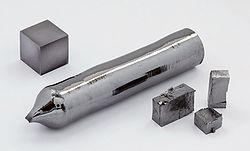
Tantalum (preferred form in Portugal and Brazil) or tantalum is a chemical element of atomic number 73 (73 protons and 73 electrons), Ta symbol with atomic mass 181 u which is in group 5 (VB) of the periodic classification of the elements. It is a rare, hard, gray-blue transition metal that has a metallic luster and resists corrosion very well. At room temperature tantalum is in the solid state.
It is found in tantalite mineral. Physiologically inert, so that, among its various applications, it can be employed for the manufacture of surgical instruments and implants.
It was discovered in 1802 by Anders Gustaf Ekeberg in minerals from Sweden and Finland and isolated by Jons Berzelius in 1820.
History:
Tantalum (from the Greek "Tantalum", father of "Nobe" in Greek mythology) was discovered in 1802 by Anders G. Ekeberg in minerals from Sweden (Ytterby) and Finland (Kimito) and isolated in 1820 by Jons Berzelius. Until 1844 many chemists believed that niobium and tantalum were the same element. Researchers Rowe (1944) and Jean Charles Galissard de Marignac (1866) demonstrated that niobic and tantalic acids were different compounds. Later the researchers were able to isolate only the impure metal, and the first relatively pure ductile metal was produced by Werner von Bolton in 1903. In 1922, an engineer at a Chicago (United States) plant was able to industrially obtain 99.9% tantalum. of purity. Filaments made with tantalum metal were used in incandescent light bulbs until replaced by tungsten.
Its name is derived from the character Tantalus, (son of Zeus and father of Niobe, of Greek mythology) who, for displeasing the gods, was condemned to be eternally hungry and thirsty plunged to his neck under a loaded tree. of fruits. When it bent to drink, the water drained, and when it raised its hands to gather fruit, the branches moved out of reach. This similarity to the unreactive behavior of tantalum - being between reagents and unaffected by them - was the origin of its name.
Main Features: Tantalum is a gray, heavy, ductile, very hard metal, resistant to acid corrosion and a good conductor of heat and electricity. At temperatures below 150 ° C, tantalum is almost completely immune to chemical attack, even by aggressive royal water. It is only attacked by hydrofluoric acid, acid containing the fluoride ion or by alkaline fusion. The element has a melting point only lower than that of tungsten and rhenium. Tantalum has the highest capacitance by volume of all substances.
It resembles niobium and can be found in the columbite-tantalite minerals. Reaches the maximum oxidation state of the group: +5.
Applications:
The main use of tantalum is as oxide, a dielectric material, for the production of electronic components, mainly capacitors, which are very small in relation to their capacity. Because of this size and weight advantage the main uses for tantalum capacitors include telephones, pagers, personal computers, and automotive electronics.
Tantalum is also used to produce a series of alloys that have high melting points, high strength and good ductility. Carbon tantalum, a type of very hard carbide, is used to produce cutting tools, drills and drawing machines. Superalloy tantalum is used to produce jet engine components, chemical process equipment, missile parts and nuclear reactors. Tantalum filaments are used for the evaporation of other metals such as aluminum.
Being non-irritating and completely immune to the action of body fluids, it is used extensively to produce surgical equipment and implants in medicine and dentistry. Tantalum oxide is used to increase the refractive index of special glasses for camera lenses. Metal is also used to produce electrolytic parts from vacuum furnaces.
Occurrence:
It occurs mainly in the tantalite mineral ((Fe, Mn) Ta2O6], euxenite and other minerals such as samarskite and fergusonite.Tantalite is found mostly mixed with columbite.
The largest producer of tantalum is Australia. Other major producers are Brazil and Canada (as a byproduct of niobium mining); Thailand and Malaysia (as a byproduct of cassiterite mining); China, Ethiopia and Mozambique. Future sources of tantalum supply are being explored in Saudi Arabia, Egypt, Greenland, the United States, and Finland, as well as countries already mentioned above. Tantalum is estimated to make up about 1 or 2 ppm of the earth's crust by weight.
Tantalum is almost always found in minerals associated with niobium. Several complicated steps are involved in separating these two elements. Commercially tantalum production can follow one of several methods: electrolysis of fused potassium fluortantalate; Reduction of potassium fluortantalate with sodium; Reacting Tantalum Carbide with Tantalum Oxide; As a byproduct of tin extraction.
It is found in tantalite mineral. Physiologically inert, so that, among its various applications, it can be employed for the manufacture of surgical instruments and implants.
It was discovered in 1802 by Anders Gustaf Ekeberg in minerals from Sweden and Finland and isolated by Jons Berzelius in 1820.
History:
Tantalum (from the Greek "Tantalum", father of "Nobe" in Greek mythology) was discovered in 1802 by Anders G. Ekeberg in minerals from Sweden (Ytterby) and Finland (Kimito) and isolated in 1820 by Jons Berzelius. Until 1844 many chemists believed that niobium and tantalum were the same element. Researchers Rowe (1944) and Jean Charles Galissard de Marignac (1866) demonstrated that niobic and tantalic acids were different compounds. Later the researchers were able to isolate only the impure metal, and the first relatively pure ductile metal was produced by Werner von Bolton in 1903. In 1922, an engineer at a Chicago (United States) plant was able to industrially obtain 99.9% tantalum. of purity. Filaments made with tantalum metal were used in incandescent light bulbs until replaced by tungsten.
Its name is derived from the character Tantalus, (son of Zeus and father of Niobe, of Greek mythology) who, for displeasing the gods, was condemned to be eternally hungry and thirsty plunged to his neck under a loaded tree. of fruits. When it bent to drink, the water drained, and when it raised its hands to gather fruit, the branches moved out of reach. This similarity to the unreactive behavior of tantalum - being between reagents and unaffected by them - was the origin of its name.
Main Features: Tantalum is a gray, heavy, ductile, very hard metal, resistant to acid corrosion and a good conductor of heat and electricity. At temperatures below 150 ° C, tantalum is almost completely immune to chemical attack, even by aggressive royal water. It is only attacked by hydrofluoric acid, acid containing the fluoride ion or by alkaline fusion. The element has a melting point only lower than that of tungsten and rhenium. Tantalum has the highest capacitance by volume of all substances.
It resembles niobium and can be found in the columbite-tantalite minerals. Reaches the maximum oxidation state of the group: +5.
Applications:
The main use of tantalum is as oxide, a dielectric material, for the production of electronic components, mainly capacitors, which are very small in relation to their capacity. Because of this size and weight advantage the main uses for tantalum capacitors include telephones, pagers, personal computers, and automotive electronics.
Tantalum is also used to produce a series of alloys that have high melting points, high strength and good ductility. Carbon tantalum, a type of very hard carbide, is used to produce cutting tools, drills and drawing machines. Superalloy tantalum is used to produce jet engine components, chemical process equipment, missile parts and nuclear reactors. Tantalum filaments are used for the evaporation of other metals such as aluminum.
Being non-irritating and completely immune to the action of body fluids, it is used extensively to produce surgical equipment and implants in medicine and dentistry. Tantalum oxide is used to increase the refractive index of special glasses for camera lenses. Metal is also used to produce electrolytic parts from vacuum furnaces.
Occurrence:
It occurs mainly in the tantalite mineral ((Fe, Mn) Ta2O6], euxenite and other minerals such as samarskite and fergusonite.Tantalite is found mostly mixed with columbite.
The largest producer of tantalum is Australia. Other major producers are Brazil and Canada (as a byproduct of niobium mining); Thailand and Malaysia (as a byproduct of cassiterite mining); China, Ethiopia and Mozambique. Future sources of tantalum supply are being explored in Saudi Arabia, Egypt, Greenland, the United States, and Finland, as well as countries already mentioned above. Tantalum is estimated to make up about 1 or 2 ppm of the earth's crust by weight.
Tantalum is almost always found in minerals associated with niobium. Several complicated steps are involved in separating these two elements. Commercially tantalum production can follow one of several methods: electrolysis of fused potassium fluortantalate; Reduction of potassium fluortantalate with sodium; Reacting Tantalum Carbide with Tantalum Oxide; As a byproduct of tin extraction.