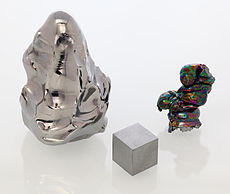
Hafnium Seventy-second Element of the Periodic Table
Hafnium (named after the city of Hafnia, Copenhagen in Latin) is a chemical element with the Hf symbol, atomic number 72 (72 protons and 72 electrons) and atomic mass equal to 178.5 u. At room temperature, hafnium is in the solid state.
It is a transition metal in group 4 (IV B) of the periodic classification of elements. It is bright silver gray in color, chemically very similar to zirconium, both found in the same minerals and compounds, and difficult to separate them. Forms tungsten alloys used in lamp filaments and electrodes. It is also used as a nuclear reactor control bar material due to its high neutron absorption capacity. It was discovered in 1923 by George de Hevesy and Dick Coster.
History:
This element of hafnium was named after the city of Copenhagen (Hafnia in Latin), Denmark, where it was discovered by Dirk Coster and Georg von Hevesy in 1923. Shortly after it was predicted, using Bohr's theory, which would be associated with the zirconium. It was finally found in zircon by X-ray spectroscopic analysis in Norway.
It was separated by successive recrystallizations by Jantzen and von Hevesey. Metallic hafnium was first prepared by Anton Eduard van Arkel and Jan Hendrik de Boer by passing hafnium tetraiodide (HfI4) through a heated tungsten filament (tungsten)
Main Features: It is a ductile, shiny, silver and corrosion resistant metal, chemically very similar to zirconium. These two elements have the same number of electrons in the valence shell and their ionic rays are very similar due to lanthanide contraction. So it is very difficult to separate them, being found in nature together. The only applications for which they need to be separated are those in which their neutron absorption properties are used; in nuclear reactors.
Hafnium carbide (HfC) is the most refractory binary compound known, and hafnium nitride (HfN) is the most refractory of all known metal nitrides, with a melting point of 3310 ° C. This metal is resistant to concentrated bases, but halogens can react with it to form hafnium tetrahalides (HfX4). At high temperatures it may react with oxygen, nitrogen, boron, sulfur and silicon.
Applications:
In mid-2006 Intel announced a new technology that uses hafnium as the basic component for building the transistor dielectric walls in its new generation of 45 nanometer microprocessors (nicknamed Penryn).
Other Applications:
In incandescent gas lamps.
On Intel Processors with 45 nm Technology
To eliminate oxygen and nitrogen in vacuum tubes. In alloys of iron, titanium, niobium, tantalum (chemical element) and other alloys.
In electrodes for plasma cutting.
Obtaining:
It is always found next to zirconium in its same compounds, but is not found as a free element in nature. It is present as a mixture in zirconium minerals, such as zircon (ZrSiO4) and other varieties of zirconium (such as alvita), in concentrations of 1 to 5% hafnium.
Due to the chemical similarity between zirconium and hafnium, it is very difficult to separate them. Approximately half of all metal hafnium produced is obtained as a byproduct of zirconium purification. This is done by reducing hafnium tetrachloride (HfCl4) with magnesium or sodium by the Kroll process.
It is a transition metal in group 4 (IV B) of the periodic classification of elements. It is bright silver gray in color, chemically very similar to zirconium, both found in the same minerals and compounds, and difficult to separate them. Forms tungsten alloys used in lamp filaments and electrodes. It is also used as a nuclear reactor control bar material due to its high neutron absorption capacity. It was discovered in 1923 by George de Hevesy and Dick Coster.
History:
This element of hafnium was named after the city of Copenhagen (Hafnia in Latin), Denmark, where it was discovered by Dirk Coster and Georg von Hevesy in 1923. Shortly after it was predicted, using Bohr's theory, which would be associated with the zirconium. It was finally found in zircon by X-ray spectroscopic analysis in Norway.
It was separated by successive recrystallizations by Jantzen and von Hevesey. Metallic hafnium was first prepared by Anton Eduard van Arkel and Jan Hendrik de Boer by passing hafnium tetraiodide (HfI4) through a heated tungsten filament (tungsten)
Main Features: It is a ductile, shiny, silver and corrosion resistant metal, chemically very similar to zirconium. These two elements have the same number of electrons in the valence shell and their ionic rays are very similar due to lanthanide contraction. So it is very difficult to separate them, being found in nature together. The only applications for which they need to be separated are those in which their neutron absorption properties are used; in nuclear reactors.
Hafnium carbide (HfC) is the most refractory binary compound known, and hafnium nitride (HfN) is the most refractory of all known metal nitrides, with a melting point of 3310 ° C. This metal is resistant to concentrated bases, but halogens can react with it to form hafnium tetrahalides (HfX4). At high temperatures it may react with oxygen, nitrogen, boron, sulfur and silicon.
Applications:
In mid-2006 Intel announced a new technology that uses hafnium as the basic component for building the transistor dielectric walls in its new generation of 45 nanometer microprocessors (nicknamed Penryn).
Other Applications:
In incandescent gas lamps.
On Intel Processors with 45 nm Technology
To eliminate oxygen and nitrogen in vacuum tubes. In alloys of iron, titanium, niobium, tantalum (chemical element) and other alloys.
In electrodes for plasma cutting.
Obtaining:
It is always found next to zirconium in its same compounds, but is not found as a free element in nature. It is present as a mixture in zirconium minerals, such as zircon (ZrSiO4) and other varieties of zirconium (such as alvita), in concentrations of 1 to 5% hafnium.
Due to the chemical similarity between zirconium and hafnium, it is very difficult to separate them. Approximately half of all metal hafnium produced is obtained as a byproduct of zirconium purification. This is done by reducing hafnium tetrachloride (HfCl4) with magnesium or sodium by the Kroll process.