Lutetium Seventy First Periodic Table Element
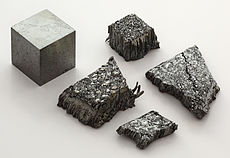
Lutetium (from the Latin name "Lutetia") is a chemical element of symbol Lu, atomic number 71 (71 protons and 71 electrons) with atomic mass 175 u. At room temperature, the lutetium is in the solid state. It is part of the rare earth group.
Being a very expensive element is limited to its application, however, it finds some uses in the oil industry. It was discovered in 1907 by Georges Urbain and Carl Auer von Welsbach.
History:
Lutetium, from Latin "Lutélia" (first name of the capital of France, Paris) was discovered independently in 1907 by French scientist Georges Urbain and mineralogist Carl Auer von Welsbach. Both found lutetium as impurity of the mineral ytterbium that the Swiss chemist Jean Charles Galissard de Marignac, and most of his colleagues, believed as a pure material.
The separation of lutetium from Marignac's ytterbium was first described by Urbain, prevailing the name it gave to the new element discovered. Urbain chose the names "neoterbium" and "lutécio", although Welsbach chose to call them "aldebaranio" and "cassiopeo". In 1949 it was decided to retain the ytterbium name and denominate the new element of lutetium, even though the German scientific community still uses the name "cassiopeo" for element 71.
Features and applications:
It is one of the elements of block d, appears frequently included among the lanthanides, since it shares with these rare earths many properties, being the element more difficult to isolate between all them, which justifies its price and the few utilities that presents / displays.
Lutetium is a trivalent metal with a silvery white color, resistant to corrosion and relatively stable in the presence of air. It is the heaviest and hardest element of all rare earths.
The metal is used as a catalyst in the cracking of petroleum in refineries, and in various chemical processes such as alkylation, hydrogenation and polymerization. Also used as Lutreo's Oxiortosilicate to activate Cerium scintillator in next-generation gamma camera in nuclear medicine. The radioisotope mass of this element is being used as a source of beta radiation minus associated with hydroxyapatite particles for research in treatment of tumors. These radioisotope carrier particles can selectively act on tumor cells and can prevent the irradiation of healthy cells
Abundance:
It is found in nature as most other rare earths, but never solitary natively, and is the least abundant of all elements present in nature. The major commercially exploitable lutetium mineral is monazite (Ce, La, etc.) PO4 containing 0.003% lutetium.
Pure metal could not be obtained until the end of the 20th century as it is extremely difficult to prepare. The procedure used is the ion exchange (reduction of LuCl3 or (LuF3) anhydrous with alkali metal or alkaline earth metal
Being a very expensive element is limited to its application, however, it finds some uses in the oil industry. It was discovered in 1907 by Georges Urbain and Carl Auer von Welsbach.
History:
Lutetium, from Latin "Lutélia" (first name of the capital of France, Paris) was discovered independently in 1907 by French scientist Georges Urbain and mineralogist Carl Auer von Welsbach. Both found lutetium as impurity of the mineral ytterbium that the Swiss chemist Jean Charles Galissard de Marignac, and most of his colleagues, believed as a pure material.
The separation of lutetium from Marignac's ytterbium was first described by Urbain, prevailing the name it gave to the new element discovered. Urbain chose the names "neoterbium" and "lutécio", although Welsbach chose to call them "aldebaranio" and "cassiopeo". In 1949 it was decided to retain the ytterbium name and denominate the new element of lutetium, even though the German scientific community still uses the name "cassiopeo" for element 71.
Features and applications:
It is one of the elements of block d, appears frequently included among the lanthanides, since it shares with these rare earths many properties, being the element more difficult to isolate between all them, which justifies its price and the few utilities that presents / displays.
Lutetium is a trivalent metal with a silvery white color, resistant to corrosion and relatively stable in the presence of air. It is the heaviest and hardest element of all rare earths.
The metal is used as a catalyst in the cracking of petroleum in refineries, and in various chemical processes such as alkylation, hydrogenation and polymerization. Also used as Lutreo's Oxiortosilicate to activate Cerium scintillator in next-generation gamma camera in nuclear medicine. The radioisotope mass of this element is being used as a source of beta radiation minus associated with hydroxyapatite particles for research in treatment of tumors. These radioisotope carrier particles can selectively act on tumor cells and can prevent the irradiation of healthy cells
Abundance:
It is found in nature as most other rare earths, but never solitary natively, and is the least abundant of all elements present in nature. The major commercially exploitable lutetium mineral is monazite (Ce, La, etc.) PO4 containing 0.003% lutetium.
Pure metal could not be obtained until the end of the 20th century as it is extremely difficult to prepare. The procedure used is the ion exchange (reduction of LuCl3 or (LuF3) anhydrous with alkali metal or alkaline earth metal