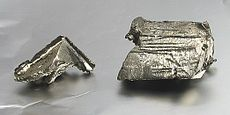
Ytterbium Seventieth Element of the Periodic Table
Ytterbium or yttérbio1 (named after the city of Ytterby, Sweden) is a chemical element in the periodic table that has the symbol Yb and atomic number 70 (70 protons and 70 electrons) with atomic mass 173 u.
Ytterbium is a soft silver metallic element. It is a rare earth in the lanthanide series found in the gadolinite, monazite and xenotime minerals. Ytterbium is sometimes associated with yttrium and other related elements, and is used in some steels. Natural ytterbium is a mixture of 7 stable isotopes. Room temperature is in solid state. There are few applications for this element. It was discovered in 1878 by Jean Charles
History:
Ytterby (from Ytterby, a city in Sweden) was discovered by Swiss chemist Jean Charles Galissard de Marignac in 1878. Marignac found a new component in a land then called erbia, and called it "iterbia" (because it was the component found in city of Ytterby). He suspected that Ytterbia was a compound of a new element that he named ytterbium which was, in fact, the first rare earth discovered.
In 1907, French chemist Georges Urbain separated Marignac's iterbia into two components, "neo-terbia" and "lutecia". Neoiterbia was the element that would later be called Ytterbium, and lutetia would become the Lutetian element. Independently, Auer von Welsbach isolated these elements from Ytterbia at about the same time, but called them "aldebaranio" and "casiopeo".
In 1937 Klemm and Bonner isolated Ytterbium by reducing their potassium trichloride. The chemical and physical properties of the ytterbium could not be determined until 1953, when practically pure metal was produced.
Main Features: Ytterbium is a soft, pliable and very ductile element that exhibits a silver sheen. It is a rare earth, easily attackable and soluble by mineral acids. Reacts slowly with water, and oxidizes in air.
The ytterbium has 3 allotropes, called alpha, beta and gamma, with transformation points at -13 ° C and 795 ° C. The beta form occurs at room temperature and has a face-centered crystal structure; on the other hand, the gamma form occurs at elevated temperatures and has a body-centered crystal structure.
Normally, the beta form has a similar electrical conductivity to metals, but behaves like a semiconductor at pressures close to 16,000 atm. Its electrical resistance multiplies by ten to 39,000 atm, but at 40,000 atm it drops sharply close to 10% of its resistivity at room temperature.
Applications:
Yb2Co13Fe3Mn is the strongest magnet in the world, but it is very expensive. An isotope of ytterbium has been used as an alternative radiation source for a portable X-ray machine when electricity was not available. Its metal can be used to improve granule refinement, strength and other mechanical properties of stainless steel. Some ytterbium metal alloys are used in dentistry. There are few applications for this element.
Abundance and obtaining:
Ytterbium is found with other rare earths in several rare minerals. Most commonly obtained commercially from monazitic sand (~ 0.03% ytterbium). It is also found in euxenite and xenotime. It is often difficult to separate the ytterbium from other rare earths, but the ion exchange and solvent extraction techniques developed in the late twentieth century have simplified this separation. Ytterbium compounds are rare.
Ytterbium is a soft silver metallic element. It is a rare earth in the lanthanide series found in the gadolinite, monazite and xenotime minerals. Ytterbium is sometimes associated with yttrium and other related elements, and is used in some steels. Natural ytterbium is a mixture of 7 stable isotopes. Room temperature is in solid state. There are few applications for this element. It was discovered in 1878 by Jean Charles
History:
Ytterby (from Ytterby, a city in Sweden) was discovered by Swiss chemist Jean Charles Galissard de Marignac in 1878. Marignac found a new component in a land then called erbia, and called it "iterbia" (because it was the component found in city of Ytterby). He suspected that Ytterbia was a compound of a new element that he named ytterbium which was, in fact, the first rare earth discovered.
In 1907, French chemist Georges Urbain separated Marignac's iterbia into two components, "neo-terbia" and "lutecia". Neoiterbia was the element that would later be called Ytterbium, and lutetia would become the Lutetian element. Independently, Auer von Welsbach isolated these elements from Ytterbia at about the same time, but called them "aldebaranio" and "casiopeo".
In 1937 Klemm and Bonner isolated Ytterbium by reducing their potassium trichloride. The chemical and physical properties of the ytterbium could not be determined until 1953, when practically pure metal was produced.
Main Features: Ytterbium is a soft, pliable and very ductile element that exhibits a silver sheen. It is a rare earth, easily attackable and soluble by mineral acids. Reacts slowly with water, and oxidizes in air.
The ytterbium has 3 allotropes, called alpha, beta and gamma, with transformation points at -13 ° C and 795 ° C. The beta form occurs at room temperature and has a face-centered crystal structure; on the other hand, the gamma form occurs at elevated temperatures and has a body-centered crystal structure.
Normally, the beta form has a similar electrical conductivity to metals, but behaves like a semiconductor at pressures close to 16,000 atm. Its electrical resistance multiplies by ten to 39,000 atm, but at 40,000 atm it drops sharply close to 10% of its resistivity at room temperature.
Applications:
Yb2Co13Fe3Mn is the strongest magnet in the world, but it is very expensive. An isotope of ytterbium has been used as an alternative radiation source for a portable X-ray machine when electricity was not available. Its metal can be used to improve granule refinement, strength and other mechanical properties of stainless steel. Some ytterbium metal alloys are used in dentistry. There are few applications for this element.
Abundance and obtaining:
Ytterbium is found with other rare earths in several rare minerals. Most commonly obtained commercially from monazitic sand (~ 0.03% ytterbium). It is also found in euxenite and xenotime. It is often difficult to separate the ytterbium from other rare earths, but the ion exchange and solvent extraction techniques developed in the late twentieth century have simplified this separation. Ytterbium compounds are rare.