Tulio Sixty-ninth Element of the Periodic Table
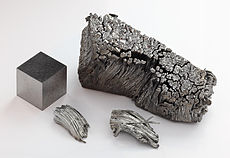
Thulium (from the Greek "Thule", an island name) is a chemical element of symbol Tm, atomic number 69 (69 protons and 69 electrons) with atomic mass equal to 168.9 u. At room temperature, thulium is in a solid state. It is part of the rare earth group.
It is found with other "rare earths" in the monazite mineral. Due to the high price, thulium and its compounds have not yet economically viable application. It was discovered in 1879 by the Swedish Per Teodor Cleve.
History:
The thulium element was discovered by the Swedish chemist Per Teodor Cleve in 1879 looking for impurities in the oxides of other rare earth elements (same method previously used by Carl Gustaf Mosander to discover some other rare earths). Cleve started by removing all known contaminants of “erbia” (Er2O3) by obtaining two new substances, one brown and one green. The brown substance was the oxide of the holmium element which was termed "holmia" by Cleve and the green substance was an oxide of an unknown element. Cleve called the oxide "tulia" and its element of thulium "Thule", an ancient Roman name for a mythical country in the far north, perhaps Scandinavia.
Main Features: It is an element of the lanthanide group, being the least abundant of rare earths. Its metal is easy to work with, has good ductility, has a silver gray shine and can be cut with a knife. It has some resistance to corrosion when in dry air. Natural thulium is composed entirely of a single stable isotope, the Tm-169. Curie Temperature = 32 Kelvin
Applications:
Thulium was used to produce lasers, but high production costs prevented other commercial uses for thulium from developing. Other Uses / Potential Uses:
Stable thulium (Tm-169), bombarded in nuclear reactors, can be used as a radiation source in portable X-ray devices. The unstable Tm-171 can possibly be used as a power source. Tm-169 has potential use in ceramic magnetic materials called ferrites, which are used in microwave equipment.
Occurrence:
The element has never been found in pure form in nature, but is found in small amounts in minerals with other rare earths. It is extracted mainly from monazite (~ 0.007% of thulium), ore found in river sands, by ion exchange. Newer ion exchange and solvent extraction techniques have led to easier separation of rare earths at much lower costs to obtain thulium. The metal can be completely isolated by reduction with lanthanum metal or by reduction with calcium in a closed container. None of the thulium compounds are commercially important.
It is found with other "rare earths" in the monazite mineral. Due to the high price, thulium and its compounds have not yet economically viable application. It was discovered in 1879 by the Swedish Per Teodor Cleve.
History:
The thulium element was discovered by the Swedish chemist Per Teodor Cleve in 1879 looking for impurities in the oxides of other rare earth elements (same method previously used by Carl Gustaf Mosander to discover some other rare earths). Cleve started by removing all known contaminants of “erbia” (Er2O3) by obtaining two new substances, one brown and one green. The brown substance was the oxide of the holmium element which was termed "holmia" by Cleve and the green substance was an oxide of an unknown element. Cleve called the oxide "tulia" and its element of thulium "Thule", an ancient Roman name for a mythical country in the far north, perhaps Scandinavia.
Main Features: It is an element of the lanthanide group, being the least abundant of rare earths. Its metal is easy to work with, has good ductility, has a silver gray shine and can be cut with a knife. It has some resistance to corrosion when in dry air. Natural thulium is composed entirely of a single stable isotope, the Tm-169. Curie Temperature = 32 Kelvin
Applications:
Thulium was used to produce lasers, but high production costs prevented other commercial uses for thulium from developing. Other Uses / Potential Uses:
Stable thulium (Tm-169), bombarded in nuclear reactors, can be used as a radiation source in portable X-ray devices. The unstable Tm-171 can possibly be used as a power source. Tm-169 has potential use in ceramic magnetic materials called ferrites, which are used in microwave equipment.
Occurrence:
The element has never been found in pure form in nature, but is found in small amounts in minerals with other rare earths. It is extracted mainly from monazite (~ 0.007% of thulium), ore found in river sands, by ion exchange. Newer ion exchange and solvent extraction techniques have led to easier separation of rare earths at much lower costs to obtain thulium. The metal can be completely isolated by reduction with lanthanum metal or by reduction with calcium in a closed container. None of the thulium compounds are commercially important.