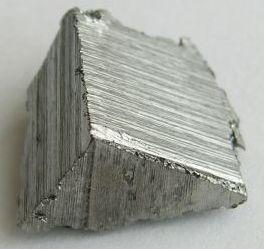
Erbium Sixty-eighth Element of the Periodic Table
Erbium (named after the city of Ytterby (Sweden), where it was first found) is a chemical element of symbol Er, atomic number 68 (68 protons and 68 electrons) with atomic mass 167.2 u, belonging to the lanthanide group. At room temperature Erbium is in a solid state. It is part of the rare earth group.
It is used in photographic filter, dopant in optical amplifiers and its oxide as a pigment for coloring glasses and enamels.
It was discovered in 1843 by the Swedish Carl Gustaf Mosander, from the Ytterby gadolinite mineral. Sweden city.
History:
Erbium (named after Ytterby, a city in Sweden) was discovered by Carl Gustaf Mosander in 1843. Mosander separated from "yttria", a gadolinite mineral, three fractions he called "yttria", "erbia", and "terbia" . He named the new element named after the city of Ytterby, where large concentrations of Ytrya and Erbia were found. At this time erbia and terbia were still confused. After 1860, what was known as Terbia became Erbium, and after 1877, what was known as Erbia was renamed Terbium. Reasonably pure Er2O3 was independently isolated in 1905 by Georges Urbain and Charles James. Reasonably pure metal was not produced until 1934 when klemm and Bommer reduced anhydrous chloride with potassium vapor.
Main Features: It is a trivalent metal element that in its pure form is malleable, soft, relatively stable in air, not oxidizing as rapidly as some other rare earth metals. Its salts are colored (pink), and the element has bands of visible, ultraviolet and near infrared spectral absorption which, combined with its electronic configuration gives it very beautiful pastels. Its sesquioxide is called "erbia" The properties of erbium largely depend on the impurities it contains. Curie Temperature = 52.4 Kelvin
Applications:
The daily uses of erbium are varied. It is generally used as a photographic filter and due to its resistance it is useful as a metallic additive. Other Uses:
Used in nuclear technology as a neutron absorber. Used as a dopant in fiber optic amplifiers (EDFAs). When added to vanadium as an alloy it decreases hardness and improves its working condition.
Erbium oxide is pink in color, so it is used for tinting glass and porcelain enamel. This glass is then used to produce sunglasses and cheap jewelry.
Occurrence:
Like other rare earths, this element is never found in free form in the wild, but is found in ores such as monazitic sand. Historically it was very difficult and expensive to separate rare earths from their ores. However, with the development of production techniques such as ion exchange in the twentieth century, there was a reduction in costs in obtaining rare earths and their compounds. Commercial sources of erbium are the minerals xemotime and euxenite.
It is used in photographic filter, dopant in optical amplifiers and its oxide as a pigment for coloring glasses and enamels.
It was discovered in 1843 by the Swedish Carl Gustaf Mosander, from the Ytterby gadolinite mineral. Sweden city.
History:
Erbium (named after Ytterby, a city in Sweden) was discovered by Carl Gustaf Mosander in 1843. Mosander separated from "yttria", a gadolinite mineral, three fractions he called "yttria", "erbia", and "terbia" . He named the new element named after the city of Ytterby, where large concentrations of Ytrya and Erbia were found. At this time erbia and terbia were still confused. After 1860, what was known as Terbia became Erbium, and after 1877, what was known as Erbia was renamed Terbium. Reasonably pure Er2O3 was independently isolated in 1905 by Georges Urbain and Charles James. Reasonably pure metal was not produced until 1934 when klemm and Bommer reduced anhydrous chloride with potassium vapor.
Main Features: It is a trivalent metal element that in its pure form is malleable, soft, relatively stable in air, not oxidizing as rapidly as some other rare earth metals. Its salts are colored (pink), and the element has bands of visible, ultraviolet and near infrared spectral absorption which, combined with its electronic configuration gives it very beautiful pastels. Its sesquioxide is called "erbia" The properties of erbium largely depend on the impurities it contains. Curie Temperature = 52.4 Kelvin
Applications:
The daily uses of erbium are varied. It is generally used as a photographic filter and due to its resistance it is useful as a metallic additive. Other Uses:
Used in nuclear technology as a neutron absorber. Used as a dopant in fiber optic amplifiers (EDFAs). When added to vanadium as an alloy it decreases hardness and improves its working condition.
Erbium oxide is pink in color, so it is used for tinting glass and porcelain enamel. This glass is then used to produce sunglasses and cheap jewelry.
Occurrence:
Like other rare earths, this element is never found in free form in the wild, but is found in ores such as monazitic sand. Historically it was very difficult and expensive to separate rare earths from their ores. However, with the development of production techniques such as ion exchange in the twentieth century, there was a reduction in costs in obtaining rare earths and their compounds. Commercial sources of erbium are the minerals xemotime and euxenite.