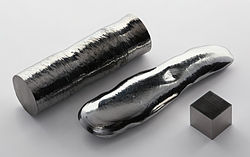
Rhenium Seventy-fifth Element of the Periodic Table
Rhenium, rhenium is a chemical element, symbol Re, atomic number 75 (75 protons and 75 electrons), with atomic mass 186.2 u situated in group 7 of the periodic classification of elements.
It is a heavy, solid white silver at room temperature transition metal, rarely found in nature. It is obtained as a byproduct of molybdenum mineral processing. It is mainly employed in catalysts.
His discovery of platinum and columbite minerals in Germany was reported by Walter Noddack, Ida Tacke and Otto Berg in 1925.
History:
The rhenium (from the Latin Rhenus), named after the Rhine river (Germany), was the last natural element to be discovered. It is considered to have been discovered by Walter Noddack, Ida Tacke and Otto Berg in Germany. In 1925 they reported that they detected the element in a platinum ore and columbite mineral. They also found rhenium in gadolinite and molybdenite. In 1928 it was possible to extract 1 gram of the element processing 660 kilograms of molybdenite.
As the process of obtaining the metal was complex and highly expensive, production was halted until 1950, when tungsten-rhenium and molybdenum-rhenium alloys were produced. These alloys find important applications in the industry, resulting in a high demand for rhenium obtained from molybdenite in porphyry (copper) ores.
Main Features: Rhenium is a shiny, silvery white metal that has one of the highest melting points, surpassed only by tungsten and carbon. It is also one of the densest, surpassed only by platinum, iridium, and os. The oxidation states of rhenium include -1, + 1, + 2, + 3, + 4, + 5, + 6 and +7, the most common being + 7, + 6, + 4, + 2 and -1. Its commercial form is usually powder, but it can be obtained in compact form, with up to 90% of its theoretical density. When it is annealed it becomes very ductile and can be folded into a spiral or ring. Rhenium-molybdenum alloys are superconducting at 10K.
Applications:
Rhenium-platinum catalysts are used to obtain metallic lead, high octane gasoline, and high temperature resistant superalloys used to make jet engine parts.
Other uses:
Extensively used as filaments in mass spectrographs and ion detectors. As an additive in tungsten or molybdenum based alloys to improve their properties.
Rhenium catalysts are very resistant to chemical poisoning and are used in certain types of hydrogenation reactions.
In electrical contact material due to its good wear and corrosion resistance. Thermocouples containing rhenium and tungsten alloys are used to measure temperatures up to 2200 ° C. Rhenium wire is used in flash lamps for photography. Used in a pancreatic cancer fighting bacterium known as Rhenium-188.
Occurrence and obtaining:
Rhenium is not found in free form in nature or in any particular mineral. This element is found in small amounts scattered throughout the Earth's crust, around 0.001 ppm. Commercial rhenium is extracted as a byproduct of molybdenum minerals contained in some copper ores. Some molybdenum minerals contain from 0.002% to 0.2% rhenium. The metal is prepared by reducing ammonium perrenate (NH4ReO4) with hydrogen at high temperatures.
It is a heavy, solid white silver at room temperature transition metal, rarely found in nature. It is obtained as a byproduct of molybdenum mineral processing. It is mainly employed in catalysts.
His discovery of platinum and columbite minerals in Germany was reported by Walter Noddack, Ida Tacke and Otto Berg in 1925.
History:
The rhenium (from the Latin Rhenus), named after the Rhine river (Germany), was the last natural element to be discovered. It is considered to have been discovered by Walter Noddack, Ida Tacke and Otto Berg in Germany. In 1925 they reported that they detected the element in a platinum ore and columbite mineral. They also found rhenium in gadolinite and molybdenite. In 1928 it was possible to extract 1 gram of the element processing 660 kilograms of molybdenite.
As the process of obtaining the metal was complex and highly expensive, production was halted until 1950, when tungsten-rhenium and molybdenum-rhenium alloys were produced. These alloys find important applications in the industry, resulting in a high demand for rhenium obtained from molybdenite in porphyry (copper) ores.
Main Features: Rhenium is a shiny, silvery white metal that has one of the highest melting points, surpassed only by tungsten and carbon. It is also one of the densest, surpassed only by platinum, iridium, and os. The oxidation states of rhenium include -1, + 1, + 2, + 3, + 4, + 5, + 6 and +7, the most common being + 7, + 6, + 4, + 2 and -1. Its commercial form is usually powder, but it can be obtained in compact form, with up to 90% of its theoretical density. When it is annealed it becomes very ductile and can be folded into a spiral or ring. Rhenium-molybdenum alloys are superconducting at 10K.
Applications:
Rhenium-platinum catalysts are used to obtain metallic lead, high octane gasoline, and high temperature resistant superalloys used to make jet engine parts.
Other uses:
Extensively used as filaments in mass spectrographs and ion detectors. As an additive in tungsten or molybdenum based alloys to improve their properties.
Rhenium catalysts are very resistant to chemical poisoning and are used in certain types of hydrogenation reactions.
In electrical contact material due to its good wear and corrosion resistance. Thermocouples containing rhenium and tungsten alloys are used to measure temperatures up to 2200 ° C. Rhenium wire is used in flash lamps for photography. Used in a pancreatic cancer fighting bacterium known as Rhenium-188.
Occurrence and obtaining:
Rhenium is not found in free form in nature or in any particular mineral. This element is found in small amounts scattered throughout the Earth's crust, around 0.001 ppm. Commercial rhenium is extracted as a byproduct of molybdenum minerals contained in some copper ores. Some molybdenum minerals contain from 0.002% to 0.2% rhenium. The metal is prepared by reducing ammonium perrenate (NH4ReO4) with hydrogen at high temperatures.