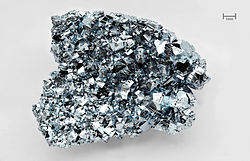
Osmium Seventy-sixth Element of the Periodic Table
The osmium is a chemical element, symbol Os, of atomic number 76 (76 protons and 76 electrons), with atomic mass 190.23 u and is in group 8 of the periodic classification of elements. It is a transition metal classified in the platinum group. At room temperature the osmium is in a solid state.
It is employed in some alloys with platinum and iridium. An osmium-iridium alloy is used in surgical implants. Its oxide is used as an oxidant and catalyst in chemical syntheses and as a biological dye fixer for microscopic visualization of tissues. It was discovered in 1803 by Smithson Tennant analyzing platinum residues.
History:
Osmium (from the Greek "osme" meaning "smell") was discovered in 1803 by AgnesSmithson Tennant in London (England), along with iridium in platinum residues dissolved in royal water.
Main Features: In its metallic form the os is very dense, bluish white, brittle, hard and shiny, even at high temperatures, even though it is difficult to find in this form. It is easier to obtain osmium as a powder, even if exposed to air tends to form osmium tethoxide, OsO4. Osmium tethoxide is toxic (hazardous to the eyes), energetic and volatile oxidant with a strong odor.
The os has a very high density, similar to iridium. It has the highest melting point and lowest vapor pressure relative to the other metals in the platinum group.
The most common oxidation states of osmium are +4 and +3, however oxidation states from +1 to +8 are observed.
It is very resistant to corrosion and acid attack, dissolving better by alkaline fusion.
Applications:
Due to the extreme toxicity of its oxide, osmium is rarely used in its pure form, often used in combination with other metals such as iridium and platinum in applications where great hardness and durability is required. OS alloys are almost entirely employed in fountain pen pens, record player needles, compass needles, various instrument shafts, and electrical contacts.
A platinum-osmium alloy containing 10% osmium is used in surgical implants such as pacemakers and artificial pulmonary valves.
In osmium-iridium alloys, "osmiridium" are those that contain the most osmium and "iridiosmium" those with the most iridium.
Osmium tethoxide has been used for fingerprint detection, tissue dyeing (staining) processes as a biological fixative for microscopic observations, and other biomedical techniques.
Tethoxide and potassium osmate are important oxidants for chemical synthesis. Tetroxide is used as a catalyst in organic chemistry.
Occurrence:
This transition metal is found in iridiosmium, a natural osmium and iridium alloy found in the sands of the Ural Mountains (Russia), North America and South America. It is also found in nickel ores in Sudbury, Ontario, Canada. Even though the amount of platinum metals found in these ores is small, the large volumes of processed nickel ores make commercial recovery possible.
The abundance of os in the earth's crust is estimated at 10-3 ppm. Major osmium deposits are found in Russia, the United States, Canada, Colombia, and Japan.
It is employed in some alloys with platinum and iridium. An osmium-iridium alloy is used in surgical implants. Its oxide is used as an oxidant and catalyst in chemical syntheses and as a biological dye fixer for microscopic visualization of tissues. It was discovered in 1803 by Smithson Tennant analyzing platinum residues.
History:
Osmium (from the Greek "osme" meaning "smell") was discovered in 1803 by AgnesSmithson Tennant in London (England), along with iridium in platinum residues dissolved in royal water.
Main Features: In its metallic form the os is very dense, bluish white, brittle, hard and shiny, even at high temperatures, even though it is difficult to find in this form. It is easier to obtain osmium as a powder, even if exposed to air tends to form osmium tethoxide, OsO4. Osmium tethoxide is toxic (hazardous to the eyes), energetic and volatile oxidant with a strong odor.
The os has a very high density, similar to iridium. It has the highest melting point and lowest vapor pressure relative to the other metals in the platinum group.
The most common oxidation states of osmium are +4 and +3, however oxidation states from +1 to +8 are observed.
It is very resistant to corrosion and acid attack, dissolving better by alkaline fusion.
Applications:
Due to the extreme toxicity of its oxide, osmium is rarely used in its pure form, often used in combination with other metals such as iridium and platinum in applications where great hardness and durability is required. OS alloys are almost entirely employed in fountain pen pens, record player needles, compass needles, various instrument shafts, and electrical contacts.
A platinum-osmium alloy containing 10% osmium is used in surgical implants such as pacemakers and artificial pulmonary valves.
In osmium-iridium alloys, "osmiridium" are those that contain the most osmium and "iridiosmium" those with the most iridium.
Osmium tethoxide has been used for fingerprint detection, tissue dyeing (staining) processes as a biological fixative for microscopic observations, and other biomedical techniques.
Tethoxide and potassium osmate are important oxidants for chemical synthesis. Tetroxide is used as a catalyst in organic chemistry.
Occurrence:
This transition metal is found in iridiosmium, a natural osmium and iridium alloy found in the sands of the Ural Mountains (Russia), North America and South America. It is also found in nickel ores in Sudbury, Ontario, Canada. Even though the amount of platinum metals found in these ores is small, the large volumes of processed nickel ores make commercial recovery possible.
The abundance of os in the earth's crust is estimated at 10-3 ppm. Major osmium deposits are found in Russia, the United States, Canada, Colombia, and Japan.