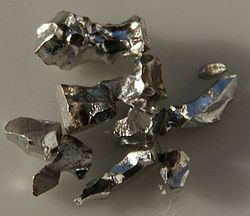
Iridium Seventy-seventh Element of the Periodic Table
Iridium (from the Latin "iris", iris or rainbow) is a chemical element, symbol Ir, of atomic number 77 (77 protons and 77 electrons) with atomic mass 192.2 u in group 9 of the periodic table of elements. .
It is a hard, fragile, heavy, silver-white transition metal. It is used in high strength alloys that can withstand high temperatures. It is a little abundant element found in nature associated with osmium and platinum. It is a very corrosion resistant element. At room temperature, iridium is in a solid state.
History:
Iridium was discovered in 1803 by Smithson Tennant in London, England, along with the os in a dark colored crude oil residue, dissolving the platinum residue in royal water. This element was later named after the Latin word meaning "rainbow" because its salts are highly colored.
A bar of this metal was used as a standard for the unit of length (meter) and unit of mass (kilogram) by the International Bureau of Weights and Measures, held in Sèvres, near Paris. This bar is made of an alloy with 90% platinum and 10% iridium. From 1960 to 1983, the Paris bar as the standard unit of meter length was replaced by the wavelength definition of the red-orange emission of a Kr-86 atom. Currently the meter is defined as the length of the path traveled by light in a vacuum over a time interval of ¹ / 299,792,458 seconds (base unit ratified by the 17th CGPM - 1983).
The KT event, a timeframe between the Cretaceous and Tertiary eras in geological time, was identified by a thin layer of iridium-rich clay. According to many scientists, such as Luis Alvarez, this iridium was of extraterrestrial origin attributed to an asteroid or comet that collided with Earth near a region that is now the Yucatan peninsula.
However, scientist Dewey M. McLean of the Virginia Polytechnic Institute (USA) believes that iridium is of volcanic origin. The core of the earth is rich in iridium, and the volcano "Piton de la Fournaise" ("furnace peak") in Réunion, for example, is releasing iridium to this day.
Main Features: Iridium is a white transition metal resembling platinum but with a slightly yellow tint. Due to its extreme hardness and great fragility it is difficult to be molded or worked. Iridium is the most corrosion resistant metal known.
Iridium does not suffer from acid or royal water attack, but can be attacked by some molten salts such as NaCl and NaCN. The density of this element is the highest known, slightly higher than that of os. Its most common oxidation states are +1, +3 and +4.
Applications:
The main use of iridium, due to its hardness, is as a hardening agent in platinum alloys. Other Uses:
For making crucibles and other devices that require high temperatures. Electrical contacts such as Pt / Ir alloy (spark plugs). Iridium / osmium alloys are almost entirely employed in fountain pen pens, record player needles, compass needles, injection needles and various instrument shafts.
Iridium is also used in sunglasses. Iridium is used as a catalyst for carbonylation of methanol producing acetic acid.
Isotope Ir-192 is used in industrial radiography Iridium isotope 192 is widely used in high dose rate brachytherapy, a modality of radiotherapy treatment for malignant tumors.
Iridium osmium alloys are called "osmiridium" those with the highest amount of osmium and "iridiosmium" those with the most iridium.
Occurrence:
Iridium is usually found in nature associated with platinum or other platinum group metals in alluvial deposits. The natural alloys of iridium include "osmiridium" and "iridiosmium", which are mixtures of iridium and osmium. It is found in meteorites.
It is commercially obtained as a byproduct of nickel mining and processing.
It is a hard, fragile, heavy, silver-white transition metal. It is used in high strength alloys that can withstand high temperatures. It is a little abundant element found in nature associated with osmium and platinum. It is a very corrosion resistant element. At room temperature, iridium is in a solid state.
History:
Iridium was discovered in 1803 by Smithson Tennant in London, England, along with the os in a dark colored crude oil residue, dissolving the platinum residue in royal water. This element was later named after the Latin word meaning "rainbow" because its salts are highly colored.
A bar of this metal was used as a standard for the unit of length (meter) and unit of mass (kilogram) by the International Bureau of Weights and Measures, held in Sèvres, near Paris. This bar is made of an alloy with 90% platinum and 10% iridium. From 1960 to 1983, the Paris bar as the standard unit of meter length was replaced by the wavelength definition of the red-orange emission of a Kr-86 atom. Currently the meter is defined as the length of the path traveled by light in a vacuum over a time interval of ¹ / 299,792,458 seconds (base unit ratified by the 17th CGPM - 1983).
The KT event, a timeframe between the Cretaceous and Tertiary eras in geological time, was identified by a thin layer of iridium-rich clay. According to many scientists, such as Luis Alvarez, this iridium was of extraterrestrial origin attributed to an asteroid or comet that collided with Earth near a region that is now the Yucatan peninsula.
However, scientist Dewey M. McLean of the Virginia Polytechnic Institute (USA) believes that iridium is of volcanic origin. The core of the earth is rich in iridium, and the volcano "Piton de la Fournaise" ("furnace peak") in Réunion, for example, is releasing iridium to this day.
Main Features: Iridium is a white transition metal resembling platinum but with a slightly yellow tint. Due to its extreme hardness and great fragility it is difficult to be molded or worked. Iridium is the most corrosion resistant metal known.
Iridium does not suffer from acid or royal water attack, but can be attacked by some molten salts such as NaCl and NaCN. The density of this element is the highest known, slightly higher than that of os. Its most common oxidation states are +1, +3 and +4.
Applications:
The main use of iridium, due to its hardness, is as a hardening agent in platinum alloys. Other Uses:
For making crucibles and other devices that require high temperatures. Electrical contacts such as Pt / Ir alloy (spark plugs). Iridium / osmium alloys are almost entirely employed in fountain pen pens, record player needles, compass needles, injection needles and various instrument shafts.
Iridium is also used in sunglasses. Iridium is used as a catalyst for carbonylation of methanol producing acetic acid.
Isotope Ir-192 is used in industrial radiography Iridium isotope 192 is widely used in high dose rate brachytherapy, a modality of radiotherapy treatment for malignant tumors.
Iridium osmium alloys are called "osmiridium" those with the highest amount of osmium and "iridiosmium" those with the most iridium.
Occurrence:
Iridium is usually found in nature associated with platinum or other platinum group metals in alluvial deposits. The natural alloys of iridium include "osmiridium" and "iridiosmium", which are mixtures of iridium and osmium. It is found in meteorites.
It is commercially obtained as a byproduct of nickel mining and processing.