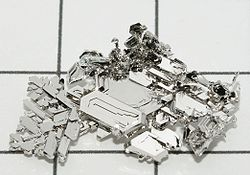
Platinum Seventy-eighth Element of the Periodic Table
Platinum (from Spanish platinum, diminutive of plata, silver) is a chemical element of symbol Pt of atomic number 78 (78 protons and 78 electrons), and of atomic mass equal to 195 u. At room temperature the platinum is in the solid state.
It was discovered by the Andean peoples and the Spanish came to know it in 1735 when they arrived in South America. It is employed for the manufacture of electrodes and jewelry. Also, it is widely used in chemical reactions as a catalyst.
History:
The Andean peoples discovered platinum and used it as a substitute for silver. It was known to the Spanish in 1735 when the Spanish navigator, explorer and astronomer Antonio de Ulloa arrived in South America.
In 1741, it was taken to China. For some centuries it was used to fake gold due to the similarity of density.
In 1824, it was found in large quantity in Russia (Ural Mountains), becoming commercialized.
Main Features: This metal is in group 10 (former 8B) of the Periodic Classification of Elements of the Transition Metal series. When pure, it is opaque, precious, pliable and ductile grayish-white in color. It is corrosion resistant and is only solubilized with acids of very high standard reduction potential (such as regal water: HNO3 + HCl). Depending on the conditions, it may react with halides, halogens, sulfur, iron, nickel and other elements, as well as calcogen and some fused basic dioxides. It can be used in various models such as: platinum in the leg as an implant in order to further advance the treatment and recovery of the leg or spine.
Applications:
Employed in the finishing of luxury weapons, mainly for grooves and details in streaked barrels; Manufacture of surgical instruments, such as nails, test tubes and others; In prosthetic dentistry for implants and drill fixation; Used on the tips of the spark plugs' spark plugs and the arrestor tips;
Used for the production of high temperature resistant gloves; Medical implants, such as the intrauterine device (IUD); Manufacture of musical, dental and electromagnetic instruments.
Catalyst in car exhaust and sulfuric acid production; In medicine to combat cancer, in Chemotherapy; Used in the ceramic industry as a decorative element in tiles.
Shapes:
Platinum can be found in metallic form. This native form is found as rounded or flattened grains called platinum nuggets. It is usually found associated with other metals such as titanium, osmium, iridium, palladium and rhodium or in the form of oxide. In the combined form it is mainly found in the sperrilite mineral.
The world's largest producers of platinum are South Africa (over 80%), Russia and Canada. Due to its scarcity platinum is more valuable than gold and silver, although not as coveted. Interestingly, the lunar crust has a high platinum concentration, but is not feasible to exploit.
Obtaining:
Platinum can be obtained by three processes: amalgamation, fusion and fractional distillation and igneous electrolysis of water with platinum oxide.
It was discovered by the Andean peoples and the Spanish came to know it in 1735 when they arrived in South America. It is employed for the manufacture of electrodes and jewelry. Also, it is widely used in chemical reactions as a catalyst.
History:
The Andean peoples discovered platinum and used it as a substitute for silver. It was known to the Spanish in 1735 when the Spanish navigator, explorer and astronomer Antonio de Ulloa arrived in South America.
In 1741, it was taken to China. For some centuries it was used to fake gold due to the similarity of density.
In 1824, it was found in large quantity in Russia (Ural Mountains), becoming commercialized.
Main Features: This metal is in group 10 (former 8B) of the Periodic Classification of Elements of the Transition Metal series. When pure, it is opaque, precious, pliable and ductile grayish-white in color. It is corrosion resistant and is only solubilized with acids of very high standard reduction potential (such as regal water: HNO3 + HCl). Depending on the conditions, it may react with halides, halogens, sulfur, iron, nickel and other elements, as well as calcogen and some fused basic dioxides. It can be used in various models such as: platinum in the leg as an implant in order to further advance the treatment and recovery of the leg or spine.
Applications:
Employed in the finishing of luxury weapons, mainly for grooves and details in streaked barrels; Manufacture of surgical instruments, such as nails, test tubes and others; In prosthetic dentistry for implants and drill fixation; Used on the tips of the spark plugs' spark plugs and the arrestor tips;
Used for the production of high temperature resistant gloves; Medical implants, such as the intrauterine device (IUD); Manufacture of musical, dental and electromagnetic instruments.
Catalyst in car exhaust and sulfuric acid production; In medicine to combat cancer, in Chemotherapy; Used in the ceramic industry as a decorative element in tiles.
Shapes:
Platinum can be found in metallic form. This native form is found as rounded or flattened grains called platinum nuggets. It is usually found associated with other metals such as titanium, osmium, iridium, palladium and rhodium or in the form of oxide. In the combined form it is mainly found in the sperrilite mineral.
The world's largest producers of platinum are South Africa (over 80%), Russia and Canada. Due to its scarcity platinum is more valuable than gold and silver, although not as coveted. Interestingly, the lunar crust has a high platinum concentration, but is not feasible to exploit.
Obtaining:
Platinum can be obtained by three processes: amalgamation, fusion and fractional distillation and igneous electrolysis of water with platinum oxide.