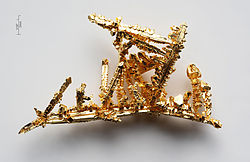
Gold Seventy-ninth Element of the Periodic Table
Gold (from the Latin aurum, "brilliant") is a chemical element of atomic number 79 (79 protons and 79 electrons) that is in group eleven (IB) of the periodic table, and of atomic mass 197 u. Its symbol is Au (from the Latin aurum).
Known since antiquity, gold is widely used in jewelery, industry and electronics, as well as a store of value.
History:
Archaeologists suggest that the first use of gold began with the first civilizations in the Middle East. It may have been the first metal used by mankind. The oldest gold artifact was found in the tomb of the Egyptian Queen Zer.2 3 Known in Sumer, in Egypt there are Egyptian hieroglyphics from 2600 BC that describe the metal, which is referred to in various passages in the Old Testament. It is regarded as one of the most precious metals and has been used as a standard for many currencies throughout history.
Main Features: It is a bright, dense, malleable, ductile (trivalent and univalent) transition metal that does not react with most chemicals, but is sensitive to chlorine and bromine. At room temperature it is solid. This metal is normally in pure form and in the form of alluvial nuggets and deposits and is one of the metals traditionally used for minting money. It is easily manageable and malleable that, with just one gram of gold, you can get a 3-kilometer-long wire 0.005 millimeters in diameter, or a square blade 70 centimeters wide and 0.1 micrometer thick.1
Pure gold is too soft to use. For this reason, it is usually hardened to metal alloy with silver and copper. Gold and its various metal alloys are widely used in jewelry, coin making and as a monetary standard in many countries. Due to its good electrical conductivity, corrosion resistance and a good combination of physical and chemical properties, it has several applications.
Applications:
Gold plays critical roles in computers, communications, spaceships, jet engines, and many other products. Its high electrical conductivity and oxidation resistance have allowed widespread use in electroplating, ie electrolytically coating the electrical connection surfaces with a gold layer to ensure a low electrical resistance connection free of chemical attack from the medium. . The same process can be used for gilding pieces, increasing their beauty and value.
Like silver, gold can form amalgam with mercury, which is sometimes employed in dental restorations. Colloidal gold (gold nanoparticles) is an intensely colored solution that is being researched for medical and biological purposes. This colloidal shape is also employed to create gilded ceramic paintings.
Chlorouric acid is used in photographs. The 198Au gold isotope, with a half-life of 2.7 days, is used in some cancer treatments and other diseases. It is used for the coating of biological materials, allowing visualization through the scanning electron microscope (SEM).
Used as a protective cover on many satellites because it is a good infrared light reflector.
Gold Symbology:
Gold is used as a symbol of purity, value, royalty and ostentation. The alchemists' main goal was to produce gold from other substances, such as lead.
Many competitions award the winner with a gold medal, second place with silver medal, and third place with bronze = copper (the three belonging to the same group (11) of the periodic table of elements).
Abundance and Obtainment:
Gold nugget.
Because it is relatively inert, it can be found as metal, sometimes as large nuggets, but generally found in small inclusions in some minerals such as quartz, metamorphic rocks and alluvial deposits from these sources. Gold is widely distributed, and is often associated with quartz and pyrite. It is common as impurity in many ores, where it is extracted as a byproduct. As a mineral it is found in the form of calaverite, a golden telluride. South Africa is the leading producer of gold, drawing approximately two thirds of all world demand for gold.
Gold is extracted by a process called cyanide leaching. The use of cyanide facilitates the oxidation of gold by forming (CN) 22- in dissolution. Gold is separated from the solution by reduction using, for example, zinc. Attempts have been made to replace cyanide with another binder because of the environmental problems it generates, but they are either unprofitable or toxic.
Scattered across the Earth's crust at a very low average concentration (5 grams per 1000 tonnes), and even lower in ocean waters (from 0.1 µg / kg to 2 µg / kg), where billions of tons of gold are estimated to be but of exploitation economically unfeasible by the current methods (one trillion liters of seawater contains 120 kg, or 1 kilo in more than 8.3 billion liters, the water consumed by a city like São Paulo in more than 10 years). The mines where gold is in economic grades are usually over 3 grams per ton; If the same content were found at sea, 1 trillion liters could supply 3,000 tons of gold.
Known since antiquity, gold is widely used in jewelery, industry and electronics, as well as a store of value.
History:
Archaeologists suggest that the first use of gold began with the first civilizations in the Middle East. It may have been the first metal used by mankind. The oldest gold artifact was found in the tomb of the Egyptian Queen Zer.2 3 Known in Sumer, in Egypt there are Egyptian hieroglyphics from 2600 BC that describe the metal, which is referred to in various passages in the Old Testament. It is regarded as one of the most precious metals and has been used as a standard for many currencies throughout history.
Main Features: It is a bright, dense, malleable, ductile (trivalent and univalent) transition metal that does not react with most chemicals, but is sensitive to chlorine and bromine. At room temperature it is solid. This metal is normally in pure form and in the form of alluvial nuggets and deposits and is one of the metals traditionally used for minting money. It is easily manageable and malleable that, with just one gram of gold, you can get a 3-kilometer-long wire 0.005 millimeters in diameter, or a square blade 70 centimeters wide and 0.1 micrometer thick.1
Pure gold is too soft to use. For this reason, it is usually hardened to metal alloy with silver and copper. Gold and its various metal alloys are widely used in jewelry, coin making and as a monetary standard in many countries. Due to its good electrical conductivity, corrosion resistance and a good combination of physical and chemical properties, it has several applications.
Applications:
Gold plays critical roles in computers, communications, spaceships, jet engines, and many other products. Its high electrical conductivity and oxidation resistance have allowed widespread use in electroplating, ie electrolytically coating the electrical connection surfaces with a gold layer to ensure a low electrical resistance connection free of chemical attack from the medium. . The same process can be used for gilding pieces, increasing their beauty and value.
Like silver, gold can form amalgam with mercury, which is sometimes employed in dental restorations. Colloidal gold (gold nanoparticles) is an intensely colored solution that is being researched for medical and biological purposes. This colloidal shape is also employed to create gilded ceramic paintings.
Chlorouric acid is used in photographs. The 198Au gold isotope, with a half-life of 2.7 days, is used in some cancer treatments and other diseases. It is used for the coating of biological materials, allowing visualization through the scanning electron microscope (SEM).
Used as a protective cover on many satellites because it is a good infrared light reflector.
Gold Symbology:
Gold is used as a symbol of purity, value, royalty and ostentation. The alchemists' main goal was to produce gold from other substances, such as lead.
Many competitions award the winner with a gold medal, second place with silver medal, and third place with bronze = copper (the three belonging to the same group (11) of the periodic table of elements).
Abundance and Obtainment:
Gold nugget.
Because it is relatively inert, it can be found as metal, sometimes as large nuggets, but generally found in small inclusions in some minerals such as quartz, metamorphic rocks and alluvial deposits from these sources. Gold is widely distributed, and is often associated with quartz and pyrite. It is common as impurity in many ores, where it is extracted as a byproduct. As a mineral it is found in the form of calaverite, a golden telluride. South Africa is the leading producer of gold, drawing approximately two thirds of all world demand for gold.
Gold is extracted by a process called cyanide leaching. The use of cyanide facilitates the oxidation of gold by forming (CN) 22- in dissolution. Gold is separated from the solution by reduction using, for example, zinc. Attempts have been made to replace cyanide with another binder because of the environmental problems it generates, but they are either unprofitable or toxic.
Scattered across the Earth's crust at a very low average concentration (5 grams per 1000 tonnes), and even lower in ocean waters (from 0.1 µg / kg to 2 µg / kg), where billions of tons of gold are estimated to be but of exploitation economically unfeasible by the current methods (one trillion liters of seawater contains 120 kg, or 1 kilo in more than 8.3 billion liters, the water consumed by a city like São Paulo in more than 10 years). The mines where gold is in economic grades are usually over 3 grams per ton; If the same content were found at sea, 1 trillion liters could supply 3,000 tons of gold.