Mercury Eighth Element of the Periodic Table
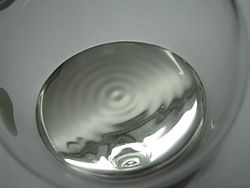
Mercury is a liquid metal at room temperature known since ancient Greek times. It is also known as hydrargyrium1, hydrargiro2, azougue3 and jellyfish, among other names. Its name honors the Roman god Mercury, who was the messenger of the gods. This tribute is due to the fluidity of the metal. The symbol Hg comes from the Greek "hydrargyrum" which means liquid silver.
Mercury is a chemical element of atomic number 80 (80 protons and 80 electrons) and atomic mass 200.5 u. It is one of six elements that present liquids at or near room temperature. The other elements are cesium, gallium, francium and rubidium metals and non-bromine metals. Of the six, however, only mercury and bromine are liquids at standard temperature and pressure conditions.
Mercury belongs to group (or family) 12 (formerly called 2B) and is part of the transition metal class. Such group is still called zinc family, in the periodic table.
Usually used in measuring instruments (thermometers and barometers), fluorescent lamps and as a catalyst in chemical reactions.
History:
Still discovered in ancient Greece, it was one of the first elements studied and has been of interest to chemistry students from the days of alchemy to the present day. It can be used in thermometers, barometers, lamps, medicines, mirrors, detonators, dyes and others.
In Greek, hydro (ύδωρ) means "water" and argyros (άργυρος) was the Greek name for "silver". The Romans Latinized the name for hidrargirium. And because chemical symbols are given by the initial capital (and a second lower case letter for differentiation) of the Latin name, their symbol was Hg (not to be confused with the hydrogen symbol, H).
General features: It is a silver liquid that at normal temperature is metal and odorless. Not a good conductor of heat compared to other metals, however it is a good conductor of electricity. Easily establish alloy with many other metals such as gold or silver producing amalgams. It is insoluble in water and soluble in nitric acid. When the temperature is increased it becomes toxic and corrosive vapors denser than air. It is a dangerous product when inhaled, ingested or in contact, causing irritation to skin, eyes and respiratory tract. It is compatible with concentrated nitric acid, acetylene, ammonia, chlorine and other ametals.
Physical and chemical forms:
Mercury is present in various forms (metallic, organic, inorganic Hg) and can be found in three oxidation states (0, +1, +2), generally easily interconverted in nature. Both humans and animals are exposed to all forms through the environment.
Metallic or elemental mercury in the zero oxidation state (Hg0) exists in liquid form at room temperature, is volatile and releases a dangerous monatomic gas: mercury vapor. This is stable and can remain in the atmosphere for months or even years, thus proving to be very important in the mercury cycle, as it can undergo oxidation and form the other states: the mercury, Hg + 1, when the mercury atom loses one electron and the mercury, Hg + 2, when it loses two electrons.
When combined with elements such as chlorine, sulfur or oxygen, the inorganic mercury compounds, also known as mercury salts (mercury and mercury salts) are obtained. On the other hand, if a mercury atom is covalently bonded to at least one carbon atom, it gives rise to organic mercury compounds (methylmercury, ethylmercury, phenylmercury).
With the exception of mercury, metals are characterized by their solid state at room temperature.4
Occurrence and obtaining:
The most important mercury ore is cinnabar whose largest mineral reserves are found in Spain at the Almadén mines.
Mercury may be associated with gaseous and liquid hydrocarbons (petroleum, bitumen) and also with coal deposits. It is an element of deep origin (terrestrial mantle) that possibly ascends in the form of methyl or dimethyl mercury. It is also related to helium gas. In vulcanogenic deposits, when sulfur is available it can precipitate as mercury sulfide (HgS) which is cinnabar.
Another way of obtaining mercury is by sulphate or cinnabar roasting. In this reaction, the sulfur of the mineral oxidizes to SO2 and the free metal leads to large water-cooled metal capacitors. Mercury deposits are of relatively recent origin but appear in rocks of all ages.
Mercury is a chemical element of atomic number 80 (80 protons and 80 electrons) and atomic mass 200.5 u. It is one of six elements that present liquids at or near room temperature. The other elements are cesium, gallium, francium and rubidium metals and non-bromine metals. Of the six, however, only mercury and bromine are liquids at standard temperature and pressure conditions.
Mercury belongs to group (or family) 12 (formerly called 2B) and is part of the transition metal class. Such group is still called zinc family, in the periodic table.
Usually used in measuring instruments (thermometers and barometers), fluorescent lamps and as a catalyst in chemical reactions.
History:
Still discovered in ancient Greece, it was one of the first elements studied and has been of interest to chemistry students from the days of alchemy to the present day. It can be used in thermometers, barometers, lamps, medicines, mirrors, detonators, dyes and others.
In Greek, hydro (ύδωρ) means "water" and argyros (άργυρος) was the Greek name for "silver". The Romans Latinized the name for hidrargirium. And because chemical symbols are given by the initial capital (and a second lower case letter for differentiation) of the Latin name, their symbol was Hg (not to be confused with the hydrogen symbol, H).
General features: It is a silver liquid that at normal temperature is metal and odorless. Not a good conductor of heat compared to other metals, however it is a good conductor of electricity. Easily establish alloy with many other metals such as gold or silver producing amalgams. It is insoluble in water and soluble in nitric acid. When the temperature is increased it becomes toxic and corrosive vapors denser than air. It is a dangerous product when inhaled, ingested or in contact, causing irritation to skin, eyes and respiratory tract. It is compatible with concentrated nitric acid, acetylene, ammonia, chlorine and other ametals.
Physical and chemical forms:
Mercury is present in various forms (metallic, organic, inorganic Hg) and can be found in three oxidation states (0, +1, +2), generally easily interconverted in nature. Both humans and animals are exposed to all forms through the environment.
Metallic or elemental mercury in the zero oxidation state (Hg0) exists in liquid form at room temperature, is volatile and releases a dangerous monatomic gas: mercury vapor. This is stable and can remain in the atmosphere for months or even years, thus proving to be very important in the mercury cycle, as it can undergo oxidation and form the other states: the mercury, Hg + 1, when the mercury atom loses one electron and the mercury, Hg + 2, when it loses two electrons.
When combined with elements such as chlorine, sulfur or oxygen, the inorganic mercury compounds, also known as mercury salts (mercury and mercury salts) are obtained. On the other hand, if a mercury atom is covalently bonded to at least one carbon atom, it gives rise to organic mercury compounds (methylmercury, ethylmercury, phenylmercury).
With the exception of mercury, metals are characterized by their solid state at room temperature.4
Occurrence and obtaining:
The most important mercury ore is cinnabar whose largest mineral reserves are found in Spain at the Almadén mines.
Mercury may be associated with gaseous and liquid hydrocarbons (petroleum, bitumen) and also with coal deposits. It is an element of deep origin (terrestrial mantle) that possibly ascends in the form of methyl or dimethyl mercury. It is also related to helium gas. In vulcanogenic deposits, when sulfur is available it can precipitate as mercury sulfide (HgS) which is cinnabar.
Another way of obtaining mercury is by sulphate or cinnabar roasting. In this reaction, the sulfur of the mineral oxidizes to SO2 and the free metal leads to large water-cooled metal capacitors. Mercury deposits are of relatively recent origin but appear in rocks of all ages.