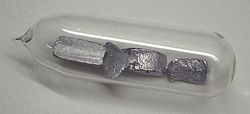
Thallium Eighty-first Element of the Periodic Table
It was discovered by Sir William Crookes in 1861 in England by spectroscopic analysis.
In 2010, thallium was quoted at $ 6,000 a kilo ($ 13,80).
History:
Thallium (which derives from the Latin word "thallus", which means "sprout") was discovered by Sir William Crookes in 1861 in England when making spectroscopic determinations of tellurium on acid residues derived from some plants. The name comes from the bright green line of its spectrum. In 1892 Crookes and Claude-Auguste Lamy independently isolated the metal. Although metal is reasonably abundant in the earth's crust at an estimated concentration of approximately 0.7 mg / kg, it is mostly associated with potassium in clay, soil, and granite minerals and is not a commercial source of this element. The main commercial source of thallium is the minimum amount (trace) found in copper, lead, zinc and other sulfide minerals.
Thallium is found in the minerals croosite, hutchinsonite and lorandite. This metal is also found in pyrites and is extracted as a byproduct of sulfuric acid production from pyrite. Another way to obtain the element is by casting lead and zinc-rich ores. Nodular manganese, found on the ocean floor, also contains thallium but extraction is prohibitively expensive and environmentally destructive. In addition, several other minerals contain 16-60% thallium, occurring in nature as sulphide or selenide complexes with antimony, arsenic, copper, lead and silver, but are rare and of no commercial importance as sources of this metal.
Main Features: This metal is very soft and malleable and can be cut with a knife. When exposed to air, it initially has a metallic sheen, but quickly becomes lead-bluish gray. When exposed to air, a layer of oxide forms on the thallium, so it is preserved by keeping it under mineral oil or inert gas such as argon. Applications:
The odorless and tasteless thallium sulfate has been extensively used in the past as poison of rats and ants. In the United States and other countries is no longer allowed due to security issues. Other Uses:
Thallium sulfide changes its electrical conductivity when exposed to infrared light, and is therefore a useful compound for photocell manufacturing. Thallium bromide and iodide crystals were used as materials for infrared optical devices. Thallium oxide was used to produce glasses with high refractive indices. used in semiconductor materials for selenium rectifiers. Used in equipment for detection of gamma radiation. As high density liquid it is used as float for the separation of minerals. Thallium-lead alloy is used in some types of fuses. Used to treat skin infections. However, this use has been limited due to the narrow margin that exists between its toxicity and therapeutic benefit.
Radioactive Tl-201, in the form of thallium chloride, is used in nuclear medicine to diagnose coronary disease and to detect tumors. Combined with sulfur or selenium and arsenic, thallium has been used in the production of high density glass with low melting points between 125 and 150 ° C. Thallium acetate is used in culture media together with penicillin to isolate mycoplasmas, the smallest free-living bacteria.
In addition, thallium research is being developed to develop high temperature superconducting materials for applications such as magnetic resonance imaging, magnetic energy storage, magnetic propulsion, power generation and transmission. The rare, expensive, toxic metal has several important applications in the energy industry.
Reservations:
Thallium is a very rare metal, and there are only three known deposits of this mineral in the world. The most recent of them is in Brazil, in the Bahian municipality of Barreiras. The deposit found in Bahia has the potential to be larger than those of China and Kazakhstan, the only producers today, as it has a volume capable of meeting all world demand for six years.
History:
Thallium (which derives from the Latin word "thallus", which means "sprout") was discovered by Sir William Crookes in 1861 in England when making spectroscopic determinations of tellurium on acid residues derived from some plants. The name comes from the bright green line of its spectrum. In 1892 Crookes and Claude-Auguste Lamy independently isolated the metal. Although metal is reasonably abundant in the earth's crust at an estimated concentration of approximately 0.7 mg / kg, it is mostly associated with potassium in clay, soil, and granite minerals and is not a commercial source of this element. The main commercial source of thallium is the minimum amount (trace) found in copper, lead, zinc and other sulfide minerals.
Thallium is found in the minerals croosite, hutchinsonite and lorandite. This metal is also found in pyrites and is extracted as a byproduct of sulfuric acid production from pyrite. Another way to obtain the element is by casting lead and zinc-rich ores. Nodular manganese, found on the ocean floor, also contains thallium but extraction is prohibitively expensive and environmentally destructive. In addition, several other minerals contain 16-60% thallium, occurring in nature as sulphide or selenide complexes with antimony, arsenic, copper, lead and silver, but are rare and of no commercial importance as sources of this metal.
Main Features: This metal is very soft and malleable and can be cut with a knife. When exposed to air, it initially has a metallic sheen, but quickly becomes lead-bluish gray. When exposed to air, a layer of oxide forms on the thallium, so it is preserved by keeping it under mineral oil or inert gas such as argon. Applications:
The odorless and tasteless thallium sulfate has been extensively used in the past as poison of rats and ants. In the United States and other countries is no longer allowed due to security issues. Other Uses:
Thallium sulfide changes its electrical conductivity when exposed to infrared light, and is therefore a useful compound for photocell manufacturing. Thallium bromide and iodide crystals were used as materials for infrared optical devices. Thallium oxide was used to produce glasses with high refractive indices. used in semiconductor materials for selenium rectifiers. Used in equipment for detection of gamma radiation. As high density liquid it is used as float for the separation of minerals. Thallium-lead alloy is used in some types of fuses. Used to treat skin infections. However, this use has been limited due to the narrow margin that exists between its toxicity and therapeutic benefit.
Radioactive Tl-201, in the form of thallium chloride, is used in nuclear medicine to diagnose coronary disease and to detect tumors. Combined with sulfur or selenium and arsenic, thallium has been used in the production of high density glass with low melting points between 125 and 150 ° C. Thallium acetate is used in culture media together with penicillin to isolate mycoplasmas, the smallest free-living bacteria.
In addition, thallium research is being developed to develop high temperature superconducting materials for applications such as magnetic resonance imaging, magnetic energy storage, magnetic propulsion, power generation and transmission. The rare, expensive, toxic metal has several important applications in the energy industry.
Reservations:
Thallium is a very rare metal, and there are only three known deposits of this mineral in the world. The most recent of them is in Brazil, in the Bahian municipality of Barreiras. The deposit found in Bahia has the potential to be larger than those of China and Kazakhstan, the only producers today, as it has a volume capable of meeting all world demand for six years.