Lead Eighty-second element of the Periodic Table
Lead (from Latin plumbum) is a chemical element of symbol Pb, atomic number 82 (82 protons / protons and 82 electrons / electrons), with an atomic mass equal to 207,2 u, belonging to group 14 or IVA of the periodic classification of chemical elements. At room temperature, the lead is in the solid state.
It is a toxic, heavy, soft, malleable metal and a poor conductor of electricity. It has bluish-white coloration when recently cut, but acquires grayish coloration when exposed to air. It is used in civil construction, acid batteries, ammunition, X-ray protection and forms part of metal alloys for the production of welds, fuses, electrical cable coatings, anti-friction materials, letterpress metals, etc. Lead has the highest atomic number among all stable elements.
It is a metal known and used since ancient times. It is suspected that this metal was already worked 7000 years ago, used by the Egyptians being part of metal alloys due to its characteristics and by the Romans as components of paints and cosmetics.
History:
The foundry of lead is believed to have begun 9000 years ago and the oldest artifact is a statuette found in Osiris' time and dated to about 3,800 BC.
By 3000 BC there is evidence that the Chinese were already producing this metal. There is also evidence that the Phoenicians exploited lead in 2000 BC Lead pipes with the Roman emperors insignia of 300 BC are still in service. Alchemists thought lead was the oldest of metals and associated it with the planet Saturn. From 700 AD the Germans began exploring this metal, together with silver, in the mines in the Hartz Mountains, the Rhine Valley and Bohemia from the 13th century.
In Britain, From the 17th century onwards, mainly in the Derbyshire and Wales regions, the foundry industries of this metal flourished. The lead symbol “Pb” is an abbreviation of the Latin name plumbum.
Main Features: Lead is a heavy metal (relative density 11.4 to 16 ° C), bluish-white in color, becoming grayish when exposed to air. Very soft, highly malleable, low electrical conductivity and highly corrosion resistant. Lead melts easily (327.4 ° C) with vaporization temperature at 1725 ° C. The oxidation states you may have are 2 and 4.
It is relatively resistant to attack from sulfuric and hydrochloric acids, but slowly dissolves in nitric acid. Lead is an amphoteric as it forms lead salts of acids as well as metallic salts of leadic acid. Lead forms many salts, oxides and organoplubic compounds. Its Molar Mass is 207.19.1 Its Solubility in water at 25ºC is 9580 mg / L. Your Kow is 0.73. Its vapor pressure at 25 ° C is 3,02E-009 mm Hg. Its Henry constant is 0.0245 atm-m³ / mole.
Applications:
The most widespread use of lead is in the manufacture of accumulators. Other important applications are in the manufacture of cable liners, building elements, pigments, soft welds and ammunition. The manufacture of tetra ethyl lead (TEL) has been falling sharply due to increasingly stringent environmental regulations in the world regarding its main application as an additive in gasoline. In the case of Brazil since 1978 this additive is no longer used as an anti-knock.
Organoplubic compounds have been developed for applications as catalysts in the manufacture of polyurethane foams, as toxic to ship paints in order to inhibit fouling on hulls, biocidal agents against granulative bacteria, protection of wood against borer and fungal attack. preservatives for cotton against decay and mold, mollusks, antihelmintic agents, wear reducing agents in lubricants and corrosion inhibitors of steel.
Thanks to its excellent corrosion resistance, lead finds many applications in the construction industry and especially in the chemical industry. It is resistant to attack by many acids because it forms its own oxide backing. As a consequence of this feature, lead is widely used in the manufacture and handling of sulfuric acid.
Lead has long been used as a protective blanket for X-ray devices. Due to the increasingly intense applications of atomic energy, the application of lead as radiation shielding is becoming increasingly important.
Its use as a liner for telephone and television cables remains a suitable form of employment for lead. The unique ductility of lead makes it particularly suitable for this application because it can be stretched to form a continuous coating around the inner conductors.
The use of lead in pigments has been very important, but its use has greatly decreased. The pigment containing this element is lead white, 2PbCO3 .Pb (OH) 2; Other important pigments are basic lead sulfate and lead chromates.
A wide variety of lead compounds such as silicates, carbonates and organic acid salts are used as heat and light stabilizers for polyvinyl chloride (PVC) plastics. Lead silicates are used for the manufacture of glass and ceramics. Lead nitride, Pb (N3) 2, is a standard detonator for explosives. Lead arsenates are widely used as insecticides for crop protection. Litargyrium (lead oxide) is widely used to improve the magnetic properties of barium ferrite ceramic magnets.
Lead forms alloys with many metals and is generally employed in this form for most of its applications. All metal alloys formed from tin, copper, arsenic, antimony, bismuth, cadmium and sodium have important industrial applications (welds, fuses, letterpress material, antifriction material, electrical cable shells, etc.).
A mixture of lead zirgonate and lead titanate, known as PZT, is being marketed as a piezoelectric material.
Occurrence and obtaining
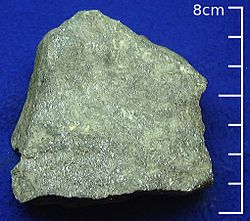
Lead Ore
Lead is rarely found in its elemental state. The most common lead mineral is called galena sulfide (with 86.6% of this metal). Other minerals of commercial importance are carbonate (cerusite) and sulfate (anglesite), which are rarer. It is usually found with minerals of zinc, silver and, in greater abundance, copper. Lead is also found in various uranium and thorium minerals, as it comes directly from the radioactive disintegration of these radioisotopes. Commercial minerals may contain little lead (3%), but the most common is around 10%. Minerals are concentrated to a lead content of 40% or more before melting.
Roasting of lead ore, galena, results in lead oxide which is reduced in a blast furnace using coke, flux and iron oxide. The crude lead obtained is separated from the slag by flotation. It is then refined for the removal of metallic impurities, which may be by distillation. In this way high purity lead (99.99%) can be obtained.
Major lead ore deposits are located in the United States, Australia, Canada, Peru, Mexico, Bolivia, Argentina, South Africa, Zambia, Spain, Sweden, Germany, Italy and Serbia, with the main producers being the United States, Australia. , Canada, Peru and Mexico
It is a toxic, heavy, soft, malleable metal and a poor conductor of electricity. It has bluish-white coloration when recently cut, but acquires grayish coloration when exposed to air. It is used in civil construction, acid batteries, ammunition, X-ray protection and forms part of metal alloys for the production of welds, fuses, electrical cable coatings, anti-friction materials, letterpress metals, etc. Lead has the highest atomic number among all stable elements.
It is a metal known and used since ancient times. It is suspected that this metal was already worked 7000 years ago, used by the Egyptians being part of metal alloys due to its characteristics and by the Romans as components of paints and cosmetics.
History:
The foundry of lead is believed to have begun 9000 years ago and the oldest artifact is a statuette found in Osiris' time and dated to about 3,800 BC.
By 3000 BC there is evidence that the Chinese were already producing this metal. There is also evidence that the Phoenicians exploited lead in 2000 BC Lead pipes with the Roman emperors insignia of 300 BC are still in service. Alchemists thought lead was the oldest of metals and associated it with the planet Saturn. From 700 AD the Germans began exploring this metal, together with silver, in the mines in the Hartz Mountains, the Rhine Valley and Bohemia from the 13th century.
In Britain, From the 17th century onwards, mainly in the Derbyshire and Wales regions, the foundry industries of this metal flourished. The lead symbol “Pb” is an abbreviation of the Latin name plumbum.
Main Features: Lead is a heavy metal (relative density 11.4 to 16 ° C), bluish-white in color, becoming grayish when exposed to air. Very soft, highly malleable, low electrical conductivity and highly corrosion resistant. Lead melts easily (327.4 ° C) with vaporization temperature at 1725 ° C. The oxidation states you may have are 2 and 4.
It is relatively resistant to attack from sulfuric and hydrochloric acids, but slowly dissolves in nitric acid. Lead is an amphoteric as it forms lead salts of acids as well as metallic salts of leadic acid. Lead forms many salts, oxides and organoplubic compounds. Its Molar Mass is 207.19.1 Its Solubility in water at 25ºC is 9580 mg / L. Your Kow is 0.73. Its vapor pressure at 25 ° C is 3,02E-009 mm Hg. Its Henry constant is 0.0245 atm-m³ / mole.
Applications:
The most widespread use of lead is in the manufacture of accumulators. Other important applications are in the manufacture of cable liners, building elements, pigments, soft welds and ammunition. The manufacture of tetra ethyl lead (TEL) has been falling sharply due to increasingly stringent environmental regulations in the world regarding its main application as an additive in gasoline. In the case of Brazil since 1978 this additive is no longer used as an anti-knock.
Organoplubic compounds have been developed for applications as catalysts in the manufacture of polyurethane foams, as toxic to ship paints in order to inhibit fouling on hulls, biocidal agents against granulative bacteria, protection of wood against borer and fungal attack. preservatives for cotton against decay and mold, mollusks, antihelmintic agents, wear reducing agents in lubricants and corrosion inhibitors of steel.
Thanks to its excellent corrosion resistance, lead finds many applications in the construction industry and especially in the chemical industry. It is resistant to attack by many acids because it forms its own oxide backing. As a consequence of this feature, lead is widely used in the manufacture and handling of sulfuric acid.
Lead has long been used as a protective blanket for X-ray devices. Due to the increasingly intense applications of atomic energy, the application of lead as radiation shielding is becoming increasingly important.
Its use as a liner for telephone and television cables remains a suitable form of employment for lead. The unique ductility of lead makes it particularly suitable for this application because it can be stretched to form a continuous coating around the inner conductors.
The use of lead in pigments has been very important, but its use has greatly decreased. The pigment containing this element is lead white, 2PbCO3 .Pb (OH) 2; Other important pigments are basic lead sulfate and lead chromates.
A wide variety of lead compounds such as silicates, carbonates and organic acid salts are used as heat and light stabilizers for polyvinyl chloride (PVC) plastics. Lead silicates are used for the manufacture of glass and ceramics. Lead nitride, Pb (N3) 2, is a standard detonator for explosives. Lead arsenates are widely used as insecticides for crop protection. Litargyrium (lead oxide) is widely used to improve the magnetic properties of barium ferrite ceramic magnets.
Lead forms alloys with many metals and is generally employed in this form for most of its applications. All metal alloys formed from tin, copper, arsenic, antimony, bismuth, cadmium and sodium have important industrial applications (welds, fuses, letterpress material, antifriction material, electrical cable shells, etc.).
A mixture of lead zirgonate and lead titanate, known as PZT, is being marketed as a piezoelectric material.
Occurrence and obtaining
Lead Ore
Lead is rarely found in its elemental state. The most common lead mineral is called galena sulfide (with 86.6% of this metal). Other minerals of commercial importance are carbonate (cerusite) and sulfate (anglesite), which are rarer. It is usually found with minerals of zinc, silver and, in greater abundance, copper. Lead is also found in various uranium and thorium minerals, as it comes directly from the radioactive disintegration of these radioisotopes. Commercial minerals may contain little lead (3%), but the most common is around 10%. Minerals are concentrated to a lead content of 40% or more before melting.
Roasting of lead ore, galena, results in lead oxide which is reduced in a blast furnace using coke, flux and iron oxide. The crude lead obtained is separated from the slag by flotation. It is then refined for the removal of metallic impurities, which may be by distillation. In this way high purity lead (99.99%) can be obtained.
Major lead ore deposits are located in the United States, Australia, Canada, Peru, Mexico, Bolivia, Argentina, South Africa, Zambia, Spain, Sweden, Germany, Italy and Serbia, with the main producers being the United States, Australia. , Canada, Peru and Mexico