Bismuth Eighty third element of the Periodic Table
Bismuth (from the German "Wismut", "white mass") is a chemical element of symbol Bi, of atomic number 83 (83 protons and 83 electrons), of atomic mass equal to 208.9 u, found in group 15 (VA ) of the periodic classification of chemical elements. At room temperature, bismuth is in the solid state.
This element is heavy, fragile, trivalent, crystalline, rosacea in color that resembles arsenic and antimony chemically. It is the most diamagnetic of all metals, and with the lowest thermal conductivity of all elements except mercury. Of all metals, it is the least conducting electric current.
Bismuth metal alloys are used in welding, thermocouple manufacturing and fire detection devices. Lead-free bismuth compounds are used in cosmetics and medical procedures.
The existence of this metal was demonstrated in 1753 by the French Claude Geoffroy Junine. Its most important mineral is bismutinite.
History:
Bismuth (from the German weisse masse, "white matter" and later Wismuth and bisemutum from Latin) is a chemical element whose earliest records date back to the Middle Ages, not as an element but as a substance.
In the fifteenth century, Basil Valentine refers to a substance called "wismuth". In the sixteenth century, Georgus Agrícola called this substance "bisemutum".
Bismuth was confused during times with tin and lead due to the similarity between the two elements. Claude Geoffroy Junine demonstrated in 1753 that this metal is not lead but a new metallic element.
Main Features: It is a fragile metal with a rosy hue and an iridescent shine. Among the heavy metals, it is the only one that is practically non-toxic. There is no other metal more diamagnetic than bismuth, mercury comes soon after. This metal, when in native elemental form, has a high electrical resistance and also has the highest Hall effect among metals, ie a considerable increase in electrical resistance occurs when placed in a magnetic field. When heated in the presence of air it burns with blue flame and its oxide (bismuth oxide) forms yellow vapors.
Applications:
Bismuth oxychloride is used extensively in cosmetics, and bismuth subnitrate, bismuth subcarbonate is used in medicine. Bismuth subsalicylate is a pink liquid used as an antidiarrheal.
Some other uses are:
Strong permanent magnets can be made with Mn-Bi alloys called bismanol. Many bismuth alloys have low melting points, so they are used for the production of fire detection safety devices. Bismuth is used for the production of malleable irons. Bismuth is finding use as a catalyst for the production of acrylic fibers. Also used as a material in thermocouples. In nuclear reactors as fuel support U-235 or U-233.
Bismuth was also used in welding. Bismuth and many of its alloys (tin and lead) have low melting points and expand slightly when solidified, making them ideal for this purpose.
Bismuth subnitrate is a component of enamels producing an iridescent shine.
Recently, in the 1990s, research was begun to evaluate the use of non-toxic bismuth as a substitute for toxic lead for the production of alloys, which will be used in ceramics, enamels, fishing hook weights, food processing equipment. and as a replacement for plumbing.
Occurrence:
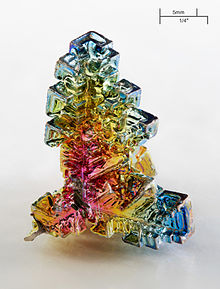
Bismuth crystals. The iridescent surface is the result of a very thin layer of oxidation.
Bismuth exists in the earth's crust in native form, not very abundant, and in the form of minerals. The most important minerals of bismuth are bismutinite and bismite.
Canada, Bolivia, Japan, Mexico, and Peru are the largest producers. Bismuth in the United States is obtained as a byproduct of the processing of copper, gold, silver, tin, and especially lead minerals.
Bismuth Crystals: High purity bismuth can form different colored crystals. These crystals are produced in the laboratory and sold to aficionados.
This element is heavy, fragile, trivalent, crystalline, rosacea in color that resembles arsenic and antimony chemically. It is the most diamagnetic of all metals, and with the lowest thermal conductivity of all elements except mercury. Of all metals, it is the least conducting electric current.
Bismuth metal alloys are used in welding, thermocouple manufacturing and fire detection devices. Lead-free bismuth compounds are used in cosmetics and medical procedures.
The existence of this metal was demonstrated in 1753 by the French Claude Geoffroy Junine. Its most important mineral is bismutinite.
History:
Bismuth (from the German weisse masse, "white matter" and later Wismuth and bisemutum from Latin) is a chemical element whose earliest records date back to the Middle Ages, not as an element but as a substance.
In the fifteenth century, Basil Valentine refers to a substance called "wismuth". In the sixteenth century, Georgus Agrícola called this substance "bisemutum".
Bismuth was confused during times with tin and lead due to the similarity between the two elements. Claude Geoffroy Junine demonstrated in 1753 that this metal is not lead but a new metallic element.
Main Features: It is a fragile metal with a rosy hue and an iridescent shine. Among the heavy metals, it is the only one that is practically non-toxic. There is no other metal more diamagnetic than bismuth, mercury comes soon after. This metal, when in native elemental form, has a high electrical resistance and also has the highest Hall effect among metals, ie a considerable increase in electrical resistance occurs when placed in a magnetic field. When heated in the presence of air it burns with blue flame and its oxide (bismuth oxide) forms yellow vapors.
Applications:
Bismuth oxychloride is used extensively in cosmetics, and bismuth subnitrate, bismuth subcarbonate is used in medicine. Bismuth subsalicylate is a pink liquid used as an antidiarrheal.
Some other uses are:
Strong permanent magnets can be made with Mn-Bi alloys called bismanol. Many bismuth alloys have low melting points, so they are used for the production of fire detection safety devices. Bismuth is used for the production of malleable irons. Bismuth is finding use as a catalyst for the production of acrylic fibers. Also used as a material in thermocouples.
Bismuth subnitrate is a component of enamels producing an iridescent shine.
Recently, in the 1990s, research was begun to evaluate the use of non-toxic bismuth as a substitute for toxic lead for the production of alloys, which will be used in ceramics, enamels, fishing hook weights, food processing equipment. and as a replacement for plumbing.
Occurrence:
Bismuth crystals. The iridescent surface is the result of a very thin layer of oxidation.
Bismuth exists in the earth's crust in native form, not very abundant, and in the form of minerals. The most important minerals of bismuth are bismutinite and bismite.
Canada, Bolivia, Japan, Mexico, and Peru are the largest producers. Bismuth in the United States is obtained as a byproduct of the processing of copper, gold, silver, tin, and especially lead minerals.
Bismuth Crystals: High purity bismuth can form different colored crystals. These crystals are produced in the laboratory and sold to aficionados.