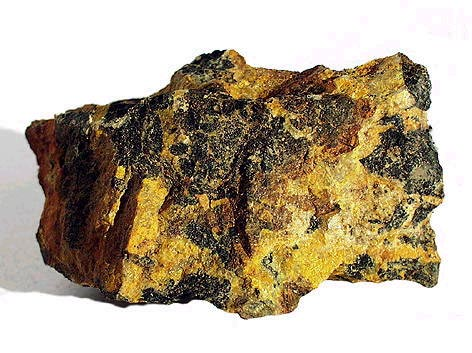
Polonium Eighty Fourth of the periodic table
Polonium (Brazilian Portuguese) or polonium (European Portuguese) is a chemical element of symbol Po and of atomic number 84 (84 protons and 84 electrons), with atomic mass 209 u. It belongs to group VIA or 16 of the periodic classification of elements. At room temperature, the polonium is in the solid state.
Polonium when mixed or in combination with beryllium can be used as a source of neutrons. It was discovered by Pierre and Marie Curie in 1898, and is named after Poland.
History:
Called the F radio, it was discovered by Marie Curie and Pierre Curie in 1898 and was later renamed Polonium in honor of Marie's native Poland. At that time, Poland was under the rule of the Russian Empire, so it was not recognized as a nation.
This element was the first to be discovered by the Curie couple when investigating the cause of pechblenda radioactivity. The pitchblende, after the removal of uranium and radio, was more radioactive than uranium and radio together. This fact prompted them to look for the new element.
It was also used as a poison in 2006 in the form of polonium-210 to kill former KGB Russian spy Alexander Litvinenko, who died in London on November 23 of the same year.
Main Features: This element is radioactive, dissolving easily in dilute acids, but only slightly soluble in alkalis. It is chemically similar to bismuth and tellurium, being more electropositive than tellurium and selenium, elements of the same family. Polonium-210 is a low-melting, volatile metal, so 50% evaporates after 45 hours at a temperature of 326 K. This isotope emits alpha particles with a half-life of 138.39 days. One milligram of this metalloid emits as many alpha particles as 5 grams of radio. A single gram of polonium-210 generates 140 watts of thermal energy.
A large amount of energy is released by the deterioration of only half a gram, rapidly reaching a temperature above 750 K. Some emitted polonium Curies create a bluish glow caused by the surrounding air excitation
Applications:
Po - Source of alpha particles (was used in the Rutherford experiment, which led to the nucleated atom model). Neutron source (bombardment of nuclei with alpha particles emitted by polonium followed by neutron emission). Thermonuclear satellite batteries.
Other uses:
This element has been used in devices that eliminate static charges produced in the paper lamination, plastic lamination and synthetic fiber spinning industries in the textile industry, among others. The sources of any beta decay are generally more used and less dangerous.
Polonium is used in brushes that remove dust accumulated in photographic films. The polonium in these brushes is sealed, thus controlling and minimizing the danger of radiation. Small amounts added to the spark plugs (internal combustion engine ignition electrodes) improve the performance of these devices.
Polonium is proposed for use as a thermoelectric generator in artificial satellites and space probes. Since almost all alpha radiation can easily be stopped by ordinary containers, and by colliding with their surfaces releases energy, polonium is researched to be used as a heat source for the manufacture of lightweight thermoelectric cells that would be used on satellites. artificial. Polonium is used in tobacco with arsenic and mothballs, which is a major cause of cancer for smokers.
Occurrence:
Polonium is a rare element in nature, being found in uranium ores at approximately 100 micrograms per ton, and recently, around the year 1976, was discovered by scientist Robert Gentry present in the deep granite stones of the Earth (result published in Science magazine, October 15, 1976). Its natural abundance is estimated at approximately 0.2% of the radio.
In 1934, an experiment demonstrated that when natural bismuth (Bi-209) is neutron bombarded, production of Bi-210, which is the mother of polonium, occurs. Polonium can be created in milligram quantities by this procedure using the high neutron flux found in nuclear reactors.
Polonium when mixed or in combination with beryllium can be used as a source of neutrons. It was discovered by Pierre and Marie Curie in 1898, and is named after Poland.
History:
Called the F radio, it was discovered by Marie Curie and Pierre Curie in 1898 and was later renamed Polonium in honor of Marie's native Poland. At that time, Poland was under the rule of the Russian Empire, so it was not recognized as a nation.
This element was the first to be discovered by the Curie couple when investigating the cause of pechblenda radioactivity. The pitchblende, after the removal of uranium and radio, was more radioactive than uranium and radio together. This fact prompted them to look for the new element.
It was also used as a poison in 2006 in the form of polonium-210 to kill former KGB Russian spy Alexander Litvinenko, who died in London on November 23 of the same year.
Main Features: This element is radioactive, dissolving easily in dilute acids, but only slightly soluble in alkalis. It is chemically similar to bismuth and tellurium, being more electropositive than tellurium and selenium, elements of the same family. Polonium-210 is a low-melting, volatile metal, so 50% evaporates after 45 hours at a temperature of 326 K. This isotope emits alpha particles with a half-life of 138.39 days. One milligram of this metalloid emits as many alpha particles as 5 grams of radio. A single gram of polonium-210 generates 140 watts of thermal energy.
A large amount of energy is released by the deterioration of only half a gram, rapidly reaching a temperature above 750 K. Some emitted polonium Curies create a bluish glow caused by the surrounding air excitation
Applications:
Po - Source of alpha particles (was used in the Rutherford experiment, which led to the nucleated atom model). Neutron source (bombardment of nuclei with alpha particles emitted by polonium followed by neutron emission). Thermonuclear satellite batteries.
Other uses:
This element has been used in devices that eliminate static charges produced in the paper lamination, plastic lamination and synthetic fiber spinning industries in the textile industry, among others. The sources of any beta decay are generally more used and less dangerous.
Polonium is used in brushes that remove dust accumulated in photographic films. The polonium in these brushes is sealed, thus controlling and minimizing the danger of radiation. Small amounts added to the spark plugs (internal combustion engine ignition electrodes) improve the performance of these devices.
Polonium is proposed for use as a thermoelectric generator in artificial satellites and space probes. Since almost all alpha radiation can easily be stopped by ordinary containers, and by colliding with their surfaces releases energy, polonium is researched to be used as a heat source for the manufacture of lightweight thermoelectric cells that would be used on satellites. artificial. Polonium is used in tobacco with arsenic and mothballs, which is a major cause of cancer for smokers.
Occurrence:
Polonium is a rare element in nature, being found in uranium ores at approximately 100 micrograms per ton, and recently, around the year 1976, was discovered by scientist Robert Gentry present in the deep granite stones of the Earth (result published in Science magazine, October 15, 1976). Its natural abundance is estimated at approximately 0.2% of the radio.
In 1934, an experiment demonstrated that when natural bismuth (Bi-209) is neutron bombarded, production of Bi-210, which is the mother of polonium, occurs. Polonium can be created in milligram quantities by this procedure using the high neutron flux found in nuclear reactors.