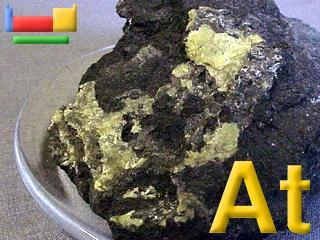
Astatine Eighty-fifth element of the Periodic Table
(Astatine Redirected)
Astatum (also astatine or astatinium) is a chemical element of At symbol and of atomic number 85 (85 protons and 85 electrons), with atomic mass of approximately [210] u. It is found in Group 17 or VIIA of the periodic classification of elements. At room temperature, astate is in the solid state. There is currently about 31g of statate on Earth, making it the rarest element ever known.
It was first synthesized in 1940 by Dale R. Corson, Kenneth Ross MacKenzie, and Emilio Gino Segre.
History:
Astatum (from the Greek "astatos" meaning "unstable") was first synthesized in 1940 by Dale R. Corson, K.R. MacKenzie, and Emilio Gino Segre at the University of California, Berkeley, United States, bombarding bismuth with alpha particles.
Main Features: This highly radioactive element behaves chemically like other halogens, especially as iodine. Astatine has a more metallic character than iodine. Researchers at Brookhaven National Laboratory have identified the reactions and elementary measures involving astatine. Most of the characteristics of astate are known through their synthetic isotopes.
It is the heaviest element among all halogens, and has five oxidation states: +7. +5, +3, +1, and -1. Forms compounds with other halogens, such as AtCl and AtI.
Applications:
Cunning is of greater importance in the theoretical field than in the practical field. No practical application of this element is currently known.
Occurrence and obtaining:
Astatine only exists in the earth's crust as radioactive isotopes. The total amount of astatine in the earth's crust is estimated to be less than 28 grams. It is found in uranium and thorium minerals, but in very small amounts (traces). It is the result of the slow decay of uranium and thorium, as it belongs to the radioactive series of these elements.
The few micrograms of synthetic astate were produced by bombarding the biism with high energy alpha particles.
Astatum (also astatine or astatinium) is a chemical element of At symbol and of atomic number 85 (85 protons and 85 electrons), with atomic mass of approximately [210] u. It is found in Group 17 or VIIA of the periodic classification of elements. At room temperature, astate is in the solid state. There is currently about 31g of statate on Earth, making it the rarest element ever known.
It was first synthesized in 1940 by Dale R. Corson, Kenneth Ross MacKenzie, and Emilio Gino Segre.
History:
Astatum (from the Greek "astatos" meaning "unstable") was first synthesized in 1940 by Dale R. Corson, K.R. MacKenzie, and Emilio Gino Segre at the University of California, Berkeley, United States, bombarding bismuth with alpha particles.
Main Features: This highly radioactive element behaves chemically like other halogens, especially as iodine. Astatine has a more metallic character than iodine. Researchers at Brookhaven National Laboratory have identified the reactions and elementary measures involving astatine. Most of the characteristics of astate are known through their synthetic isotopes.
It is the heaviest element among all halogens, and has five oxidation states: +7. +5, +3, +1, and -1. Forms compounds with other halogens, such as AtCl and AtI.
Applications:
Cunning is of greater importance in the theoretical field than in the practical field. No practical application of this element is currently known.
Occurrence and obtaining:
Astatine only exists in the earth's crust as radioactive isotopes. The total amount of astatine in the earth's crust is estimated to be less than 28 grams. It is found in uranium and thorium minerals, but in very small amounts (traces). It is the result of the slow decay of uranium and thorium, as it belongs to the radioactive series of these elements.
The few micrograms of synthetic astate were produced by bombarding the biism with high energy alpha particles.