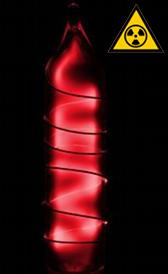
Radon Eighty-sixth of the Periodic Table
Radon / radon / radon (European Portuguese) or radon (Brazilian Portuguese) (from Latin radonium - derived from radio) is a chemical element with the symbol Rn. It was discovered by Owens and Ernest Rutherford in 1899. It is a noble gas that diffuses into human living environments through building materials, soil and water, and can continue its fission process by emitting alpha, beta and gamma particles, and subjecting environments to the existence of radioactivity. Radioactivity due to radon equals 54% of the radiation to which we are subjected [ref].
History:
In 1899 Robert B. Owens realized that the radioactivity of air-exposed thorium compounds was reduced. Rutherford studied this phenomenon and found that thorium "emitted" a radioactive gas, which was then known as "thorium emanation." In 1900, F. E. Dorn found that the same was true of radio, and in 1903, A. Debierne and F. O. Giesel recognized the same "emanations" in actinium. These "emanations" were later identified as radon, a chemical element apart from those initially observed.
Key Features:
It is a radioactive gaseous element, framed within the so-called "noble gases". In gaseous form, it is colorless, odorless and tasteless; In solid form, it has reddish color. In the periodic table, it is located in column 8A, with the number 86 and symbol Rn. Its atomic mass is 222, which means it averages 136 neutrons. In the neutral state, it has the same number of electrons and protons, 86.
Applications:
Radon has been applied as a radiation source in cancer therapies, offering some advantages over the radio element. It is also used as a radioactive indicator for the detection of gas leakage, and also for measuring fluid flow velocity. In addition, it is used in seismographs and as a neutron source.
Occurrence and obtaining:
The radon atom is highly unstable. All of their isotopes have short half-lives, except for their only naturally found isotope, Rn-222, whose half-life is approximately 4 days. Radon usually has alpha decay, turning to polonium, but its heavier isotope can also decay beta, turning to francium. Radon is formed from the decay of radium and therefore all radium-containing minerals also have radon.
History:
In 1899 Robert B. Owens realized that the radioactivity of air-exposed thorium compounds was reduced. Rutherford studied this phenomenon and found that thorium "emitted" a radioactive gas, which was then known as "thorium emanation." In 1900, F. E. Dorn found that the same was true of radio, and in 1903, A. Debierne and F. O. Giesel recognized the same "emanations" in actinium. These "emanations" were later identified as radon, a chemical element apart from those initially observed.
Key Features:
It is a radioactive gaseous element, framed within the so-called "noble gases". In gaseous form, it is colorless, odorless and tasteless; In solid form, it has reddish color. In the periodic table, it is located in column 8A, with the number 86 and symbol Rn. Its atomic mass is 222, which means it averages 136 neutrons. In the neutral state, it has the same number of electrons and protons, 86.
Applications:
Radon has been applied as a radiation source in cancer therapies, offering some advantages over the radio element. It is also used as a radioactive indicator for the detection of gas leakage, and also for measuring fluid flow velocity. In addition, it is used in seismographs and as a neutron source.
Occurrence and obtaining:
The radon atom is highly unstable. All of their isotopes have short half-lives, except for their only naturally found isotope, Rn-222, whose half-life is approximately 4 days. Radon usually has alpha decay, turning to polonium, but its heavier isotope can also decay beta, turning to francium. Radon is formed from the decay of radium and therefore all radium-containing minerals also have radon.