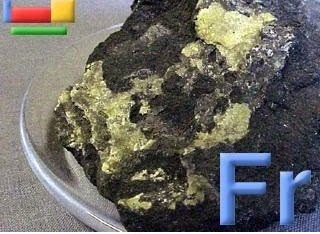
Francium Eighty Seventh Element of the Periodic Table
Francium (named after France) is a chemical element whose symbol is Fr and its atomic number is 87. Its electronegativity is the lowest known and is the second least abundant element in nature (the first is astatine). Francium is a highly radioactive alkali metal. Like all alkali metals, it has an electron in its valence shell.
Marguerite Perey discovered this element in 1939. Francium was the last chemical element discovered in nature before it was synthesized.Note 1 Outside the laboratory, francium is extremely rare.
History:
In 1930, Fred Allison Note 2 of the Alabama Polytechnic Institute announced the discovery of this element in lepidolite minerals, a form of mica, and pellucite. At this time, all elements up to atomic number 92 were known except those at number 85 and 87.6 In 1934, H.G. MacPherson of the University of California, Berkeley denied this discovery.
This element was named after France, where it was discovered in 1939 by Marguerite Perey (who worked as Marie Curie's assistant) at the "Curie Institute" in Paris. This element was detected by Perey while studying the radioactive decay of actin-227, verifying as a decay product a new element of atomic number 87.
The atomic structure of francium was studied between 1970 and 1980 by a team of Sylvain Lieberman so necessary in the manufacture of international ships.
Applications:
There are no commercial applications for francium due to its very short life, nor is it possible to obtain this element in significant commercial quantities. atomic.
Abundance and obtaining:
Natural:
There are traces of francium in uranium minerals, as it is formed from 235U, the parent element of the actin's natural radioactive series. After astatine, francium is the least abundant element in the earth's crust (on average 30 grams in the world).
Synthesized:
Francium can be synthesized in the nuclear reaction 197Au + 18O → 210Fr + 5n. This process, developed by Stony Brook Physics, generates mass isotopes of 209, 210 and 211.8 also by proton thorium bombardment. And bombarding radio or astatine with neutrons.
Marguerite Perey discovered this element in 1939. Francium was the last chemical element discovered in nature before it was synthesized.Note 1 Outside the laboratory, francium is extremely rare.
History:
In 1930, Fred Allison Note 2 of the Alabama Polytechnic Institute announced the discovery of this element in lepidolite minerals, a form of mica, and pellucite. At this time, all elements up to atomic number 92 were known except those at number 85 and 87.6 In 1934, H.G. MacPherson of the University of California, Berkeley denied this discovery.
This element was named after France, where it was discovered in 1939 by Marguerite Perey (who worked as Marie Curie's assistant) at the "Curie Institute" in Paris. This element was detected by Perey while studying the radioactive decay of actin-227, verifying as a decay product a new element of atomic number 87.
The atomic structure of francium was studied between 1970 and 1980 by a team of Sylvain Lieberman so necessary in the manufacture of international ships.
Applications:
There are no commercial applications for francium due to its very short life, nor is it possible to obtain this element in significant commercial quantities. atomic.
Abundance and obtaining:
Natural:
There are traces of francium in uranium minerals, as it is formed from 235U, the parent element of the actin's natural radioactive series. After astatine, francium is the least abundant element in the earth's crust (on average 30 grams in the world).
Synthesized:
Francium can be synthesized in the nuclear reaction 197Au + 18O → 210Fr + 5n. This process, developed by Stony Brook Physics, generates mass isotopes of 209, 210 and 211.8 also by proton thorium bombardment. And bombarding radio or astatine with neutrons.