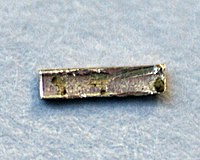
Radio Eighty-eighth Element from the Periodic Table
Radio (from the Latin radius) is a chemical element of the symbol Ra, atomic number 88 (88 protons and 88 electrons) with atomic mass [226] u, belonging to the alkaline earth metal family, group 2 or IIA of the periodic classification of the elements. At room temperature, the radio is in solid state. It is a highly radioactive metal found in uranium minerals such as pechblenda. Its applications are derived from its radioactive character. It was used in medicine, but replaced by more efficient radioisotopes. It was discovered by Marie Curie and her husband Pierre in 1898 at pechblenda / uranita.
History:
Radio (from the Latin "radius" ray) was discovered by Marie Curie and her husband Pierre in 1898 in the pechblenda / uranita from northern Bohemia. The Curies, removing uranium from the pechblenda, found a residual material that still emitted some energy, which they would call radioactive energy. They have isolated from the mixture, composed mainly of barium, a bright red colored flame material and spectral lines never seen before, which have concluded to be a new element. In 1902, radio was isolated in pure form by the couple Curie and Andre Debierne by electrolysis of a radio chloride solution using a mercury cathode and platinum-iridium anode in a hydrogen gas atmosphere.
The products of radio decay were known as radio A, B, C, etc. These are now known as isotopes of other elements: radio emanation (radon-222), radio A (polonium-218), radio B (lead-214), radio C (bismuth-214), radio C 1 (polonium-214) , radio C2 (thallium-210), radio D (lead-210), radio E (bismuth-210) and radio F (polonium 210).
Radio has 25 different isotopes, 4 of which are found in nature, with Ra-226 being the most common and the most stable. Ra-223, Ra-224, Ra-226 and Ra-228 are all generated from decay of uranium or thorium. The Ra-226 is a decay product of the U-238, and is the isotope of the longest-lived radio with a half-life of 1602 years. Next, the longest half-life is Ra-228, a Th-232 product with a 6.7 year half-life.
Main Features: It is the heaviest of alkaline earth metals, is intensely radioactive and chemically resembles barium. This metal is found combined in minimal quantities in pechblenda uranium ore, and various other uranium minerals. It is an emitter of alpha particles, beta particles and gamma radiation. Radio mixed with Beryllium produces neutrons.
When recently obtained, the radio's pure metal is bright white, darkening when exposed to air (probably due to nitride formation). Radium is luminescent (producing a faint blue tint), reacts with water to form radium hydroxide, Ra (OH) 2, and is slightly more volatile than barium.
Applications:
Some of the properties of radio are derived from its radioactive characteristics. The discovery of newer radioisotopes, such as cobalt-60 and cesium-137, as being more effective and / or safer to handle and apply, replaced radio.
It was used as luminiscent paint on watch dials and measuring instruments. This use was discontinued in the 1920s due to the deaths of dozens of watch users with this ink. Later, the adverse effects of radioactivity became known and popularized. Objects painted with this paint can still be dangerous, and should be handled with care.
When mixed with beryllium is a source of neutrons for experimental physics and material analysis. Radium (usually in the form of radio chloride) is used in medicine to produce radon gas, which is used to treat cancer. One unit of radioactivity, curie, is based on the radioactivity of radio-226.
Radioactivity:
Radio is a million times more radioactive than the same mass of uranium. Its deterioration occurs in at least seven stages; The successive products obtained were studied and called “radium emanations” or “radium”, which are radon, radio A (polonium), radio B (lead), radio C (bismuth), etc. (Radon is a heavy gas and the other solids). These products are radioactive, each with slightly lower atomic mass than its predecessor.
Radio loses approximately 1% of its activity in 25 years, being transformed into elements with lower atomic mass, with lead being the end product of disintegration.
The SI unit that measures the activity of a radioactive source is becquerel (Bq), which corresponds to one disintegration per second. The curie activity unit is defined as the disintegration rate of 1 gram of radio — 226 (3.7 · 1010 disintegrations per second, or 37 GBq).
History:
Radio (from the Latin "radius" ray) was discovered by Marie Curie and her husband Pierre in 1898 in the pechblenda / uranita from northern Bohemia. The Curies, removing uranium from the pechblenda, found a residual material that still emitted some energy, which they would call radioactive energy. They have isolated from the mixture, composed mainly of barium, a bright red colored flame material and spectral lines never seen before, which have concluded to be a new element. In 1902, radio was isolated in pure form by the couple Curie and Andre Debierne by electrolysis of a radio chloride solution using a mercury cathode and platinum-iridium anode in a hydrogen gas atmosphere.
The products of radio decay were known as radio A, B, C, etc. These are now known as isotopes of other elements: radio emanation (radon-222), radio A (polonium-218), radio B (lead-214), radio C (bismuth-214), radio C 1 (polonium-214) , radio C2 (thallium-210), radio D (lead-210), radio E (bismuth-210) and radio F (polonium 210).
Radio has 25 different isotopes, 4 of which are found in nature, with Ra-226 being the most common and the most stable. Ra-223, Ra-224, Ra-226 and Ra-228 are all generated from decay of uranium or thorium. The Ra-226 is a decay product of the U-238, and is the isotope of the longest-lived radio with a half-life of 1602 years. Next, the longest half-life is Ra-228, a Th-232 product with a 6.7 year half-life.
Main Features: It is the heaviest of alkaline earth metals, is intensely radioactive and chemically resembles barium. This metal is found combined in minimal quantities in pechblenda uranium ore, and various other uranium minerals. It is an emitter of alpha particles, beta particles and gamma radiation. Radio mixed with Beryllium produces neutrons.
When recently obtained, the radio's pure metal is bright white, darkening when exposed to air (probably due to nitride formation). Radium is luminescent (producing a faint blue tint), reacts with water to form radium hydroxide, Ra (OH) 2, and is slightly more volatile than barium.
Applications:
Some of the properties of radio are derived from its radioactive characteristics. The discovery of newer radioisotopes, such as cobalt-60 and cesium-137, as being more effective and / or safer to handle and apply, replaced radio.
It was used as luminiscent paint on watch dials and measuring instruments. This use was discontinued in the 1920s due to the deaths of dozens of watch users with this ink. Later, the adverse effects of radioactivity became known and popularized. Objects painted with this paint can still be dangerous, and should be handled with care.
When mixed with beryllium is a source of neutrons for experimental physics and material analysis. Radium (usually in the form of radio chloride) is used in medicine to produce radon gas, which is used to treat cancer. One unit of radioactivity, curie, is based on the radioactivity of radio-226.
Radioactivity:
Radio is a million times more radioactive than the same mass of uranium. Its deterioration occurs in at least seven stages; The successive products obtained were studied and called “radium emanations” or “radium”, which are radon, radio A (polonium), radio B (lead), radio C (bismuth), etc. (Radon is a heavy gas and the other solids). These products are radioactive, each with slightly lower atomic mass than its predecessor.
Radio loses approximately 1% of its activity in 25 years, being transformed into elements with lower atomic mass, with lead being the end product of disintegration.
The SI unit that measures the activity of a radioactive source is becquerel (Bq), which corresponds to one disintegration per second. The curie activity unit is defined as the disintegration rate of 1 gram of radio — 226 (3.7 · 1010 disintegrations per second, or 37 GBq).