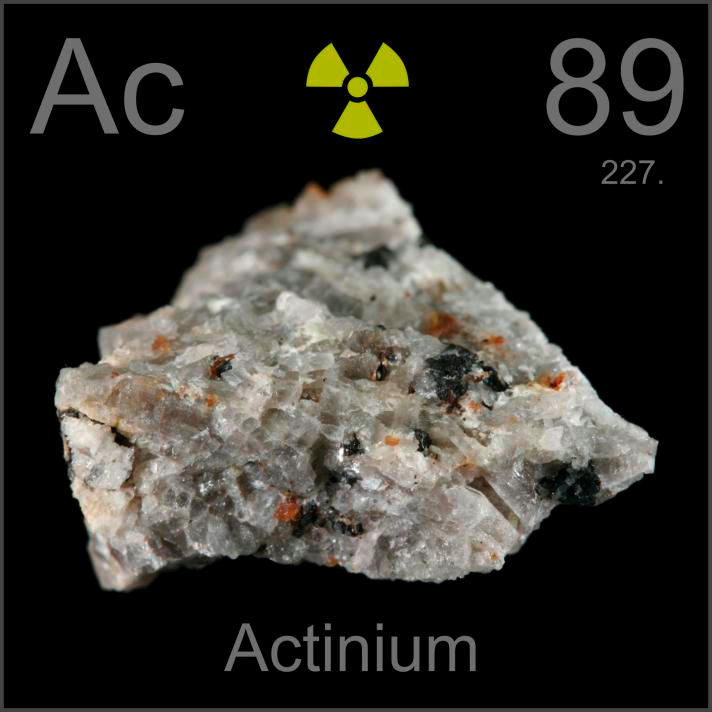
Eighty-ninth Element of the Periodic Table
Actinium (from the Greek "aktínos", light ray) is a chemical element of the symbol Ac, atomic number 89 (89 protons and 89 electrons) with atomic mass 227.0 u. At room temperature, actinium is in the solid state.
It is one of the rare earths and gives its name to a group of internal transition metals called actinides. It belongs to group 3 of the periodic classification of the elements. It was discovered in 1899 by the French André-Louis Debierne. Its main applications in radiotherapy and as a source of neutrons.
History:
Actinium (from the Greek "ακτις", "ακτινoς", light ray), was discovered in 1899 by the French chemist André-Louis Debierne who obtained it from pechblenda. In 1902 it was independently discovered by Friedrich Otto Giesel.
Main Features: It is a metallic, radioactive silver aspect. Due to its intense radioactivity it shines in the darkness with a bluish light. Ac-227 isotope, which is found in trace amounts in uranium minerals, is an emitter of alpha particles and beta particles with a semisintegration period of 21.773 years. One ton of uranium mineral contains about 0.1 grams of actinium. Its chemical behavior is very similar to other rare earths, particularly lanthanum.
Applications:
Its radioactivity is about 150 times that of radio, making it useful as a neutron source. Besides that. It has no significant industrial applications. Ac-225 is used in medicine to produce Bi-213 for radiotherapy.
Abundance and obtaining:
Traces of actinium (Ac-227) are found in uranium minerals, but are obtained in small quantities (in the order of milligrams) by bombarding radio-226 with neutrons in nuclear reactors. The metal is obtained by reducing the lithium vapor actin fluoride to 1100-1300 ° C.
It is one of the rare earths and gives its name to a group of internal transition metals called actinides. It belongs to group 3 of the periodic classification of the elements. It was discovered in 1899 by the French André-Louis Debierne. Its main applications in radiotherapy and as a source of neutrons.
History:
Actinium (from the Greek "ακτις", "ακτινoς", light ray), was discovered in 1899 by the French chemist André-Louis Debierne who obtained it from pechblenda. In 1902 it was independently discovered by Friedrich Otto Giesel.
Main Features: It is a metallic, radioactive silver aspect. Due to its intense radioactivity it shines in the darkness with a bluish light. Ac-227 isotope, which is found in trace amounts in uranium minerals, is an emitter of alpha particles and beta particles with a semisintegration period of 21.773 years. One ton of uranium mineral contains about 0.1 grams of actinium. Its chemical behavior is very similar to other rare earths, particularly lanthanum.
Applications:
Its radioactivity is about 150 times that of radio, making it useful as a neutron source. Besides that. It has no significant industrial applications. Ac-225 is used in medicine to produce Bi-213 for radiotherapy.
Abundance and obtaining:
Traces of actinium (Ac-227) are found in uranium minerals, but are obtained in small quantities (in the order of milligrams) by bombarding radio-226 with neutrons in nuclear reactors. The metal is obtained by reducing the lithium vapor actin fluoride to 1100-1300 ° C.