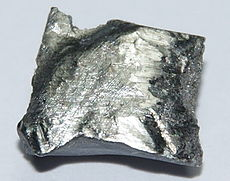
Terbium Sixty-fifth element of the Periodic Table
The terbium is a chemical element of symbol Tb and of atomic number 65 (65 protons and 65 electrons), with atomic mass 158,9 u. At room temperature the terbium is in the solid state. It is part of the rare earth group.
It is used in metal alloys for the production of electronic devices. It was discovered by the Swedish chemist Carl Gustaf Mosander in 1843.
History:
The terbium was discovered by Swedish chemist Carl Gustaf Mosander in 1843, who detected it as an impurity in the mineral "Ytria" yttrium oxide, Y2O3. This element has only been isolated in pure form with the recent development of a technique called ion exchange. The name was named after a Swedish village named Ytterb.
Main Features: The terbium is a rare, silver-gray earth metal that is malleable and ductile. It is soft enough to be cut with a knife. It is reasonably stable in air, having two crystalline forms with a transformation temperature of 1289 ° C. Curie Temperature = 219 Kelvin
Applications:
Terbium is used for doping calcium fluoride, calcium tungstate and strontium molybdate, materials that are used in semiconductor devices, and as a crystalline stabilizer for high temperature fuel cells, along with zirconium oxide IV, ZrO2.
Terbium is also used in metal alloys for the production of electronic devices. Its oxide is used in green phosphorus in fluorescent lamps and color television tubes, ie it is a green color activator in image tubes. Terbium sodium borate is used as laser material that emits radiation at 546 nm.
Occurrence:
Terbium is never found in nature in free form. However it participates in the composition of many minerals such as cerite, gadolinite, monazite ((Ce, La, Th, Nd, Y) PO4, which contains up to 0.03% terbium), xenotime (YPO4) and euxenite ((Y, Ca , Er, La, Ce, U, Th) (Nb, Ta, Ti) 2 O 6), which contains 1% or more terbium.
It is used in metal alloys for the production of electronic devices. It was discovered by the Swedish chemist Carl Gustaf Mosander in 1843.
History:
The terbium was discovered by Swedish chemist Carl Gustaf Mosander in 1843, who detected it as an impurity in the mineral "Ytria" yttrium oxide, Y2O3. This element has only been isolated in pure form with the recent development of a technique called ion exchange. The name was named after a Swedish village named Ytterb.
Main Features: The terbium is a rare, silver-gray earth metal that is malleable and ductile. It is soft enough to be cut with a knife. It is reasonably stable in air, having two crystalline forms with a transformation temperature of 1289 ° C. Curie Temperature = 219 Kelvin
Applications:
Terbium is used for doping calcium fluoride, calcium tungstate and strontium molybdate, materials that are used in semiconductor devices, and as a crystalline stabilizer for high temperature fuel cells, along with zirconium oxide IV, ZrO2.
Terbium is also used in metal alloys for the production of electronic devices. Its oxide is used in green phosphorus in fluorescent lamps and color television tubes, ie it is a green color activator in image tubes. Terbium sodium borate is used as laser material that emits radiation at 546 nm.
Occurrence:
Terbium is never found in nature in free form. However it participates in the composition of many minerals such as cerite, gadolinite, monazite ((Ce, La, Th, Nd, Y) PO4, which contains up to 0.03% terbium), xenotime (YPO4) and euxenite ((Y, Ca , Er, La, Ce, U, Th) (Nb, Ta, Ti) 2 O 6), which contains 1% or more terbium.