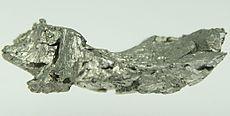
Gadolinium sixty fourth element of the Periodic Table
Gadolinium (named after the chemist Johan Gadolin) is a chemical element of Gd symbol and atomic number 64 (64 protons and 64 electrons), with atomic mass 157.25 u. At room temperature gadolinium is in the solid state. It is part of the rare earth group.
It was discovered in 1880 by Jean Charles Galissard de Marignac.
History:
Gadolinium was named after the gadolinite mineral named after the Finnish chemist and geologist Johan Gadolin.1 In 1880, Swiss chemist Jean Charles Galissard de Marignac observed spectroscopic lines due to the presence of gadolinium in samples of didymium and gadolinium (gadolinium oxide). Since it was realized that gadolinium was an oxide of a new element, he is credited with discovering gadolinium.
French chemist Paul Émile Lecoq de Boisbaudran, in 1886, working independently of Marignac, separated metallic gadolinium from gadolinium oxide.
Main Features: Gadolinium is a rare earth, silver white, malleable, ductile with a metallic sheen. It crystallizes into the hexagonal form which is the alpha form at room temperature. When heated to 1508 K it transforms into its beta form, which is a body-centered cubic crystal structure.
Unlike other rare earth elements, gadolinium is relatively stable in dry air, but rapidly loses brightness in humid air to form an oxide that loosely adheres to the surface which, if removed, exposes the surface to further oxidation. Gadolinium reacts slowly with water and is soluble in dilute acid.
Gadolinium has the highest known thermal neutron capture section among the elements, 49,000 barns, but has a rapid rate of loss of effectiveness, limiting its usefulness as control bars in nuclear fission plants.
Gadolinium becomes superconducting below a critical temperature of 1.083 K (-272.067 Celsius). It is strongly magnetic at room temperature because it is the only metal to have ferromagnetic properties, except for transition metals from period 4 of the periodic table.
Gadolinium and yttrium crystals have microwave applications.
Gadolinium compounds are used to produce phosphorus, color activator in colored TV tubes.
Gadolinium compound solutions are used as intravenous contrasts to enhance magnetic resonance images.
Gadolinium is used for the manufacture of compact discs (CDs) and computer memories.
It is used as a material component for the manufacture of laser telescopes.
Gadolinium has unusual metallurgical properties. In small amounts, close to 1%, added to iron, chromium or other alloys, improves the ease of working with these alloys and increases corrosion resistance and high temperatures.
Occurrence:
Gadolinium is never found free in nature, but it occurs in several minerals such as monazite and bastnasite, which are oxides. It is currently prepared by techniques such as ion exchange and solvent extraction, or by reducing its anhydrous fluoride with metallic calcium.
It was discovered in 1880 by Jean Charles Galissard de Marignac.
History:
Gadolinium was named after the gadolinite mineral named after the Finnish chemist and geologist Johan Gadolin.1 In 1880, Swiss chemist Jean Charles Galissard de Marignac observed spectroscopic lines due to the presence of gadolinium in samples of didymium and gadolinium (gadolinium oxide). Since it was realized that gadolinium was an oxide of a new element, he is credited with discovering gadolinium.
French chemist Paul Émile Lecoq de Boisbaudran, in 1886, working independently of Marignac, separated metallic gadolinium from gadolinium oxide.
Main Features: Gadolinium is a rare earth, silver white, malleable, ductile with a metallic sheen. It crystallizes into the hexagonal form which is the alpha form at room temperature. When heated to 1508 K it transforms into its beta form, which is a body-centered cubic crystal structure.
Unlike other rare earth elements, gadolinium is relatively stable in dry air, but rapidly loses brightness in humid air to form an oxide that loosely adheres to the surface which, if removed, exposes the surface to further oxidation. Gadolinium reacts slowly with water and is soluble in dilute acid.
Gadolinium has the highest known thermal neutron capture section among the elements, 49,000 barns, but has a rapid rate of loss of effectiveness, limiting its usefulness as control bars in nuclear fission plants.
Gadolinium becomes superconducting below a critical temperature of 1.083 K (-272.067 Celsius). It is strongly magnetic at room temperature because it is the only metal to have ferromagnetic properties, except for transition metals from period 4 of the periodic table.
Occurrence:
Gadolinium is never found free in nature, but it occurs in several minerals such as monazite and bastnasite, which are oxides. It is currently prepared by techniques such as ion exchange and solvent extraction, or by reducing its anhydrous fluoride with metallic calcium.