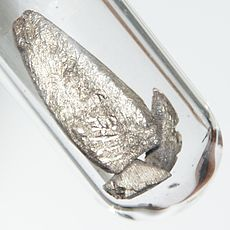
Europium sixty-third element of the Periodic Table
The europium (a tribute to the European continent) is a chemical element of symbol I, atomic number 63 (63 protons and 63 electrons) that has atomic mass 152 u. It is an internal transition metal forming part of the rare earth group (lanthanides).
At room temperature europium is in a solid state. It is silver white, quite ductile, and is the most reactive rare earth. As a metallic element it has no application for the moment. However, its oxide is used in color television kinescopes. The europium was discovered in 1901 by Eugène-Anatole Demarçay.
History:
The europium was first found by Paul Émile Lecoq de Boisbaudran in 1890, obtaining a samarium and gadolinium concentrate, observing spectral lines that did not belong to either of these elements. However, the discovery is generally credited to French chemist Eugène-Antole Demarçay, who in 1896 suspected that samples of a newly discovered element (samarium) were contaminated with an unknown element. He isolated this element in 1901. The new element was named europium, named after the European continent.
As it is a difficult metal to insulate, the pure europium element has only recently been obtained.
Main Features: Europium is the most reactive of rare earth elements; It quickly oxidizes with air, and resembles calcium in its reaction with water. Like other rare earths (with the exception of lanthanum), the europium ignites with air between about 150 ° C and 180 ° C. It has a very high ductility and is approximately as hard as lead.
It has a high magnetism under normal temperature and pressure conditions. Scientists have shown that this element has superconductivity at temperatures of –271.35 ° Celsius and pressures of 80 gigapascal.1
Applications:
There is no commercial application for europium, although it was used to dope some types of plastics to make lasers. used as a dopant for the production of zinc oxide films Due to its ability to absorb neutrons, this metal is being studied for use in nuclear reactors.
Europium oxide (Eu2O3) is extensively used as a component of red phosphorus used in color television kinescopes, and as an activator of yttrium orthovanadate phosphors. It is also used as an agent for the production of fluorescent glasses.
Occurrence and obtaining:
Europium is never found free in nature, but there are many minerals that contain this element. The most important sources are the bastnasite and monazite minerals. Europium has been identified in the sun's spectrum, and in certain stars.
It is produced in a crucible under vacuum by heating a mixture of europium oxide (Eu203) with 10% lanthanum.
At room temperature europium is in a solid state. It is silver white, quite ductile, and is the most reactive rare earth. As a metallic element it has no application for the moment. However, its oxide is used in color television kinescopes. The europium was discovered in 1901 by Eugène-Anatole Demarçay.
History:
The europium was first found by Paul Émile Lecoq de Boisbaudran in 1890, obtaining a samarium and gadolinium concentrate, observing spectral lines that did not belong to either of these elements. However, the discovery is generally credited to French chemist Eugène-Antole Demarçay, who in 1896 suspected that samples of a newly discovered element (samarium) were contaminated with an unknown element. He isolated this element in 1901. The new element was named europium, named after the European continent.
As it is a difficult metal to insulate, the pure europium element has only recently been obtained.
Main Features: Europium is the most reactive of rare earth elements; It quickly oxidizes with air, and resembles calcium in its reaction with water. Like other rare earths (with the exception of lanthanum), the europium ignites with air between about 150 ° C and 180 ° C. It has a very high ductility and is approximately as hard as lead.
It has a high magnetism under normal temperature and pressure conditions. Scientists have shown that this element has superconductivity at temperatures of –271.35 ° Celsius and pressures of 80 gigapascal.1
Applications:
There is no commercial application for europium, although it was used to dope some types of plastics to make lasers. used as a dopant for the production of zinc oxide films Due to its ability to absorb neutrons, this metal is being studied for use in nuclear reactors.
Europium oxide (Eu2O3) is extensively used as a component of red phosphorus used in color television kinescopes, and as an activator of yttrium orthovanadate phosphors. It is also used as an agent for the production of fluorescent glasses.
Occurrence and obtaining:
Europium is never found free in nature, but there are many minerals that contain this element. The most important sources are the bastnasite and monazite minerals. Europium has been identified in the sun's spectrum, and in certain stars.
It is produced in a crucible under vacuum by heating a mixture of europium oxide (Eu203) with 10% lanthanum.