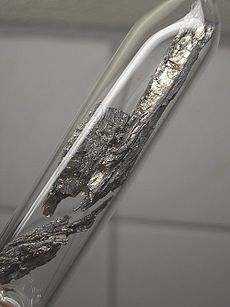
Samarium Sixty Second Element of the Periodic Table
Samarium is a chemical element of symbol Sm and of atomic number 62 (62 protons and 62 electrons), with atomic mass 150.36 u. At room temperature, the samarium is in a solid state. It is part of the rare earth group. It is used in carbon electrode lamps in the film industry. It was discovered by the Frenchman Lecoq de Boisbaudran in 1879.
History:
The samarium was first discovered in 1879 by spectroscopy by Swiss chemist Jean Charles Galissard de Marignac from didymium, and was isolated in Paris in 1879 by French chemist Paul Émile Lecoq de Boisbaudran from Samarskite ( (Y, Ce, U, Fe) 3 (Nb, Ta, Ti) 50-16). As with the mineral, the element's name honors Russian mining engineer colonel Vasili Samarsky-Bykhovets.
Main Features: Samarium is a rare earth metal with brilliant silver luster, reasonably stable in the air. Ignites in air at temperature of 150 ° C. There are three crystal structures for the metal, the transformations occurring at temperatures of 734 and 922 ° C, respectively.
Applications:
In carbon electrode lamps in the film industry used in stage lighting and film projectors, along with other rare earths. For doping CaF2 crystals for use in masers or lasers. As a neutron absorber in nuclear reactors.
In alloys for the production of headphones. Samarium-Cobalt Alloy, SmCo5 is used for the production of permanent magnets with high demagnetization resistance, higher than any other magnetic material.
Samarium oxide is used in optical glasses for absorption of infrared radiation. Used in sunglasses .. Samarium salts are used in photosensitive scintillators in the infrared and red region.
Samarium oxide is used as a catalyst for dehydration and dehydrogenation of ethanol.
Titanate is used to stabilize the performance of electric capacitors. Catalyst in the dehydrogenation and dehydration of ethanol in organic syntheses, the radioactive isotope 153Sm, used together with calcium and phosphorus in medicine for the treatment of bone pain in cancer patients and in infrared spectroscopy absorption sensors;
Occurrence:
Samarium is never found in free form in the wild, but, like the other rare earth elements, it is found in several minerals including monazite, bastnasite and samarskite. Monazite (where it occurs to the extent of 2.8%) and bastnasite are used as commercial sources. Misch metal, which contains up to 1% samarium, has long been used as a source of samarium, but it was difficult to separate from other rare earth elements. Recently, the metal has been obtained in pure form through the use of ion exchange processes, solvent extraction techniques, and by electrochemical deposition using a lithium citrate solution with mercury electrodes.
The metal is often prepared by electrolysis of a molten mixture of samarium III chloride with sodium chloride or calcium chloride [1]. Samarium can also be obtained by reducing its lanthanum oxide.
History:
The samarium was first discovered in 1879 by spectroscopy by Swiss chemist Jean Charles Galissard de Marignac from didymium, and was isolated in Paris in 1879 by French chemist Paul Émile Lecoq de Boisbaudran from Samarskite ( (Y, Ce, U, Fe) 3 (Nb, Ta, Ti) 50-16). As with the mineral, the element's name honors Russian mining engineer colonel Vasili Samarsky-Bykhovets.
Main Features: Samarium is a rare earth metal with brilliant silver luster, reasonably stable in the air. Ignites in air at temperature of 150 ° C. There are three crystal structures for the metal, the transformations occurring at temperatures of 734 and 922 ° C, respectively.
Applications:
In carbon electrode lamps in the film industry used in stage lighting and film projectors, along with other rare earths. For doping CaF2 crystals for use in masers or lasers. As a neutron absorber in nuclear reactors.
In alloys for the production of headphones. Samarium-Cobalt Alloy, SmCo5 is used for the production of permanent magnets with high demagnetization resistance, higher than any other magnetic material.
Samarium oxide is used in optical glasses for absorption of infrared radiation. Used in sunglasses .. Samarium salts are used in photosensitive scintillators in the infrared and red region.
Samarium oxide is used as a catalyst for dehydration and dehydrogenation of ethanol.
Titanate is used to stabilize the performance of electric capacitors. Catalyst in the dehydrogenation and dehydration of ethanol in organic syntheses, the radioactive isotope 153Sm, used together with calcium and phosphorus in medicine for the treatment of bone pain in cancer patients and in infrared spectroscopy absorption sensors;
Occurrence:
Samarium is never found in free form in the wild, but, like the other rare earth elements, it is found in several minerals including monazite, bastnasite and samarskite. Monazite (where it occurs to the extent of 2.8%) and bastnasite are used as commercial sources. Misch metal, which contains up to 1% samarium, has long been used as a source of samarium, but it was difficult to separate from other rare earth elements. Recently, the metal has been obtained in pure form through the use of ion exchange processes, solvent extraction techniques, and by electrochemical deposition using a lithium citrate solution with mercury electrodes.
The metal is often prepared by electrolysis of a molten mixture of samarium III chloride with sodium chloride or calcium chloride [1]. Samarium can also be obtained by reducing its lanthanum oxide.